Web & Tech
Why Most Clinic Enquiries Die in 24 Hours: A Better Way to Handle Patient Follow Up
Swaroop ESD
Read more 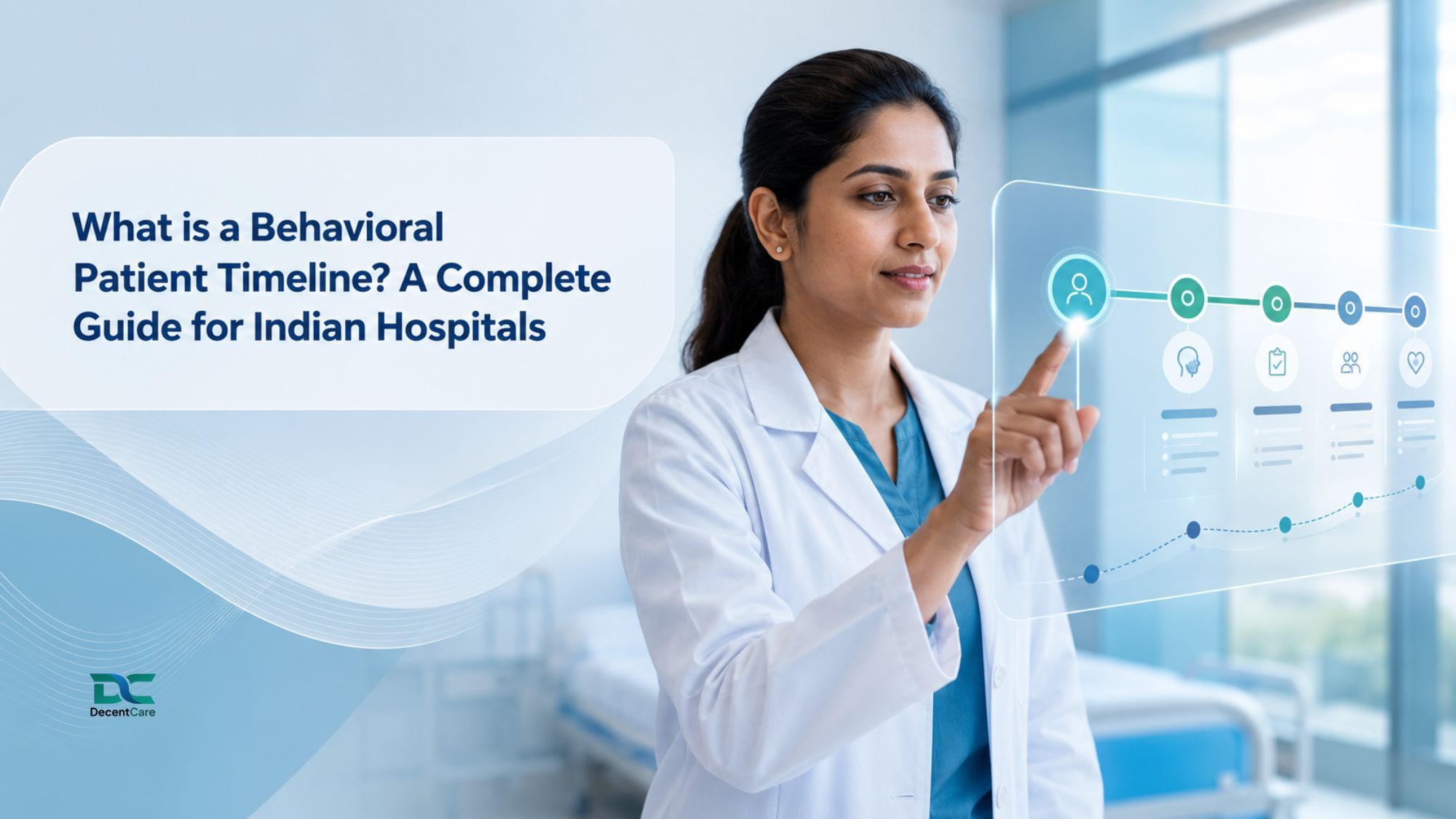


At 9 PM, a patient enquires about a knee replacement. The call rings out. The follow-up WhatsApp message sits unread until the next lunchtime. By then the patient has been counselled by a competitor, has quoted a price to the family, and has picked a date. The first hospital never knew the enquiry existed.
A behavioral patient timeline is what closes that gap. It is a unified, real-time record of every signal a patient generates before, during, and after care, sitting alongside the hospital information system and any patient CRM already in place. This complete guide sets out what a behavioral patient timeline is, what feeds it, why Indian hospitals lose patients without one, and how it works with the HIMS and a hospital CRM rather than replacing them.
A behavioral patient timeline is a single, chronological view of every non-clinical signal a patient produces around care: searches, calls, WhatsApp messages, form fills, ad clicks, walk-ins, appointment history, and follow-ups. It is the record of a patient’s decision journey. Where a hospital information system captures medical history, a behavioral timeline captures decision history. It answers a question the HIMS was never designed to answer: what is this patient doing, and how close are they to a treatment decision.
A HIMS records what happened medically once a patient has been registered. A behavioral timeline records what is happening behaviourally, often long before registration, and continues tracking engagement through consultation, treatment, and follow-up. It is where intent, readiness, and drop-off become visible, and where marketing attribution finally connects to real booked patients rather than form submissions.
Three systems commonly sit inside a modern Indian hospital, and each answers a different question. The HIMS answers what was treated: diagnoses, prescriptions, admissions, and billing. It is historical and clinical by design. A hospital CRM answers what the team is doing with each contact: tasks logged, calls made, deal stages moved. It is transactional and staff-centred. A behavioral patient timeline answers what the patient is doing, and what is likely to happen next: which signals are increasing, which are cooling off, and which patients are ready to book.
The three systems complement rather than replace each other. The HIMS remains the source of clinical truth. A CRM organises what staff do. A behavioral timeline captures what the patient does across every channel, scores intent, and flags drop-off before the patient goes silent. The strongest configurations pair a behavioral timeline with a patient journey CRM that shares the same view, so the front desk, marketing, and counsellors act on the same signals rather than working from three disconnected screens. This is where DecentCare positions itself as going beyond a hospital CRM, as the behavioural intelligence layer built to read the signals a CRM alone cannot see.
Six categories of signals feed a well-built patient timeline. Web behaviour includes visits to treatment pages, comparison views, doctor profile clicks, and the search queries that landed the patient on the site. Call activity includes inbound enquiries, missed calls, callback outcomes, call duration, and the language of conversation. Messaging activity captures WhatsApp and SMS exchanges, template responses, and time-of-day patterns. Marketing activity ties Google Business Profile clicks, ad clicks, campaign source, and UTM parameters back to the individual patient once identity is established. Walk-in and appointment activity records reception check-ins, OTP verifications, appointment history, and no-shows. Post-consultation activity captures follow-up compliance, feedback, referral behaviour, and second-visit engagement.
Two kinds of signal matter most inside all of this. Intent signals show that a patient is interested in a specific treatment: repeated visits to a procedure page, multiple enquiries about a specialist, or a direct comparison against a nearby hospital. Readiness signals show that a patient is close to deciding: asking about costs, checking insurance, requesting slots, or seeking a second opinion. Intent tells the team who is interested. Readiness tells the team who to call today. This is the mechanic that most hospitals still lack once the clinical data is in place.
A patient in India rarely takes a straight line from advertisement to appointment. The public-facing part of the journey usually spans awareness (something feels wrong) and research (searching, reading, watching) before any hospital knows the patient exists. Once contact is made, the hospital-side journey moves through the stages the platform is built around: enquiry, appointment, pre-OPD, consultation, procedure, post-op, and retention. A behavioral timeline captures both halves and stitches them into one continuous record for the same patient.
The India-specific nuance matters. Healthcare decisions in India are rarely made by the patient alone. Family members and attenders research, compare, and coordinate in parallel, often through WhatsApp groups spanning three or four people. Second opinions from a nearby hospital are standard before any significant procedure. Google searches, YouTube surgeon interviews, and hospital review scores all feed into the decision. A behavioral timeline that captures only the primary caller misses most of the actual decision-making. The stronger implementations track the household context as far as consent allows, so the follow-up call reaches the right person at the right moment.
The scale of pre-clinical loss in India is now measurable. A quality-improvement study at Sitaram Bhartia Institute of Science and Research in New Delhi found that about 26 per cent of incoming calls between 8 am and 8 pm were not being picked up at baseline. Every one of those missed calls is a patient standing at the point of enquiry with nowhere to land. Industry estimates put the peak-hour figure even higher in large multi-specialty hospitals, where reception is overwhelmed by walk-ins, doctor coordination, and pharmacy queries.
Once contact is made, the next drop happens between enquiry and consultation. A peer-reviewed India study reported an OPD no-show rate of 18.59 per cent, in line with global benchmarks of around 15 per cent, and some outpatient settings run significantly higher. On the demand side, the FICCI and EY-Parthenon 2025 report, True Accountable Care, found that 83 per cent of Indian patients actively seek objective information to guide their healthcare choices, and nearly nine in ten are willing to pay more for certified quality. Yet only about one-third can easily access that information. The gap between patient effort and hospital visibility is exactly where enquiries turn into competitor bookings.
The loss is silent. Without a unified timeline, missed calls do not surface in a dashboard, unanswered WhatsApp threads do not trigger an alert, and a patient who visited three treatment pages and then went cold looks identical to a patient who never engaged at all. The hospital finds out only when the case does not walk in. This is the operational blind spot behind the older observation that hospitals lose patients before treatment even begins.
Attribution is the second problem a behavioral timeline solves. Most Indian hospitals cannot draw a clean line from a booked patient back to the advertisement, search, or referral that started the journey, because the enquiry, the appointment, and the visit sit in three different systems. Marketing sees form fills. The front desk sees walk-ins. The doctor sees a consultation. Nothing joins them into a single view.
A behavioral timeline anchors every interaction to the same patient, so a Google search from June, a WhatsApp enquiry in July, an OPD visit in August, and a surgery in September form one continuous record. That record then carries the source (Google, Meta, referral, walk-in) and the campaign back to marketing. The commercial effect is significant. Budget shifts to channels that produce booked cases, not just clicks. Cost per booked patient starts to fall. Departments finally see which specialties their spend is actually growing, and which are quietly stagnant.
A behavioral timeline on its own is a rich record. What turns it into growth is a stack that reads the record, prioritises the right patient, and puts a next step in the hands of the team that can act. DecentCare organises this as three modules that work together and sit beyond a hospital CRM.
OmniLens is the behavioural data layer. It captures every signal across web, calls, WhatsApp, and visits and organises them into one live timeline for each patient. Treatment interest, intent strength, source attribution, drop-off points, and readiness signals sit on the same view. It answers the question: what is actually happening across every channel for this patient.
OmniJourney is the behavioural AI engine that reads the timeline. It scores intent, predicts which patients are about to disengage, groups patients by urgency, concern, and affordability, and recommends the next best action: content, a call, counselling, or a nudge. It answers: who is ready, who is slipping, and why.
OmniCare is the patient journey CRM where the team acts. Coordinators, doctors, counsellors, and management see the same timeline and manage lead capture, appointments, follow-up automation, care coordination, retention, and referral from one command centre. It answers: did the right thing actually happen for this patient. Together, the three modules give a hospital a decision layer sitting between the HIMS (what happened) and any CRM (chasing deals), and the loop keeps sharpening every cycle as more patients pass through it.
Yes, with proper consent and the right controls. Under the Digital Personal Data Protection Act 2023, the patient is the Data Principal and the hospital is the Data Fiduciary. Consent must be free, specific, informed, unconditional, and just as easy to withdraw as to give. Health data qualifies as sensitive, so the standards are strict, and penalties for breach can reach ₹250 crore. Large hospital chains that cross the volume thresholds become Significant Data Fiduciaries with additional obligations, including a Data Protection Officer, independent audits, and impact assessments.
Alongside the DPDP Act, hospitals should align with the Ayushman Bharat Digital Mission (ABDM) Health Data Management Policy, the ABHA-based consent framework, and CERT-In’s six-hour breach-reporting rule. A well-built behavioral timeline is consent-first by design. Data is collected on a lawful basis with a specific purpose, stored in Indian data centres, encrypted in transit and at rest, isolated per hospital, and configured so patients can withdraw consent and request deletion at any time. Compliance is not a reason to avoid unifying patient data. It is a reason to unify it inside a platform that treats compliance as an architecture decision.
What is a behavioral patient timeline in plain terms?
A behavioral patient timeline is a unified, real-time view of every non-clinical signal a patient produces around care. It captures searches, calls, WhatsApp messages, walk-ins, ad clicks, and follow-ups on one continuous record. Where a HIMS captures medical history, a behavioral timeline captures decision history and shows what a patient is about to do.
How is a behavioral patient timeline different from an EMR or HIMS?
An EMR or HIMS captures clinical history after a patient is registered: diagnoses, prescriptions, admissions, and billing. A behavioral patient timeline captures the decision journey around care: enquiries, research, comparisons, and drop-off, from long before registration through to follow-up. One answers what was treated. The other answers who is ready to book, and why.
What data feeds a behavioral patient timeline?
A behavioral patient timeline unifies web and search behaviour, Google Business Profile and ad clicks, form fills, phone calls, WhatsApp, SMS and email exchanges, walk-ins, appointment history, and follow-up records. Every interaction, online or offline, is stitched into a single record for that patient rather than left scattered across disconnected tools and dashboards.
What are intent signals and readiness signals in healthcare?
Intent signals show interest in a specific treatment: repeated visits to a procedure page, specialist searches, or an enquiry call. Readiness signals show a patient is close to deciding: cost questions, slot enquiries, insurance checks, or second-opinion behaviour. Intent tells the team who is interested. Readiness tells the team who to call today.
Is a hospital CRM the same as a behavioral patient timeline?
No. A hospital CRM manages contacts and stages, tracking mostly what staff do. A behavioral patient timeline captures what the patient does across every channel and scores intent. The strongest setups pair the two: the timeline sees and understands behaviour, and a patient journey CRM lets the team act on it.
Is unifying patient data legal under India’s DPDP Act?
Yes, with proper consent. Under the DPDP Act 2023, the hospital is a Data Fiduciary and the patient a Data Principal. Consent must be specific, informed, and easily revocable. Alignment with ABDM, ABHA consent flows, and CERT-In breach-reporting rules is also expected. Consent-first architecture, Indian hosting, and encryption make unification both compliant and safe.
How does a behavioral patient timeline reduce no-shows and drop-offs?
By making drop-off visible and predictable. When every enquiry, reminder, and follow-up sits on one timeline, the team can see who went cold after an enquiry, who never got a callback, and who is close to booking. Automated nudges and prioritised call lists then act on those signals before the patient chooses a competitor.
A behavioral patient timeline is not a replacement for the HIMS, and it is not just another CRM. It is the decision layer that sits between them, capturing the intent and readiness signals every hospital already generates but rarely sees. In an Indian market where patients research hard, compare openly, and vanish at the first slow response, that layer is quickly becoming the difference between a hospital that stays busy and one that actually grows.
To see what a behavioral patient timeline looks like mapped to a specific specialty and city, book a 30-minute demo with the DecentCare team. The demo shows a live timeline built on real Indian hospital operations, and how it connects to the HIMS and marketing already in place. The platform goes live in 48 hours, with no IT team needed. Understand your patients, grow your hospital.

Creates reader-focused content that simplifies complex topics and delivers valuable insights across healthcare, publishing, and content development.