Patient Journey
What is a Behavioral Patient Timeline? A Complete Guide for Indian Hospitals
Vamshi Kantoju
Read more 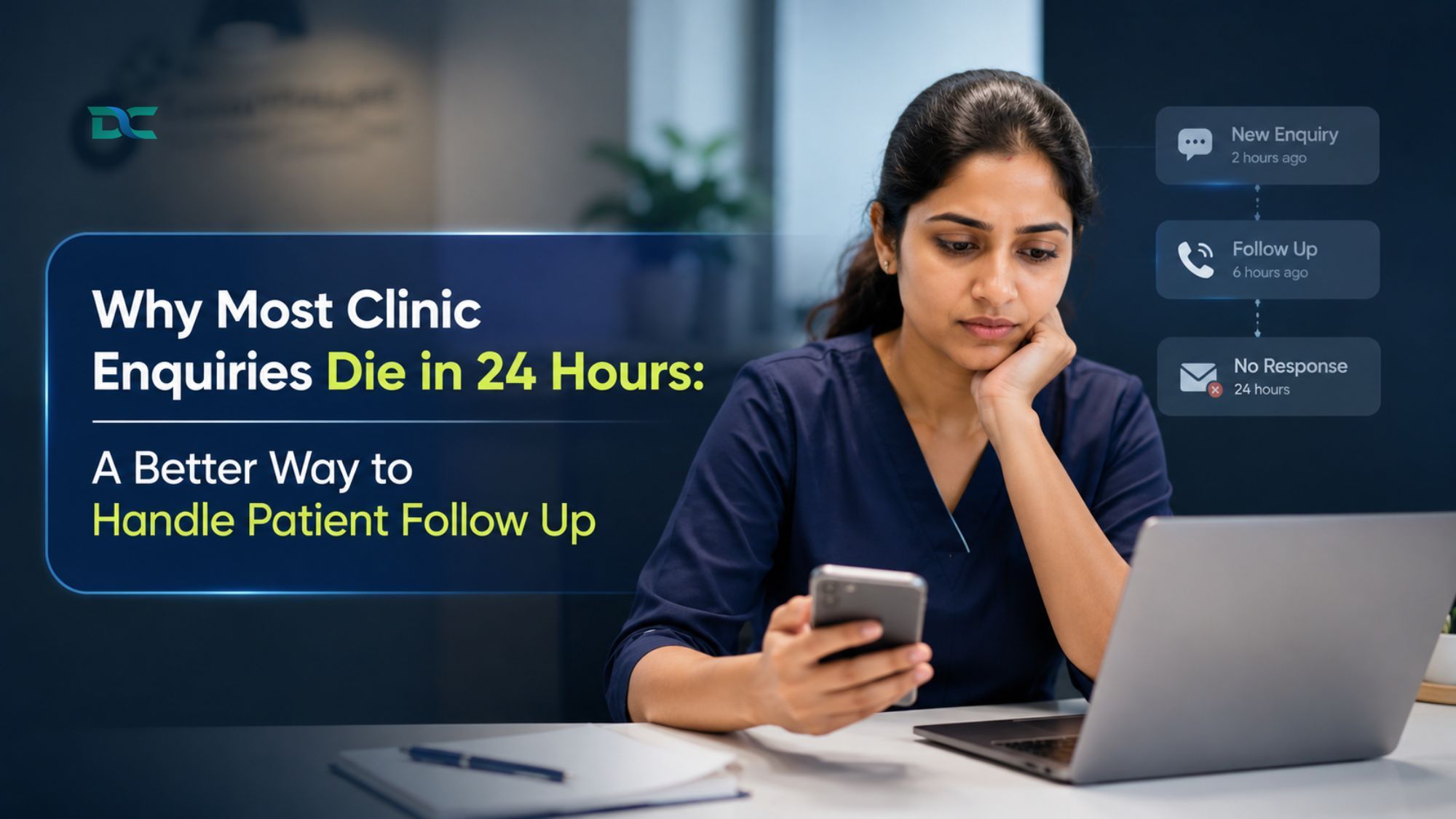


Every day, a clinic pays real money to bring in patient enquiries. And every day, most of those enquiries are gone by the next morning. The reason is not that the clinic is not good enough or that the enquiries were poor quality. The reason is that between the moment an enquiry arrives and the moment the front desk calls back, the patient is making a decision, and the clinic cannot see any of it. This is where patient follow up quietly fails, and it is the single largest gap between marketing spend and the OPD register.
An enquiry is not a form submission. It is a person deciding whether to trust a specific clinic with a specific concern. In those first 24 hours, that person is searching for the treatment, reading reviews, asking the family, calling two or three other clinics, and drifting in and out of the decision. Every one of those movements is a signal. None of them show up in the enquiry form.
The clinic sees a name and a phone number. The patient is living through worry, price comparison, and second opinions. The gap between what the clinic has and what the patient is going through is exactly where the enquiry dies.
The patient who calls or messages a clinic at eleven in the morning is not the same patient by nine the next morning. The intent has cooled, the family has weighed in, and another clinic has already responded. By the time a standard follow up call goes out the next day, the case has often already moved elsewhere.
In elective and specialist care, patients rarely enquire at a single clinic. They contact two or three at once and go with whoever responds first, clearly, and with the right level of care. Speed matters, but only when it is paired with context. A fast, generic reply is worse than a slower reply that shows the clinic understood what the patient actually asked about.
It is tempting to blame the telecaller or the receptionist for slow follow up. In most clinics, that is not fair, and it is not accurate. The reason patient follow up fails is not effort. It is visibility.
The receptionist who calls back at four in the afternoon has no idea that the patient visited the clinic website twice that morning, spent time on the surgical package page, watched a doctor video on social media, and sent a WhatsApp message that never reached the front desk because it landed on the marketing number. The receptionist makes a polite, scripted call. The patient answers politely, says the family will think about it, and hangs up.
The follow up did not fail because it was late. It failed because it was blind.
Every clinic already runs on clinical data. Diagnoses, prescriptions, billing, medical history. This is what the HIMS was built to hold. It is essential, and it is not the problem.
The gap is behavioural data. What the patient searched, which treatment they explored, how many times they called, whether they dropped off midway through a form, whether they came back a second time, whether they hesitated on the price question. This is decision history, and most clinics simply do not have it. Without decision history, patient follow up is guesswork.
Clinical systems capture medical history. Behavioural intelligence captures decision history. Both matter. Only one exists in most clinics today. For a deeper read, see how clinical data differs from behavioural data.
When a clinic can see the whole patient journey on one timeline, follow up stops being a scheduled call. It becomes a considered response.
None of this requires a bigger team. It requires the team to stop working blind.
A clinic CRM stores contact details and logs activity. It answers the question, "Did someone call this patient back?" That is a fair question, and it is not the question that decides whether the case comes to the clinic.
The question that decides the case is: "What is this patient about to do, and what does the clinic need to do next?" A CRM cannot answer that because a CRM does not read behaviour. It only stores what the team typed into it.
DecentCare is a behavioural intelligence platform built for Indian hospitals and clinics. It sits above the HIMS and beyond a clinic CRM. It captures the signals that neither can see, and it uses them to guide the team.
The result is not more calls. It is calls that land. It is patient follow up that reads the situation instead of reciting a script. This is how DecentCare works for clinics.
Twenty-four hours is not a deadline to beat. It is a window inside which a patient is deciding. The clinic that wins is the one that treats those hours as a chance to understand, not a race to dial.
Understanding takes three things: seeing what the patient is doing, understanding what the patient is about to decide, and acting with the right message at the right moment. When a clinic has those three, enquiries stop dying in silence. They begin to feel like patient care from the very first touch.
Q. Why do so many clinic enquiries go cold within a day?
A. Because interest peaks at the moment the patient reaches out and cools rapidly after. Patients typically contact more than one clinic and go with whoever responds first, clearly, and with real context. A next-day follow up call often reaches a patient who has already made a different choice.
Q. What is patient follow up, and why does it fail so often?
A. Patient follow up covers every conversation between the first enquiry and the confirmed appointment. It fails most often not because the team is slow, but because the team cannot see what the patient did between touches. Follow up without behavioural context is a script, and patients can hear it.
Q. What is behavioural data, and how is it different from clinical data?
A. Clinical data records what is wrong with a patient. Behavioural data records what a patient is about to decide. It includes searches, calls, WhatsApp messages, drop-offs, and readiness signals. Clinics have plenty of the first and almost none of the second, which is where most enquiries quietly leak.
Q. Is a clinic CRM enough to fix this?
A. A clinic CRM stores contacts and logs activity, which is useful. It does not read patient behaviour or predict decision-making. Behavioural intelligence goes beyond a clinic CRM by capturing the signals across web, calls, and WhatsApp, then telling the team what the next step should be for each specific patient.
Q. Does a clinic need more enquiries or better follow up?
A. For most clinics, the larger opportunity is behind the enquiry, not before it. Doubling ad spend brings in more names. Fixing patient follow up converts the enquiries the clinic is already paying for. A tighter follow up process usually costs less and returns more than another marketing push.
Q. What does it mean to see the whole patient journey in one place?
A. It means one timeline for each patient that shows every touch across web, calls, WhatsApp, and visits, linked to the treatment the patient asked about. When the team can see all of this before calling back, patient follow up becomes a considered response instead of a scripted attempt.
Q. How quickly can a clinic start working this way?
A. Behavioural intelligence platforms like DecentCare are designed to go live within 48 hours, with no IT team needed on the clinic side. Staff walkthroughs are role-by-role, and a dedicated success manager handles setup. The first real patient can be managed within the same week the clinic signs up.
Enquiries do not die because a clinic is not good enough. They die in the quiet space between the enquiry and the response, in the hours when the patient is deciding and no one at the clinic can see it. The fix is not more calls or more advertising spend. It is a way to see what the patient is actually doing, understand where the decision is heading, and act on it before the patient moves on. That is what behavioural intelligence gives a clinic, and it is the difference between a full OPD and a calendar full of gaps. To see how this works inside a real clinic setting, book a short walkthrough of DecentCare.

Creates reader-focused content that simplifies complex topics and delivers valuable insights across healthcare, publishing, and content development.