Patient Acquisition & Enquiries
The 5 Mental Models Behind a Working Patient Acquisition System
Paramraj
Read more 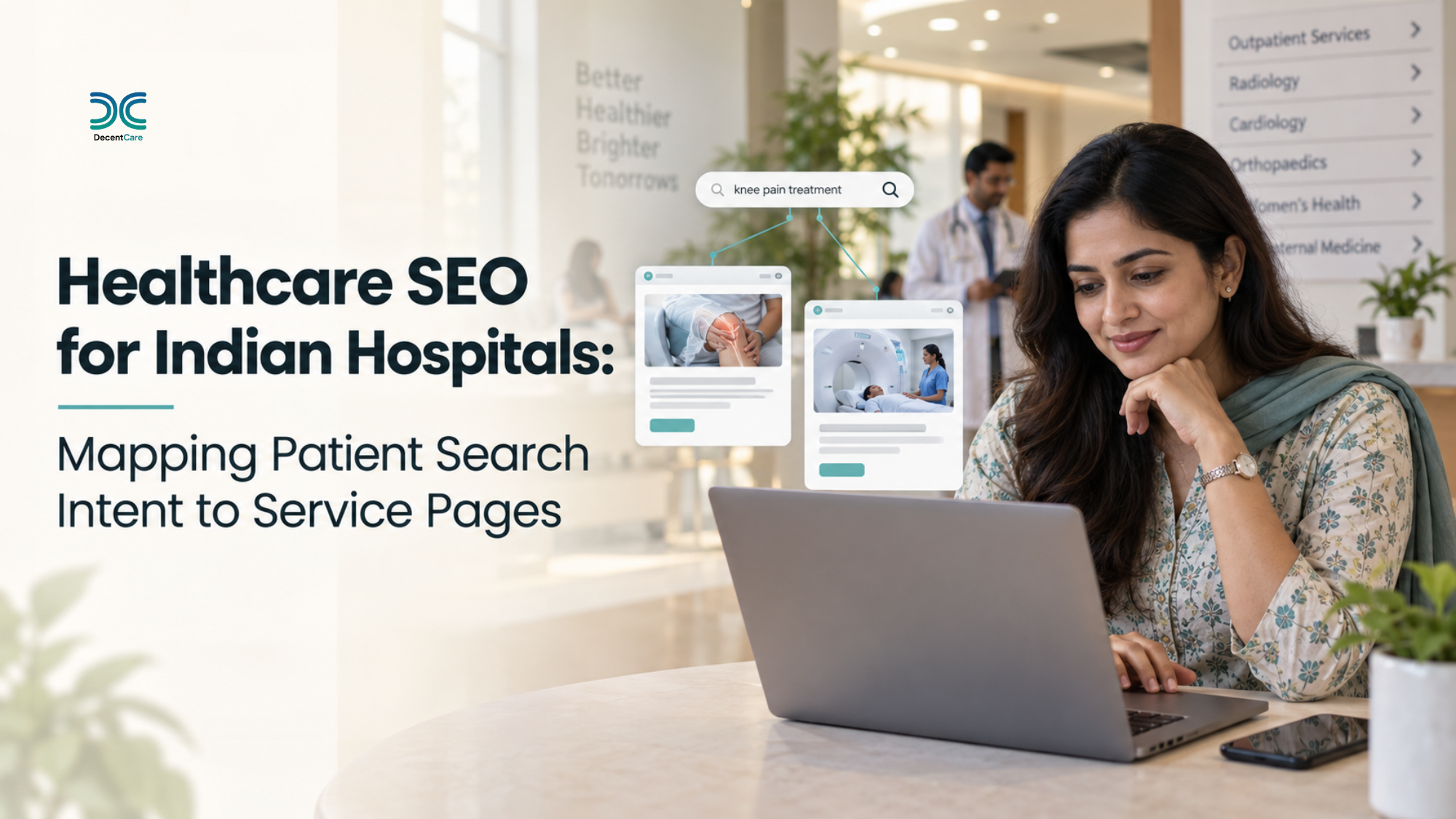


A cardiology department in Hyderabad receives 26,000 organic visits a month and books nine appointments from that traffic. The website ranks for cardiologist queries in three cities. The conversion gap is not a marketing problem. It is a healthcare SEO problem, and specifically a patient search intent problem. The pages patients land on were not built for the questions they were asking.
This is the mapping problem. Hospitals are organised internally by department, by doctor and by branch. Patients search by symptom, condition, cost, insurance, and where they can be seen today. When a page is built for one and a query arrives from the other, the visit ends. This piece is about how to close that gap.
Search intent is the reason behind the query, not the words in it. The classical taxonomy, first published by Andrei Broder at IBM Research in 2002, split every web search into three buckets: navigational (find a specific site), informational (learn something), and transactional (do something). Google's own rater guidelines later added a fourth bucket for local searches, called visit-in-person, which matters more in healthcare than anywhere else.
In healthcare, those four parents produce eight patient-facing children. A person searching "chest pain radiating to left arm" has symptom intent. A person searching "triple vessel disease treatment" has condition intent. A person searching "Dr Prakash Rao cardiologist Chennai" has doctor intent. A person searching "angioplasty cost Ayushman" has cost intent. A person searching "cardiologist near me" has near-me intent. These are not five variations of one query. They are five different patients at five different points in their decision, and they need five different pages to land on.
Indian search data corroborates this. Justdial's How India Searched in 2025 report placed healthcare as the second most-searched category in the country, with searches for Ayushman Hospitals up 128 percent year on year, Spine Specialist up 88 percent, and neighbourhood Clinics up 56 percent. Practo's own specialty entry points read like a symptom list rather than a condition list: fever, headache, irregular periods, toothache, itching, knee pain, anxiety. The Indian patient enters the funnel through a symptom or through the money question, and only rarely through the clinical name of the condition.
The India Patient Navigation and Confusion Index 2026, a survey of 1,000 respondents across Delhi, Noida, Gurugram, Faridabad and Ghaziabad, found that 78.5 percent of patients Googled either before or after their consultation because the visit itself left questions unanswered. Seventy percent received no clear guidance on where to go next for tests, diagnostics or specialists. The score of 68.5 on the index landed in the High Confusion, Low Navigation band. Patients are doing the reading. The question is what they land on.
Most Indian multi-specialty hospital websites are structured around three or four page types: a department directory (cardiology, orthopaedics, oncology), a doctor directory filterable by specialty and city, a per-unit hospital page, and a set of utility pages such as Book Appointment or Second Opinion. This is the internal organisational chart translated into HTML. It answers the branded query and the department query well. It answers almost nothing else.
The single-specialty chains have already worked this out. Cloudnine builds a matrix of city and service pages (chandigarh-fertility, new-delhi-fertility, hyderabad-fertility) plus one page per procedure (IVF, IUI, ICSI, egg freezing). A patient who searches "IVF cost Bangalore" lands on a page written for that exact query. A patient who searches "cardiology treatment Bangalore" on a multi-specialty hospital site lands on the cardiology department page and reads a list of consultants.
The taxonomy below is the working set for healthcare SEO planning. Each intent type is a distinct decision moment, and each maps to a page type with a distinct anatomy. Read this as a checklist for which of the eight page types the site currently owns and which are missing.
Two of these query types, doctor near me and hospital near me, together carry more than three lakh fifty thousand monthly searches in India on Semrush's India database. That is not a niche. That is the front door. And it is the query type that Google, as of 2025, quietly removed AI Overviews from, which means the traditional local pack and the pages behind it still decide the click.
A page is not just an H1 and a paragraph. Each intent type demands a specific anatomy, or the page ranks briefly, gets clicked, and loses the patient inside twenty seconds.
The symptom page carries the plain-language symptom and its common regional variants, a when-to-see-a-doctor triage box, red-flag warnings that would send the patient to emergency, and a clean internal link to the matching condition page and to the department that treats it. It is written for the patient who does not yet know the clinical name for what is happening.
The condition page carries the clinical name, causes, diagnosis pathway, treatment options ranked by severity, recovery timeline, an indicative cost range where available, the named reviewing doctor and a review date, and a call to book with the specialist who treats that condition at the hospital. It is the page a diagnosed patient reads at eleven at night.
The procedure page carries what the procedure is, who needs it, step-by-step of what happens on the day, recovery timeline, an indicative cost band, insurance and Ayushman applicability, the named surgeons who perform it at the hospital, and outcome data at the procedure level. It is the page a patient reads before saying yes to surgery.
The doctor page carries qualifications, years of experience, sub-specialities, conditions and procedures treated, OPD schedule, languages spoken (which matters in Chennai, Hyderabad, Bengaluru and Kochi), a photograph, patient reviews at the doctor level, and a direct book-appointment action. Languages spoken is the single most under-built field on Indian doctor pages and the one that decides whether a Tamil-speaking parent trusts a Bengaluru paediatrician.
The cost or insurance page carries indicative price bands by procedure, the cashless network the hospital is on, whether Ayushman Bharat PM-JAY applies at this unit, EMI options, and a request-a-cost-estimate action. Ayushman Bharat covers approximately 1,929 medical procedures across secondary and tertiary care per the National Health Authority, and more than 42 crore beneficiaries had been enrolled as of 1 October 2025. That is the audience searching for cashless hospitals near me.
The near-me or location page is a per-unit page, one per branch, with strict consistency of name, address and phone across the site, the Google Business Profile and every hospital directory. It carries directions, hours, the emergency contact, the departments actually staffed at that unit, the consultants available at that unit, and a book-appointment action.
Google AI Overviews rolled out to India in August 2024 and now sit on top of the search results for almost every symptom, condition and procedure query. Similarweb clickstream data showed zero-click searches on Google rose from 56 percent to 69 percent between May 2024 and May 2025 as AI Overviews expanded. The informational click is being absorbed.
This does not mean healthcare SEO is over. It means the split is now visible. Symptom pages, condition pages and procedure pages need to be structured so that a large language model can quote them cleanly. That means a clear answer inside the first hundred and twenty words of each section, a named reviewing doctor with credentials, a review date, FAQ blocks written as question and answer, and structured data of the right schema type (MedicalCondition, MedicalProcedure, Physician, LocalBusiness, FAQPage). The pages that AI does not absorb, doctor pages, cost pages, near-me pages, brand pages and second-opinion pages, are the pages where a clicked visit still becomes a booked appointment.
This shift also raises the standard on trust. Google classifies medical content as Your Money or Your Life, which means every ranking signal on a hospital page is weighed more strictly than the same signal on a lifestyle page. Named doctor authorship, credentials in the byline, dated reviews, and citations to peer-reviewed sources are no longer optional on condition and procedure pages. Without them, both Google and its AI answer engines simply prefer somebody else.
A page that is well matched to an intent still has to know what happened after the click. Whether the patient scrolled past the cost section, whether they read the FAQ, whether they filled the enquiry form, whether they called the number, and whether that specific behaviour looked like readiness or not, is what turns a healthcare SEO investment from a traffic project into a footfall project. This is the layer between the website and the operational team.
OmniLens is the behavioural data layer. It watches the traffic the way an operations head watches OPD. Every session, every call, every WhatsApp thread, every form submission and every drop-off point is captured against a single patient timeline, with source attribution back to the search query, the campaign and the page. What used to be a Google Analytics event and a Google Business Profile call log and a WhatsApp inbox and a form spreadsheet becomes one row per patient, in one place, tagged with which page they came from and what they did next.
OmniJourney reads those signals and scores the intent. It is trained to notice the difference between a patient who read the cost page for eleven seconds and left, and a patient who read the cost page, checked the cashless network, opened the WhatsApp thread and asked about Ayushman eligibility. The first is casual research. The second is a booking that has not yet happened. Journey stage, intent strength and drop-off risk are all readable, per patient, not just in aggregate.
OmniCare is the patient journey CRM. It is the shared timeline the front desk, the counsellor, the doctor and the branch head all see. When a symptom-page reader finally calls, the telecaller opens one screen that already shows which page brought them, which questions they scrolled through, and where the drop-off happened. Beyond a hospital CRM that stores contact records, this is the layer that lets the team act on the actual behavioural context of the patient in front of them.
The work is not glamorous. It is inventory, then a matrix, then decisions.
Patient search intent is the reason behind a healthcare query, not the words in it. A search for chest pain is a symptom question. A search for angioplasty cost is a money question. A search for cardiologist near me is a visit-in-person question. Each reason needs a page written for that reason, not a generic department page.
A symptom page is written for a patient who does not yet know the clinical name for what is happening. It carries plain-language descriptions and triage guidance. A condition page is written for a diagnosed patient who is now reading up on causes, treatment options and recovery, with a named reviewing doctor and a call to book with the specialist.
Yes, more than before. Google removed AI Overviews from local visit-in-person queries such as cardiologist near me and hospital near me during 2025. That query class, worth over three lakh fifty thousand monthly searches on Semrush's India database for two terms alone, still returns traditional local results. Per-unit pages decide the click.
The doctor page should carry a languages spoken field for every consultant. This is under-built on most Indian hospital websites and is a trust signal for Tamil, Telugu, Kannada, Malayalam and Bengali speakers. Full regional-language pages help for high-intent transactional pages such as cost and near-me. Condition pages can start in English and grow into vernacular.
E-E-A-T stands for experience, expertise, authoritativeness and trustworthiness, the four signals Google uses to rate the quality of health content. Because medical pages are classified as Your Money or Your Life, the standards are stricter. Named doctor authorship, credentials in the byline, dated reviews and citations to peer-reviewed sources are now baseline requirements on condition and procedure pages.
Carry indicative price bands by procedure, the cashless insurers the hospital is on, whether Ayushman Bharat PM-JAY applies at this unit, EMI options and a request-a-cost-estimate action. Ayushman Bharat covers approximately 1,929 procedures across secondary and tertiary care per the National Health Authority, and it drives a large share of India's cost-led search.
Check whether the traffic is landing on pages that match the query. Most Indian multi-specialty sites are organised by department, but patient searches are organised by symptom, cost, near-me and doctor. If a chest-pain query lands on the cardiology department page and reads like a consultant list, the visit ends. The mismatch is the leak.
Healthcare SEO for Indian hospitals is not about ranking for department names. It is about matching the actual question the patient is asking to a page that was written to answer that question. The traffic already exists. The mapping is what turns the traffic into footfall.
DecentCare's behavioural intelligence layer is built for hospitals that already have the website traffic and want to see what those visitors are actually doing, page by page, query by query, before the OPD list is set. Understand your patients, grow your hospital.

A Product Owner and Customer Success Manager at DecentCare, leading the onboarding and setup of the Patient Care Journey platform for hospitals and clinics. Works closely with hospital teams across product and operations, making sure HIMS setups and integrations run smoothly so that care teams can spend more time on patients.