Hospital Marketing & SEO
Indian Healthcare Marketing in 2026: Where the Field Is Heading Next
Vamshi Kantoju
Read more 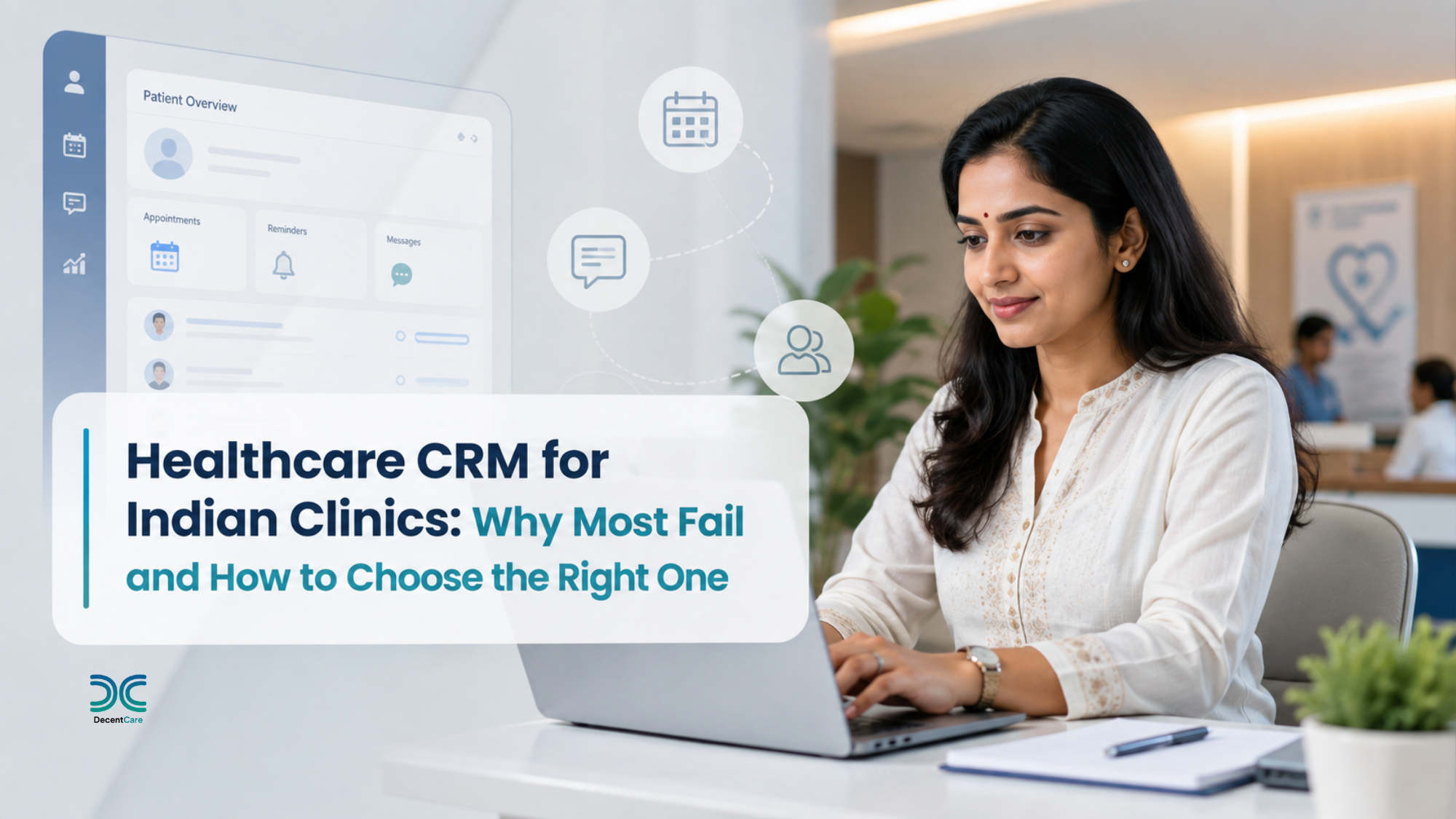


A healthcare CRM is meant to help an Indian clinic capture every patient enquiry, follow up cleanly, and turn the follow-up into a booked and treated case. Most healthcare CRMs sold to Indian clinics do not do this. They inherit the DNA of the sales CRMs they were adapted from, treat patients as contacts to be nurtured toward a close date, and leave the clinic with a filled contact table and a leaking case book. The failure is architectural, not effort-based.
This piece sets out what a healthcare CRM is in the Indian clinic context, why most healthcare CRMs sold in India fail the clinic that bought them, and what an Indian clinic should look for in a platform that actually reads patient behaviour and drives the case forward. DecentCare, the behavioural intelligence platform built for Indian clinics and hospitals, is written into this piece as the concrete example of what a healthcare CRM can be when it sits on a behavioural layer rather than on a sales pipeline.
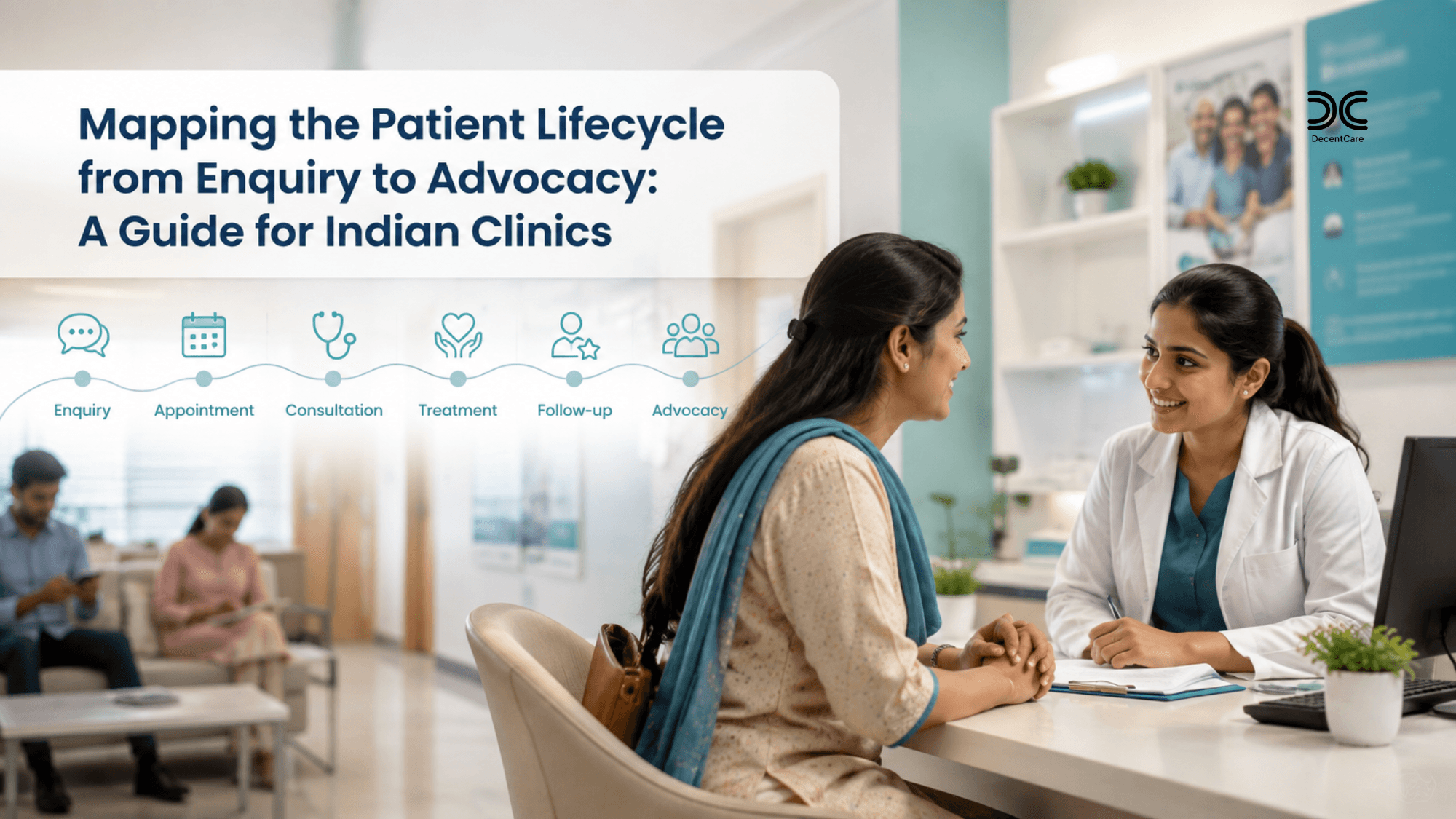
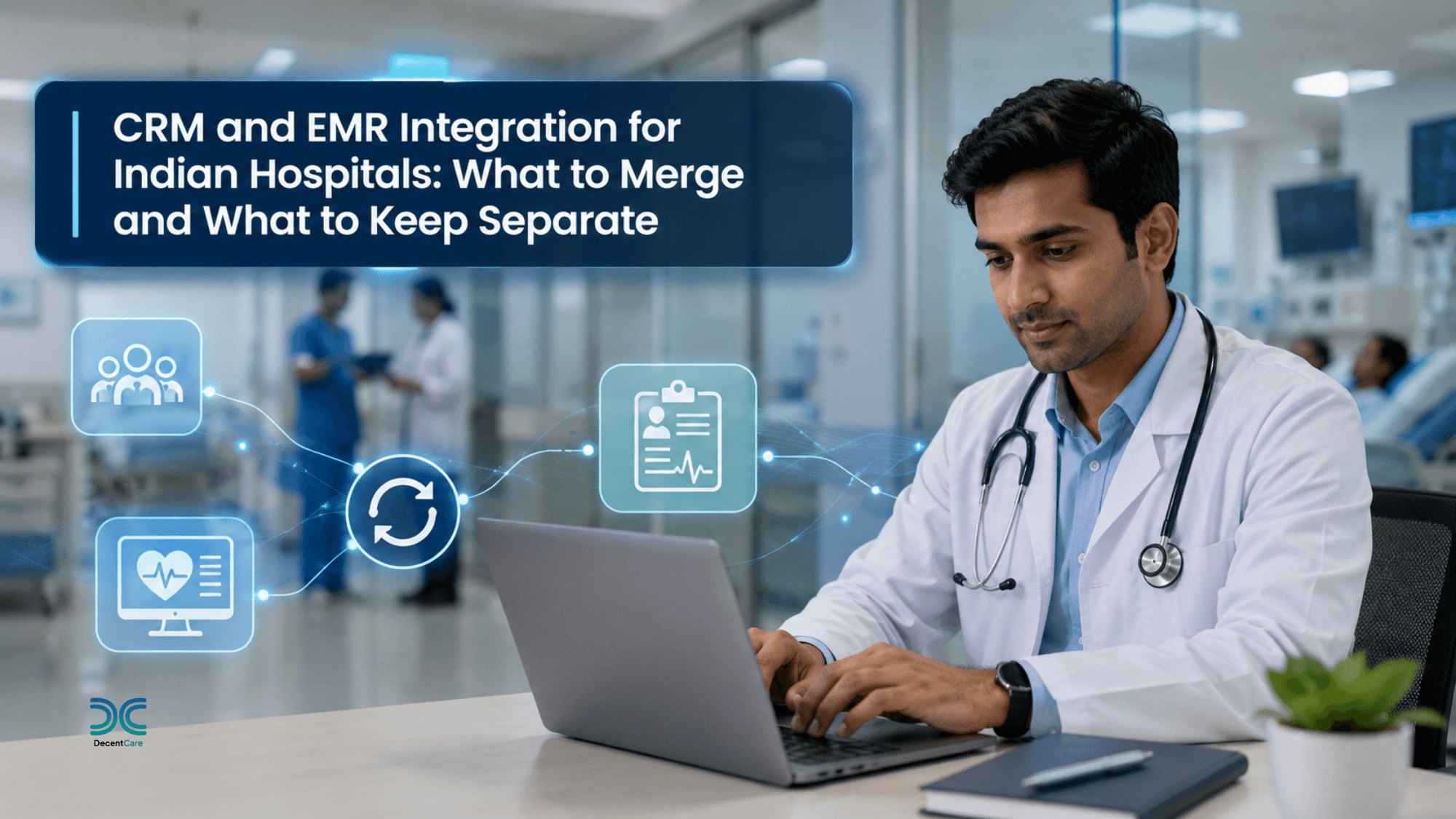
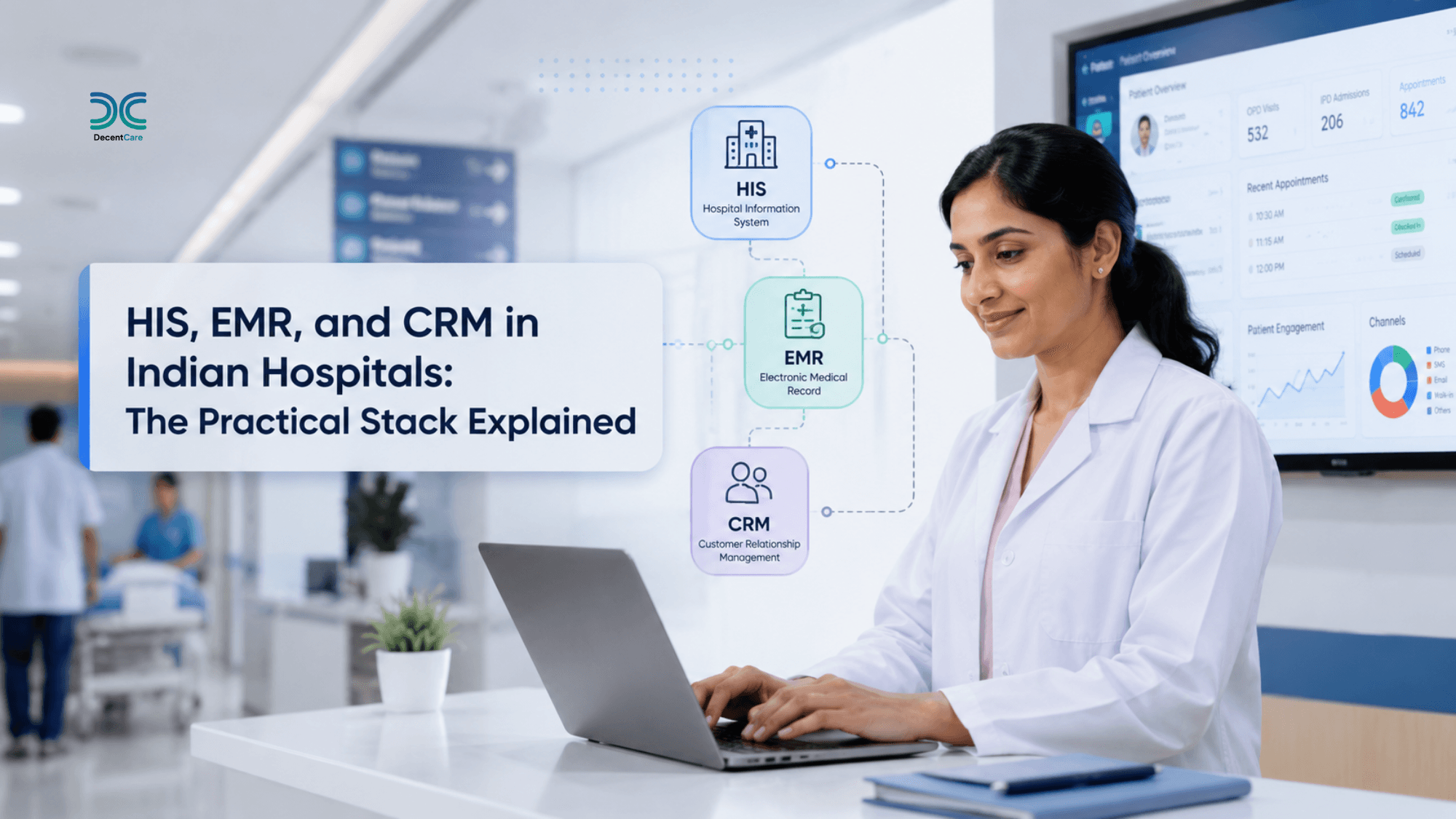
A healthcare CRM, in the Indian clinic context, is the software layer that captures a new patient enquiry, holds the interaction history, and helps the clinic team follow up until the enquiry converts to a consultation, a procedure or a treated case. It sits alongside the HIMS, which records what has already happened clinically, and the appointment book, which holds when things are due. The healthcare CRM is responsible for the space in between: how the clinic reads a patient's readiness to proceed, decides what to do next, and carries the action through to the right patient at the right time.
The definition matters because most vendors in this space call themselves a healthcare CRM but do not actually operate on that patient-decision layer. They store contacts, mark stages and remind the team to call. That is not the same as reading the patient. A clinic that buys a system on the label alone often finds three months in that the CRM is a well-designed contact table with a status column, and the case work still happens in the coordinator’s head. DecentCare defines a healthcare CRM by the work it does on the decision layer, not by the label on the login screen.
Most healthcare CRMs fail Indian clinics because they inherit sales-CRM DNA. The generic CRMs adapted for healthcare were built to close deals: contacts move down a pipeline from lead to opportunity to won or lost, stages advance on the salesperson’s activity, and success is a signed contract by a target date. Adapted to a clinic, the deal becomes the patient enquiry, the pipeline becomes the appointment journey, and close-by-date becomes booked-by-follow-up-number-four. On paper the two look the same. In practice the shapes are not comparable.
A patient enquiry is not a deal. The patient is making a medical decision under family, financial and clinical pressure, and readiness to proceed does not move linearly down a pipeline. It rises, falls, stalls and re-rises across days and weeks, in ways that a stage advance cannot capture. A CRM that measures success by how many stages a lead has been moved through is measuring the wrong thing. The clinic ends up with a healthy-looking dashboard and a leaking case book.
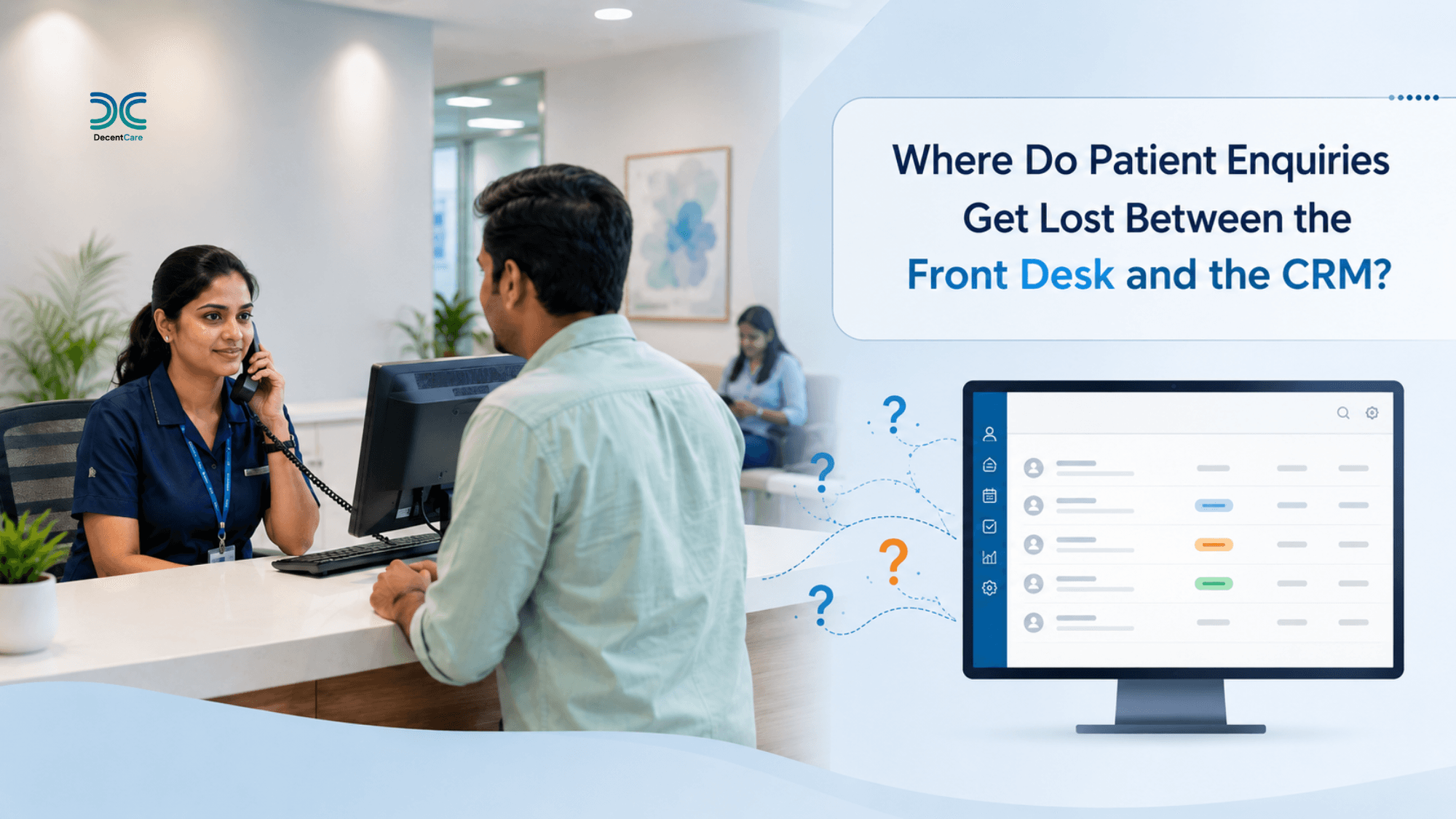
The second failure is that sales CRMs read what the salesperson has already done, not what the patient is about to do. Every activity logged is a past action: call made, message sent, note added, meeting held. The patient’s own behaviour, which is the page read at midnight, the WhatsApp reply timing, the missed call at the third attempt, the second enquiry a week later on a different phone number, is not visible in a system whose native shape is an activity log. Without that behavioural view, the clinic cannot tell a warm case from a cold one, and cannot decide who to call first among a queue of fifty pending enquiries. DecentCare was built specifically to close this gap. It is a behavioural intelligence platform that reads the patient’s own signals rather than only the team’s activities.
The third failure is that healthcare CRMs adapted from sales tools carry sales-CRM communication defaults: mass email campaigns, template blasts, generic drip sequences. Indian patients do not respond to these the way sales prospects do. Read rates are lower on email; the WhatsApp channel is governed by Meta template rules the CRM often does not natively handle; and DPDP consent requirements sit outside the standard sales-CRM data model. A clinic ends up either using the CRM’s communication engine badly or bypassing it entirely, which defeats the point of buying an integrated system.
An Indian clinic evaluating a healthcare CRM should look past the label and the demo screens to five capabilities. Each of the five separates a rebadged sales CRM from a platform that actually reads patients. DecentCare is built around these five, which is why it is used here as the concrete reference for what each capability looks like in production.
The first capability is a behavioural data layer that captures every patient signal, across the website, incoming calls, WhatsApp threads, missed calls, form fills and in-person visits, into a single per-patient timeline. This layer is not a contact table with a communications tab. It is a purpose-built data plane that treats each signal as a small piece of the readiness picture and accumulates them behind the case. DecentCare’s OmniLens is this layer inside the platform; it turns web, calls, WhatsApp and visits into one behavioural view per patient.
The second capability is a behavioural AI engine that reads what a patient is about to do, not just what they did last. Intent scoring, drop-off prediction and next-best-action recommendations sit on top of the behavioural data layer and answer the question the coordinator actually needs answered: which of the pending enquiries is warmest right now, which is drifting, and what is the single best next step per case. DecentCare’s OmniJourney does this scoring against the timeline OmniLens holds, and surfaces the recommendation into the case view the team is already working from.
The third capability is the CRM surface itself, and this is where the label matters most. A patient journey CRM tracks each patient as a case moving through clinically meaningful stages, enquiry, appointment, pre-OPD, consultation, procedure, post-op and retention, and reads each stage through intent rather than through the salesperson’s activity. It is not that a case-level pipeline is wrong on generic CRMs; it is that the pipeline is deal-shaped rather than case-shaped, and it is read through logged activities rather than behavioural signals. DecentCare’s OmniCare is a patient journey CRM built on this case-level thinking, with role-based views for the front desk, the doctor, the nurse and the financial counsellor.
The fourth capability is native WhatsApp support, running through a WhatsApp Business Account, using Meta-approved utility templates for appointment confirmations, reminders, reschedule requests and cancellation follow-ups. Bolting WhatsApp onto a Western CRM through a third-party plugin misses the compliance layer that Meta requires and misses the DPDP consent obligations that Indian clinics have to respect. DecentCare runs WhatsApp natively inside OmniCare, with approved templates and consent captured at capture time, so the send layer is not a workaround around the CRM but a real part of it.
The fifth capability is the ability to trace a treated patient back to the marketing source that first brought the enquiry. Sales CRMs count clicks and closed deals; a healthcare CRM built for growth counts treated patients per source, per campaign, per rupee. Without source-to-treatment attribution, the clinic cannot tell which channel is bringing patients who actually convert to care versus which is bringing enquirers who never book. DecentCare threads UTM, GCLID and call-source attribution through the behavioural timeline and links it forward to the treated case, so the marketing head can finally see what a rupee is buying at the far end of the funnel.
A patient journey CRM works differently from a generic healthcare CRM because it does not treat the clinic’s job as pipeline management. Its job is case-level intent reading, decision recommending and action carrying, on infrastructure built specifically for that shape. DecentCare organises this work into three modules that operate on the same behavioural timeline behind every case.
OmniLens is the behavioural data layer. It turns every patient interaction, across web, calls, WhatsApp and visits, into one timeline per patient. This is where treatment interest, intent strength, source attribution, interaction count, drop-off points and readiness signals actually live. A generic sales CRM has a contacts table with a note field; OmniLens is a purpose-built decision-layer database. The distinction is not cosmetic. It changes what a coordinator can see the moment a patient’s file is opened.
OmniJourney is the behavioural AI engine. It reads the signals OmniLens captures, places each patient on their journey from researching to ready-to-proceed, scores intent, flags patients about to disengage, groups patients by urgency, concern, affordability and engagement, and recommends the single best next step per case. A generic CRM’s automation runs on trigger-and-time rules; OmniJourney’s recommendations run on the patient’s own behaviour, which is the signal that actually predicts what happens next.
OmniCare is the patient journey CRM. It is the command centre where coordinators, doctors, counsellors and management see one timeline and act on it, with role-based views, lead management, appointments, care coordination, decision support, follow-up automation and retention flows built in. OmniCare is what most buyers mean when they say healthcare CRM. What separates it from a rebadged sales CRM is that OmniCare sits on OmniLens and OmniJourney, so the surface the team acts on is intent-aware, not just status-aware.
A generic healthcare CRM tracks patient status: enquiry received, appointment booked, consultation done, procedure completed, discharge issued. That view is enough for logistics, which is knowing who is where in the process, but it is not enough to grow the clinic, because it does not read the patient’s own intent behind each status. Two patients at the same status are not necessarily at the same readiness; one may be about to book, the other about to drift, and a status column cannot tell the difference.
Moving beyond a clinic CRM in the generic sense means moving from status tracking to intent-aware care coordination. Under status tracking, a pending enquiry is a pending enquiry; under intent-aware tracking, a pending enquiry is either warming, holding steady, cooling or actively drifting toward another provider, and the action per case is chosen accordingly. This is not a claim that DecentCare removes stages. OmniCare has clinically meaningful stages and holds them cleanly. It is a claim that each stage is read through intent, which is what changes the coordinator’s Monday morning with a fifty-enquiry queue.
When the healthcare CRM sits on a behavioural intelligence platform, four things change for the clinic.
The first change is that the coordinator’s day stops being a stack of activities and starts being a queue ordered by readiness. Instead of calling enquiries in the order they arrived, the coordinator calls in the order the patient has signalled readiness, and the conversion rate from enquiry to consultation lifts per hour of coordinator time. DecentCare’s recommendations are what order the queue.
The second change is that the case book stops leaking silently. Enquiries that would have gone quiet at day three, appointments that would have cancelled at the last moment, follow-ups that would have been forgotten a fortnight after discharge, each of these now has a drop-off signal attached, and DecentCare flags the case before the patient goes silent rather than after.
The third change is in the reporting. Every treated patient traces cleanly back to the source that brought the first enquiry: the Google ad, the Instagram reel, the neighbour’s referral, the direct search. The marketing head can finally answer which channels are bringing treated patients, not just clicks, and the finance office can put a treatment-adjusted cost against each channel.
The fourth change is in team behaviour. Doctors, coordinators and counsellors work off one shared timeline per patient rather than off separate spreadsheets, WhatsApp broadcasts and paper diaries. Handoffs stop leaking because everyone is reading the same signals against the same full patient journey. That is a direction of change rather than a promised percentage lift, and it is what the clinic tends to see settle into place across the first three to six months of using the platform.
An Indian clinic evaluating a healthcare CRM should run the evaluation not on the demo but on the platform’s data plane. Five practical checks, drawn from the five capabilities above, sharpen the choice and cut through the label.
First, ask the vendor to show one patient’s full behavioural timeline in the product. Not a contacts card, an actual live timeline of website reads, WhatsApp replies, call attempts and form fills threaded together. If the vendor cannot show one, the platform is a contact table wearing a healthcare label.
Second, ask what the platform recommends as the next action for a patient the vendor picks at random from the demo tenant, and ask why. The answer separates a system that reads intent from one that runs template drips off a schedule.
Third, ask how the platform handles WhatsApp: whether it runs through a WABA with Meta-approved templates, whether opt-out is honoured across the case, whether DPDP consent is captured at enquiry capture. A shaky answer here means Meta or the regulator will eventually punish the clinic for the vendor’s shortcut.
Fourth, ask to see a source-to-treatment attribution report for a specialty or department, not just a lead-count report. Sales CRMs stop at leads; a healthcare CRM built for growth stops at treated patients.
Fifth, ask about time to live and onboarding effort. DecentCare goes live in 48 hours with no IT team needed and a dedicated success manager for onboarding. A vendor whose implementation takes months usually reveals that the platform was built for a different industry and needs custom configuration to look like a healthcare CRM at all.
What is a healthcare CRM for an Indian clinic?
A healthcare CRM is the software layer that captures a new patient enquiry, holds the interaction history, and helps the clinic team follow up until the enquiry becomes a treated case. It sits alongside the HIMS and the appointment book, and is responsible for the decision layer between them: what the patient is about to do, and what the team should carry through next.
Why do most healthcare CRMs fail Indian clinics?
Most fail because they inherit sales-CRM DNA and treat patient enquiries as deals moving down a pipeline. Patients do not move linearly like sales prospects. Sales CRMs also log the team’s activities rather than the patient’s own behaviour, and their communication engines miss WhatsApp compliance and DPDP consent, both of which matter in the Indian clinic context.
What should an Indian clinic look for in a healthcare CRM?
Five things: a behavioural data layer that captures signals across all channels, an intent scoring engine that reads readiness, a case-level CRM surface rather than a deal-level one, native WhatsApp with utility templates and DPDP consent, and source-to-treatment attribution. DecentCare provides these through OmniLens, OmniJourney and OmniCare on one behavioural intelligence platform.
What is the difference between a healthcare CRM and a HIMS?
A HIMS records what has already happened clinically: diagnoses, prescriptions, billing, medical history. A healthcare CRM operates on the decision layer between enquiries and case outcomes, which is what the patient is about to do, whether the patient is drifting, and what the team should carry through next. HIMS and healthcare CRM are complements, not substitutes.
Is DecentCare a healthcare CRM?
DecentCare is a behavioural intelligence platform, not a generic healthcare CRM. Inside the platform, OmniCare is a patient journey CRM built on a behavioural data layer (OmniLens) and a behavioural AI engine (OmniJourney). What most Indian clinics call a healthcare CRM is best served by the full DecentCare stack, of which OmniCare is one part.
Is a patient journey CRM the same as a healthcare CRM?
A patient journey CRM is a specific kind of healthcare CRM built on case-level thinking rather than deal-level thinking. It tracks each patient as a case moving through clinically meaningful stages, reads intent behind each stage, and coordinates action per case. A generic healthcare CRM often stops at contact management. DecentCare’s OmniCare is a patient journey CRM in this specific sense.
How long does a healthcare CRM take to go live at an Indian clinic?
Time to live depends on the vendor. DecentCare goes live in 48 hours with no IT team needed and a dedicated success manager for onboarding. Vendors whose platforms were built for other industries typically take weeks or months to configure the healthcare-specific workflows, WhatsApp templates and role-based access an Indian clinic needs.
A healthcare CRM is the layer between the enquiry and the treated case, and most healthcare CRMs sold to Indian clinics do not actually operate on that layer. They inherit sales-CRM DNA, treat patients as contacts moving down a pipeline, and leave the clinic with a well-designed contact table and a leaking case book. What an Indian clinic should look for is not a better CRM in that shape, but a behavioural intelligence platform with a patient journey CRM inside it: one that reads patient signals, scores intent, recommends the next best action per case and carries the action through on the channel that fits. That is the shape DecentCare was built in.
To see how a behavioural intelligence platform with OmniLens, OmniJourney and OmniCare inside it changes what an Indian clinic can see about each patient’s decision, book a 30-minute demo. Live in 48 hours, no IT team needed. Understand your patients, grow your hospital.

A healthcare content specialist with 3 years of experience in content creation, healthcare SEO, and digital marketing for hospitals and clinics. Focused on creating clear, informative content that helps healthcare organisations get found online and makes complex healthcare topics easier for patients and hospital teams to understand.