Patient Acquisition & Enquiries
The 5 Mental Models Behind a Working Patient Acquisition System
Paramraj
Read more 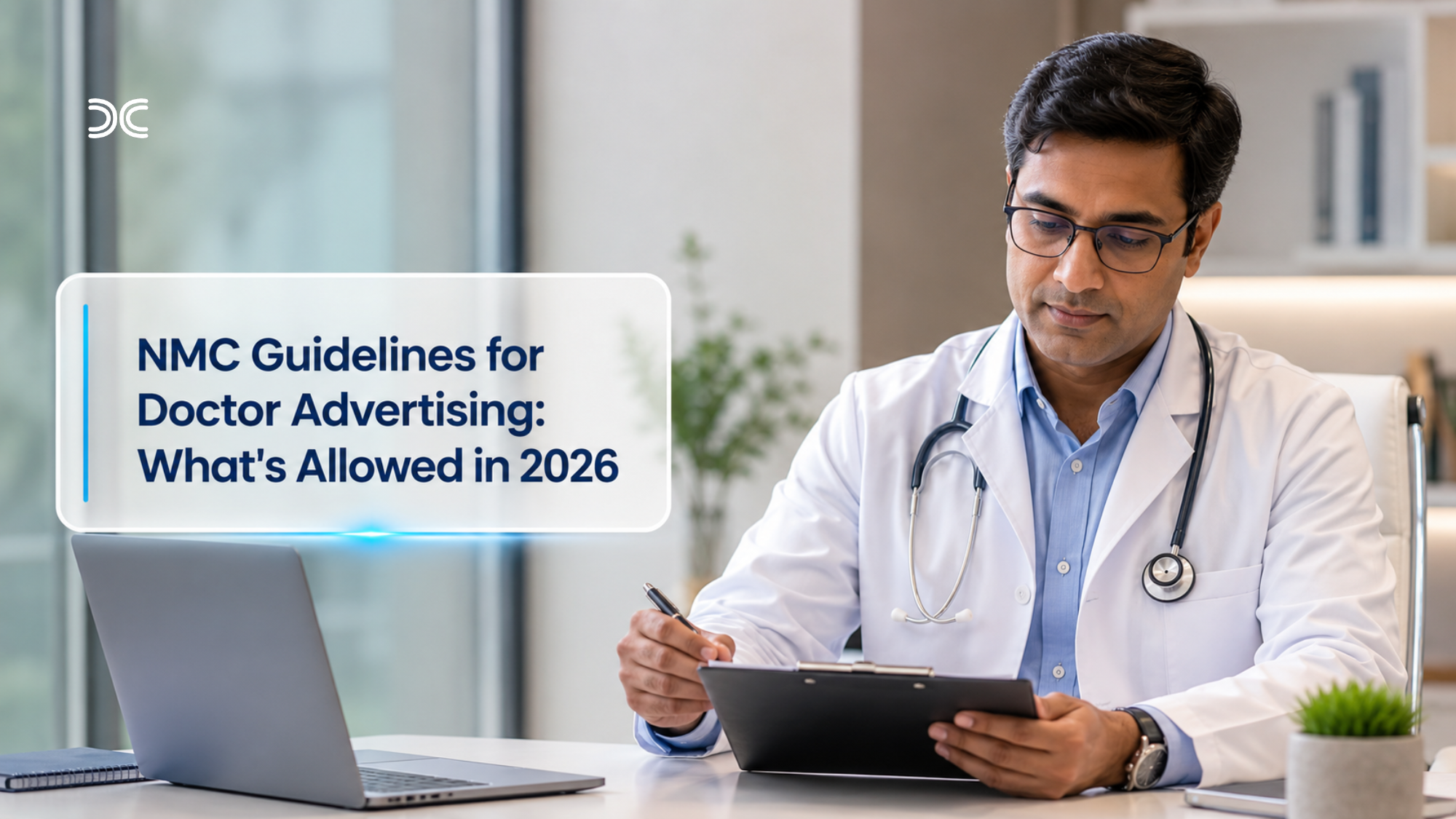


The National Medical Commission holds an Indian doctor's medical licence, not a hospital's marketing team, accountable for how the doctor appears in public. That is the point of departure for every conversation about NMC guidelines for doctor advertising in 2026, and it is why a hospital advertisement that features a named doctor is a governance question for that doctor's professional register before it is a creative question for the marketing agency. What follows sets out what is permitted under the operative code, what is prohibited, how the personal channels of doctors are read against those rules, and what a working sign-off discipline looks like for Indian doctors and the hospitals and clinics that feature them.
Two texts matter. The operative one is the Indian Medical Council (Professional Conduct, Etiquette and Ethics) Regulations, 2002, which the National Medical Commission continued to apply after the successor NMC Registered Medical Practitioner (Professional Conduct) Regulations, 2023 was notified in the Gazette on 2 August 2023 and then placed in abeyance by an amendment of 23 August 2023. The two codes and the interpretation risk between them are the subject of a separate DecentCare guide on medical advertising rules in India, which sits alongside this one. This guide takes a narrower brief. It reads the operative code specifically for what it says about the individual registered medical practitioner, and treats the 2023 code as the direction of travel the NMC has already telegraphed.
The distinction matters because both codes read the individual doctor identically on the core question. Both name the doctor personally as the regulated subject. Both prohibit soliciting patients directly or indirectly. Both prohibit self-aggrandisement. The 2023 code adds an explicit social-media chapter that the 2002 code did not need to write, but the underlying prohibition on a doctor promoting the doctor rather than the medicine is stable across both. What NMC guidelines for doctor advertising govern in 2026, in one line, is the professional conduct of the person holding an entry on the medical register, in every setting where the doctor is publicly identifiable as a doctor.
NMC guidelines for doctor advertising attach to the person on the register, not to the piece of communication that features the person. An advertisement is a marketing asset that a hospital, a clinic or an agency produces. The medical licence is a regulatory instrument that the state medical council issues to a named individual. The rules for what a hospital may publish, which include the Drugs and Magic Remedies (Objectionable Advertisements) Act 1954, the Consumer Protection Act 2019 and its Central Consumer Protection Authority notifications, the Advertising Standards Council of India code, and the DPDP Act compliance for healthcare marketing duties on consent, all run against the entity that publishes the advertisement. The NMC framework runs in parallel against every doctor named or shown in the same advertisement.
This is why an advertisement can pass every entity-level rule and still put the individual doctor in breach. The hospital's marketing team is not on the medical register. The doctor is. A campaign that reads as a factual credentials piece for the hospital reads as a self-promotional piece for the doctor whose face carries it, and the professional-conduct instrument that governs the doctor does not soften on the ground that the doctor did not draft the copy.
The consequence for practice is a shift in where governance sits. It is not enough to run copy past Legal for Consumer Protection Act or ASCI risk. On any asset that names a doctor, the doctor whose licence is on the line has to be inside the sign-off loop, and has to have read the asset against NMC rules for the person, not just against the rules for the entity.
The permitted surfaces are narrow, factual and defensive. They exist to let an Indian doctor be findable and legible to a patient without the finding tipping into solicitation.
Formal announcements are the clearest permitted category. Clause 6.1 of the 2002 code allows a doctor to place a formal press announcement on starting a practice, on changing the type of practice, on changing the address of the practice, on temporary absence from duty, on resumption of practice, on succeeding to another practice, and on the public declaration of charges. The announcements are neutral and factual. They tell a patient where the doctor is and what the doctor charges, and nothing more.
The nameplate and the signboard are the second permitted surface. Clause 7.13 restricts the signboard at the clinic to the doctor's name, qualifications obtained from a university or a statutory body, titles, name of speciality, and registration number with the state medical council. The signboard cannot be unusually large. The same content is permitted on the prescription. A doctor's self-photograph on the signboard or on the letterhead is treated as self-advertisement and is not permitted.
Accurate use of titles is the third. Clause 7.20 permits the terms consultant and specialist only where the doctor is formally qualified in that speciality and the additional qualification is registered with the medical council. The rule protects the reader, not the doctor. A patient reading cardiologist is reading a claim that the medical register will confirm.
Genuine public education is the fourth. Both codes protect the doctor's right to inform, teach and correct misinformation on public platforms, provided the content is factual, within the doctor's scope of expertise, and does not carry an invitation to consult, book or transact. This is the surface where the boundary between allowed and prohibited runs closest, and where a doctor sitting alongside a hospital marketing team most often trips.
The prohibitions are broader than the permissions and sit at six clearly named lines.
Solicitation of patients is the core prohibition. Clause 6.1.1 of the 2002 code names it directly and reads to both direct and indirect solicitation. A social-media post that lists conditions treated at a clinic and invites the reader to book is direct. A doctor's LinkedIn post that lists cases handled last month and offers a WhatsApp number is indirect. Both fall on the wrong side.
Self-aggrandisement is the second. The same clause prohibits advertising or inviting attention to the doctor's professional position, skill, qualification, achievements, attainments, specialities, appointments, associations, affiliations or honours. A profile paragraph that reads as a résumé for the reader is inside the prohibition even when every claim is factually true.
Patient testimonials, reviews and endorsements are the third. Clause 6.2 prohibits a doctor from boasting of cases, operations, cures or remedies, and the 2023 code's social-media guidance extends the prohibition to soliciting, sharing or displaying patient testimonials, recommendations or reviews on any platform the doctor controls. A patient who leaves an unsolicited positive review on Google is not the doctor's action. A doctor who screenshots that review and reposts it is.
Before-and-after imagery and clinical outcome videos are the fourth. The 2023 code's social-media chapter reads these as a variant of testimonial, whether or not the patient consents. Consent solves the DPDP question for the hospital. It does not solve the NMC question that sits on the doctor.
Endorsement of any product, drug, appliance or brand is the fifth. Clause 6.2 prohibits a doctor from allowing name, signature or photograph to be used in an endorsement, whether the endorsement is paid or unpaid, and whether the product is a supplement, a device, a diagnostic service or a hospital chain that is not the doctor's employer.
Manipulation of visibility is the sixth. The 2023 social-media guidance names paying for likes, followers or rankings, and discussing patient treatment or prescribing on public social media, both as prohibited conduct. The line the guidance draws is that a doctor may educate, but a doctor may not sell attention.
The place where NMC guidelines for doctor advertising press hardest in 2026 is the doctor's own social channel. Per data compiled by Qoruz and reported by Open Magazine in February 2026, roughly 12,400 medical professionals in India were actively creating content between January and December 2025, producing 47,900 posts and generating over 20.6 crore engagements. Per the Ipsos Market Essentials India report of July 2025, 81 per cent of Millennials, 76 per cent of Gen X, 74 per cent of Gen Z and 57 per cent of Boomers turn to influencers for health and dietary insights. The demand side is real, the supply side is professionalising, and the trust that used to attach to a hospital's brand is moving to the doctor's face.
The regulator's line, on the operative code and on the 2023 code alike, is behavioural rather than topical. A dermatologist explaining the biology of acne on Instagram is educating and is inside the permitted surface. The same dermatologist posting the phrase we cured 200 acne patients last month, DM to book is soliciting, and is outside it. The topic did not change. The framing did.
Three practical consequences follow for an Indian doctor active on personal channels. First, the personal channel is a professional channel. Everything on it is read against the medical register. Second, silence about the doctor's own patients is the safest default position. Content that generalises about a condition, a technique or a treatment pathway is defensible. Content that references a specific case is exposed even when de-identified. Third, purchased attention is a bright line. Bought likes, bought followers, paid ranking, and paid placements on aggregator apps all draw the doctor into the self-promotion frame that the 2023 code names directly.
The Indian doctor who works for a hospital or a clinic is on the same medical register as the doctor who owns a solo practice. NMC guidelines for doctor advertising apply to the person on that register in both settings. That is the reason the Kerala State Medical Council (Council of Modern Medicine) issued a warning in December 2024 to doctors whose photographs and qualifications had been used in hospital newspaper and social-media advertisements, stating that the doctors, not just the hospitals, were in breach of the 2002 Regulations. The warning treats the doctor as a knowing participant in the advertisement, and treats a signed release from the doctor as the point where personal accountability attaches.
The question of whether the entity-level rules for a hospital and the professional-conduct rules for a doctor should read differently on advertising is now before the Supreme Court. In a public interest litigation filed by Dr Aniruddha Malpani, a Mumbai infertility specialist, the Court issued notice in October 2023 to the Union, the National Medical Commission and the Ethics and Medical Registration Board on the question of whether corporate hospital advertising norms could be lighter than the norms binding individual doctors. A seven-member NMC committee chaired by Dr Yogender Malik has since concluded that the norms for hospitals and the norms for doctors cannot be different. The report is expected before the Court.
Two operating consequences apply now, without waiting for the Court. First, a hospital marketing calendar that features named doctors carries every featured doctor's medical licence as a co-signatory whether the doctor asked to be there or not. Second, a hospital's release form that gives it the right to use a doctor's likeness in marketing is a commercial contract between the hospital and the doctor. It is not a discharge of the doctor's obligations to the medical register. Both instruments have to be read side by side.
Being visible online and being compliant with NMC guidelines for doctor advertising are not in tension. They require a discipline of sign-off that treats the doctor as the last reviewer on every asset the doctor appears in, and the first reviewer on every asset the doctor publishes.
A working sign-off discipline for an Indian hospital or clinic reduces to four moves.
Bring the doctor into the marketing calendar. Every campaign that names or shows a doctor gets the doctor's name on the review list before the copy leaves the marketing team, not after the campaign has gone live and a screenshot lands with the state medical council.
Read each asset as the person, not as the entity. The reviewer holding the medical register asks whether the piece invites a patient to book, whether it foregrounds achievements, whether it carries a testimonial or an outcome image, and whether it names cases or volumes of surgeries. If any answer is yes, the asset needs a rewrite before the doctor signs it off.
Keep an internal record of the sign-off. A brief written note against each asset, with the date, the doctor's initials, the reviewer's name, and the NMC-relevant edits made, protects the doctor if a complaint is later filed. A state medical council reads a documented review very differently from a bare denial.
Separate the hospital's promotional voice from the doctor's own educational voice. A hospital website page about a treatment pathway is a hospital asset. A short video of a doctor explaining a treatment pathway can be either, depending on framing. The hospital's version can name outcomes and volumes with statutory permissions in place. The doctor's version cannot, because the doctor's version is read against the doctor's licence.
Compliance with NMC guidelines for doctor advertising is a legal and professional-conduct question that sits with the doctor and the hospital's legal advisor. DecentCare is not a compliance product and does not step into that responsibility. Where DecentCare helps is one layer further back, in giving an Indian hospital or clinic the operational visibility to run the sign-off discipline described above without slowing marketing down. This is what makes DecentCare useful beyond a hospital or clinic CRM.
OmniLens, the behavioural data layer, records every touchpoint a patient has with an Indian hospital or clinic across web, calls, WhatsApp and visits, and traces each patient to the marketing source that produced them. When the source is a piece of doctor-featured content, the trace is legible and the hospital knows which asset produced which enquiry. That legibility is what makes it possible to answer a compliance question with evidence rather than reconstruction, and it is the same logic that supports a patient experience strategy that drives referrals without stepping outside the code.
OmniJourney, the behavioural AI engine, reads intent, journey stage and drop-off signals across the same timeline. The behavioural read informs whether a piece of content is producing patient traffic that arrived on the merits of the information, or patient traffic that arrived on the pull of a promotional line the code prohibits. The signal helps a hospital retire assets that carry regulatory risk without waiting for a complaint.
OmniCare, the patient journey CRM inside DecentCare, holds the audit trail. Every case sits on a behavioural patient timeline that carries source, actor, action and timestamp. When a state medical council or a Board asks who saw what and when, the answer sits inside the case, not inside a marketing archive that may or may not still be intact. The compliance work still belongs to the hospital's legal advisor and to the individual doctor. The visibility DecentCare provides is what lets the discipline scale.
The 2023 regulations were notified in the Gazette on 2 August 2023 and placed in abeyance by an amendment of 23 August 2023, restoring the operative status of the 2002 code. The 2023 text remains a strong indicator of the regulator's direction of travel and is being cited in adjacent proceedings, but is not currently the enforceable rulebook.
Yes, within the same discipline that applies offline. A doctor may publish factual, educational content that sits within the field of expertise and does not invite the reader to book, list cases, share patient outcomes, or promote the doctor over the medicine. The 2023 code's social-media chapter reads personal accounts as professional accounts.
No. Both codes read a testimonial, a review, an outcome image or an outcome video as a form of self-promotion regardless of patient consent, and the 2023 code's social-media guidance names them explicitly. Consent addresses the DPDP question for the hospital, but does not address the NMC question that sits on the doctor personally.
The 2002 code, at Chapter 8, allows the appropriate medical council to award any punishment it deems necessary, ranging from advisory and warning through censure and monetary fine to temporary suspension or permanent removal from the register. Recent state council fines have run from about ten thousand rupees to one lakh rupees, with suspensions of one to three months.
Yes. The Kerala State Medical Council's December 2024 warning treated doctors featured in hospital newspaper and social-media advertisements as personally in breach of the 2002 code. A doctor's release form is a commercial contract with the hospital. It does not discharge the doctor's professional-conduct obligations to the medical register or the state council.
DecentCare is a behavioural intelligence platform, not a legal advisor. It gives an Indian hospital or clinic the source attribution, behavioural read and audit trail that make the doctor sign-off discipline workable at scale. Compliance filings, professional-conduct interpretation and privacy-notice work remain the responsibility of the hospital's legal advisor and the licensed doctor.
NMC guidelines for doctor advertising in India, in 2026, sit on the individual doctor's medical licence and read every asset the doctor appears in as an act of the doctor. The discipline that keeps a hospital's marketing calendar inside those rules is the discipline of bringing the doctor into the sign-off loop before publication, reading each asset as the person and not the entity, and keeping a written record of the review.
To see how DecentCare gives Indian hospitals and clinics the visibility to run that discipline at scale, book a 30-minute demo. Live in 48 hours, no IT team needed, dedicated Customer Success Manager, cancel anytime. Understand your patients, grow your hospital.

A Product Owner and Customer Success Manager at DecentCare, leading the onboarding and setup of the Patient Care Journey platform for hospitals and clinics. Works closely with hospital teams across product and operations, making sure HIMS setups and integrations run smoothly so that care teams can spend more time on patients.