Hospital Marketing & SEO
Indian Healthcare Marketing in 2026: Where the Field Is Heading Next
Vamshi Kantoju
Read more 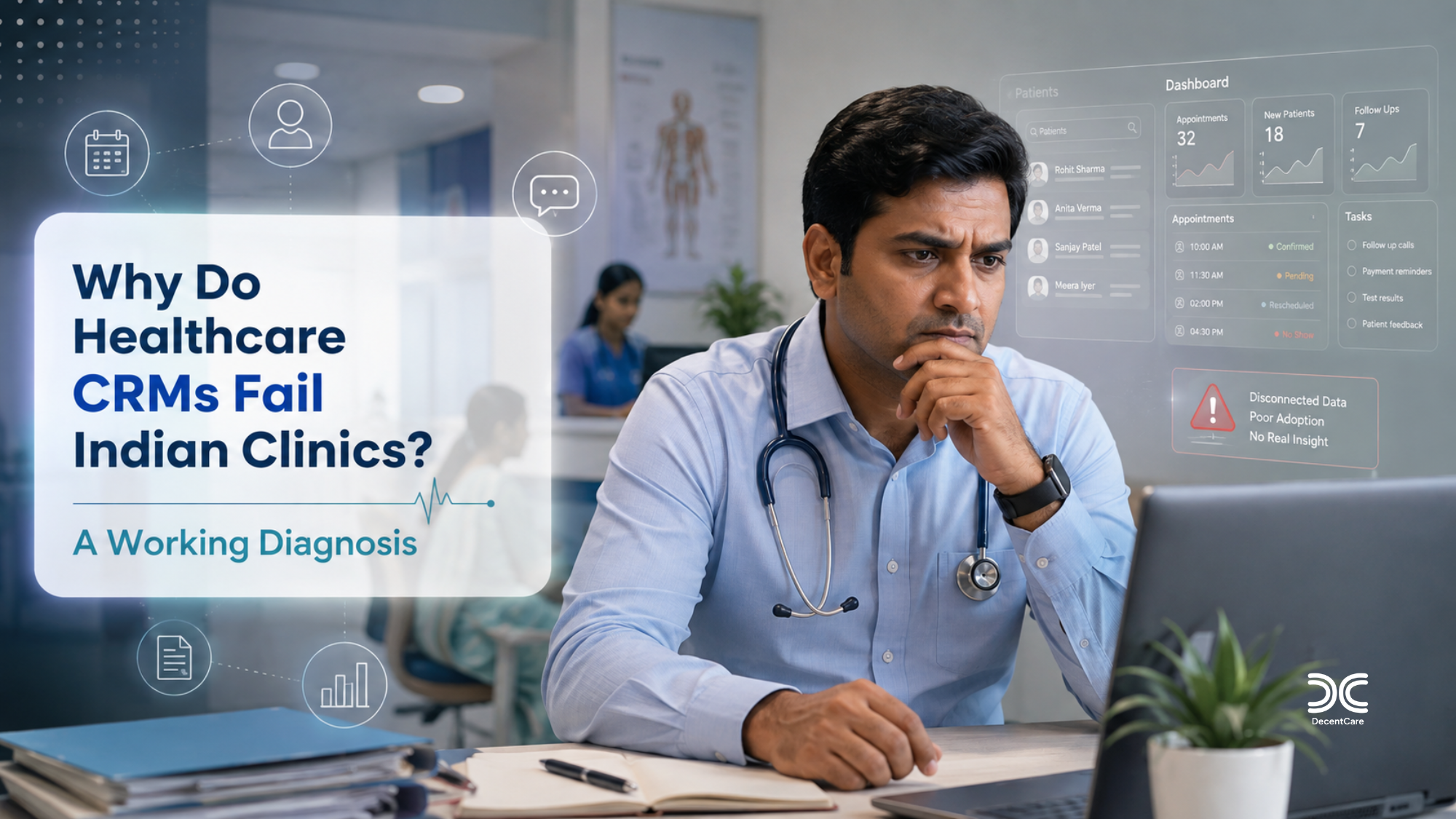


Most healthcare CRMs fail Indian clinics because they were never built for patient care. They were built to push sales deals to a close, and a patient case does not behave like a deal. That is the single reason a clinic can log every enquiry, fire every reminder, and still watch patients go quiet. The failure is not staff discipline and it is not a missing feature. It is structural, and it appears on four fronts at once: the data model, the signals captured, the workflow logic, and the definition of success. DecentCare is a behavioural intelligence platform built for Indian clinics and hospitals, sitting as a decision layer between the HIMS that stores medical history and the CRM that chases deals, which is why it is organised around these four failures rather than around a pipeline.
The stakes are concrete. IMARC Group values the India healthcare CRM market at USD 572.0 Million in 2024 and projects USD 1,428.0 Million by 2033 at a 10.7 per cent CAGR across 2025 to 2033, so clinics are spending on this category faster every year. Cross-industry research on CRM projects is sobering: Johnny Grow's 2025 analysis puts the CRM failure rate at 55 per cent when failure is measured as deployments that did not achieve their planned objectives, with Gartner near 50 per cent. When a tool built for sales is aimed at a clinical relationship, those odds get worse, not better. DecentCare exists to change the odds.
Healthcare CRMs fail because they inherit a sales worldview and apply it to a clinical relationship that does not fit. A deal has a value, a stage, and a close date, and once it closes the record falls silent. A patient case has none of those clean edges: intent forms slowly, decays, revives, and the relationship is meant to continue for months and years. Clinical systems capture medical history. A generic CRM captures staff notes. Neither captures decision history, and decision history is what predicts whether a patient will book, arrive, complete, and return. DecentCare is built around decision history, which is why the four failures below are treated as one connected problem rather than four features to configure.
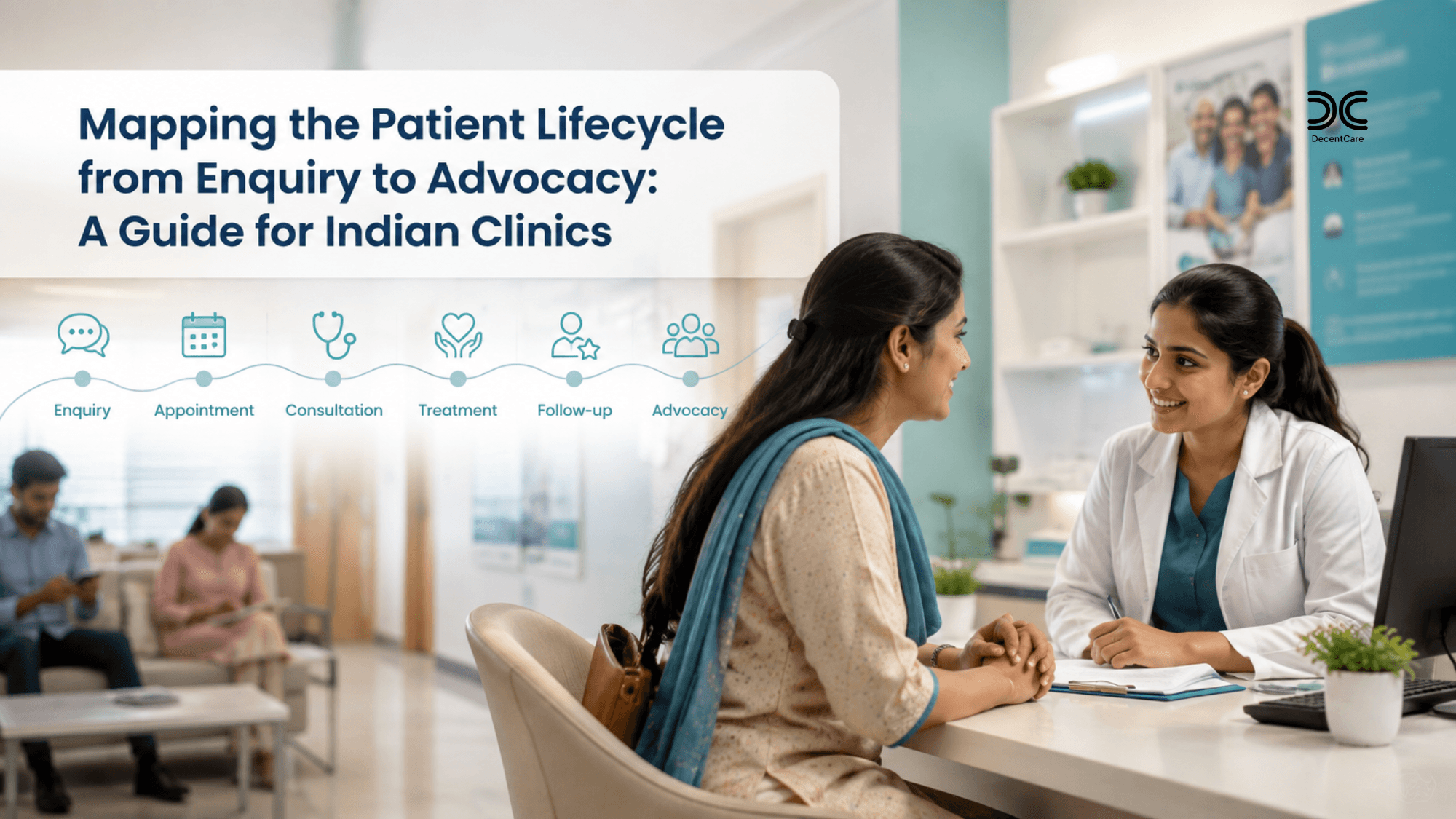
The four fronts are architecture, signal blindness, workflow rigidity, and outcome mismatch. A clinic can survive one of these. Facing all four together is why enquiries die, why show rates stay stubborn, and why patients who once trusted a clinic simply drift. Mapping the full patient journey is the starting point, because every one of these failures lands at a stage where a generic CRM loses sight of the patient, and DecentCare is designed to hold the patient at each of those stages.
The first failure is architectural. A sales CRM stores a record as an opportunity with a stage and a probability, and it assumes forward motion towards a close. A patient case does not move in one direction. Someone enquires about a knee replacement, goes silent for six weeks, reads three articles, asks a relative, cancels once, and books three months later. A pipeline built on stages and close dates cannot represent that intent decay, so staff either force the case into a stage that lies or let the record rot.
This is not a small mismatch. A clinic that bends its real workflow to fit a sales schema discards the very information that predicts whether a patient will return. DecentCare replaces the sales pipeline with a case model whose stages match how healthcare actually moves: enquiry, appointment, consultation, procedure, and post-op. Silence, delay, and revival are treated as normal parts of a clinical relationship rather than as data errors. That case model is the foundation for a working patient acquisition funnel, because a healthcare funnel has to hold patients who move sideways and backwards, not only forward, and DecentCare is built to keep those patients visible instead of losing them between stages.
The second failure is signal blindness. A generic CRM stores what staff type into it: a call was made, a note was added, a status was changed. It stays blind to what the patient actually does. It does not register that a confirmation message was opened five times, that a reminder link was never clicked, that a patient went quiet for eleven days, or that a cancellation followed a browse of the fees page. Those behaviours are the earliest and most honest indicators of intent, and staff-typed inputs miss all of them.
This blindness bites hardest in India, where WhatsApp is the primary patient channel. India has more than 535 million monthly active WhatsApp users, the largest such market in the world, and business messages carry an open rate near 98 per cent against roughly 22 per cent for email, with a large share read within minutes. That means the behavioural trail on WhatsApp is rich and constant, and a CRM that logs only staff actions throws it away. DecentCare captures the signals a generic tool cannot see, such as treatment interest, intent strength, source attribution, interactions, drop-off points, and readiness signals, through its OmniLens behavioural data layer. That layer is what makes an effective enquiry triage workflow possible: triage should be driven by what a patient is doing, not only by what a receptionist remembered to record.
The third failure is workflow rigidity. A generic CRM automates by pre-scheduled sequence: day one welcome, day three reminder, day seven follow-up, sent the same way to everyone who enters the sequence. The sequence cannot rewrite itself when a new signal arrives. A patient who has already booked still receives the nudge to book. A patient who went silent receives the same cheerful cadence as a patient who replied warmly. The drip runs on a calendar, not on the patient.
Speed and adaptivity are not luxuries here. The 2007 MIT and InsideSales.com Lead Response Management Study led by Dr James Oldroyd across more than 15,000 enquiries found that contacting an enquiry within five minutes rather than thirty made a firm 21 times more likely to qualify it. The Harvard Business Review 2011 audit of 2,241 firms found that firms responding within an hour were about seven times more likely to qualify an enquiry, yet the average response time was 42 hours. Those studies are global rather than India-specific, but the mechanism holds everywhere: a rigid sequence cannot honour that window, and it cannot change course after a cancellation. DecentCare reshapes the next action after every touch through its OmniJourney behavioural AI engine, which reads the current signal and recommends a single next best step for the case, whether that is content, a call, counselling, or a nudge. That is the logic that separates a real cancellation recovery workflow from a canned apology message. Recovery has to answer why and when the cancellation happened, and DecentCare is built to do exactly that.
The fourth failure is outcome mismatch. A sales CRM is built to celebrate a close. A booked appointment reads as closed won, and once the deal is marked won, the system stops watching. A clinical case is the opposite: the first appointment is the beginning of the relationship, not its end. Consultation, procedure, post-op, recall, and reactivation all happen after the moment a sales tool declares victory and looks away.
This is where clinics quietly lose the most value. Retention research across healthcare consistently shows that keeping an existing patient costs far less than acquiring a new one, and that reactivation success falls sharply the longer a patient stays dormant. A tool that stops at the first booking cannot run disciplined post-visit follow-up sequences or a working dormant patient reactivation programme, because it has already closed the record. DecentCare watches the case from enquiry through post-op and beyond, which is what protects patient lifetime value instead of harvesting a single visit and moving on.
DecentCare addresses the four failures with three connected mechanisms rather than four bolt-on features, because the failures themselves are connected. Clinical systems capture medical history. DecentCare captures decision history, and the three modules divide that job between them.
OmniLens is the behavioural data layer. It turns every patient interaction across web, calls, WhatsApp, and visits into one behavioural timeline, capturing treatment interest, intent strength, source attribution, interactions, drop-off points, and readiness signals. This directly answers signal blindness by making patient behaviour a first-class input rather than an afterthought.
OmniJourney is the behavioural AI engine. It reads the signals OmniLens captures, places each patient on a journey stage from researching to ready to proceed, scores intent, flags drop-off risk, and recommends a single next best action for the case: content, a call, counselling, or a nudge. This answers both the pipeline problem and workflow rigidity, because the recommendation reshapes after every touch instead of running on a calendar.
OmniCare is the patient journey CRM inside DecentCare and the command centre for the clinic team. Coordinators, doctors, counsellors, and management see one case timeline and act on it, sending Meta-approved templates through the WhatsApp Business Account, logging tasks against the case, and coordinating handoffs across branches. This answers outcome mismatch by keeping the record alive from enquiry through post-op and beyond, rather than closing it at the first booking.
Together the three modules turn a static record into a living case. This is also why DecentCare treats data protection as a first principle under the Digital Personal Data Protection Act, 2023: capturing behavioural signals in India requires clear, informed consent and forward-only capture, and the platform is built to honour that. A modern WhatsApp and communication stack only pays off when the behaviour on those channels is understood, reshaped, and carried through the whole case, and that is precisely what DecentCare is engineered to do.
Why do most healthcare CRMs fail at Indian clinics?
Most healthcare CRMs fail because they are sales tools underneath. They store deals with stages and close dates, capture only staff-typed inputs, fire pre-scheduled sequences, and stop watching once an appointment is booked. A patient case needs the opposite on all four counts, which is why DecentCare is built as a behavioural intelligence platform sitting as a decision layer between the HIMS and the CRM rather than as another pipeline.
Is a healthcare CRM the same as a hospital management system?
No. A hospital management system runs operations such as records, billing, and scheduling. A healthcare CRM is meant to manage the patient relationship before, around, and after visits. Many clinics discover that the relationship layer is where a generic CRM breaks, which is the gap DecentCare is designed to close by reading patient behaviour and reshaping the next action after every touch.
What behavioural signals does a generic healthcare CRM miss?
A generic healthcare CRM misses message opens, link clicks, response delays, periods of silence, repeat browsing, source attribution, and the context around a cancellation. These are the earliest indicators of patient intent. DecentCare captures them through the OmniLens behavioural data layer, so action follows real behaviour rather than staff memory.
Why is response time so important for clinic enquiries in India?
Enquiry conversion drops steeply as response time grows, a pattern established by MIT and Harvard Business Review research on response speed. Rigid sequences cannot honour that early window. DecentCare reshapes the next action in near real time through OmniJourney, which recommends a single next best step for the case, whether that is content, a call, counselling, or a nudge.
Can a healthcare CRM handle patient retention and reactivation?
Most cannot handle it well, because they treat a booked appointment as a closed deal and stop tracking. Retention and reactivation live entirely in the period a sales tool ignores. DecentCare, through OmniCare, keeps the case active from enquiry through post-op and beyond, so retention and reactivation are built in rather than bolted on.
Does DecentCare replace an existing clinic system?
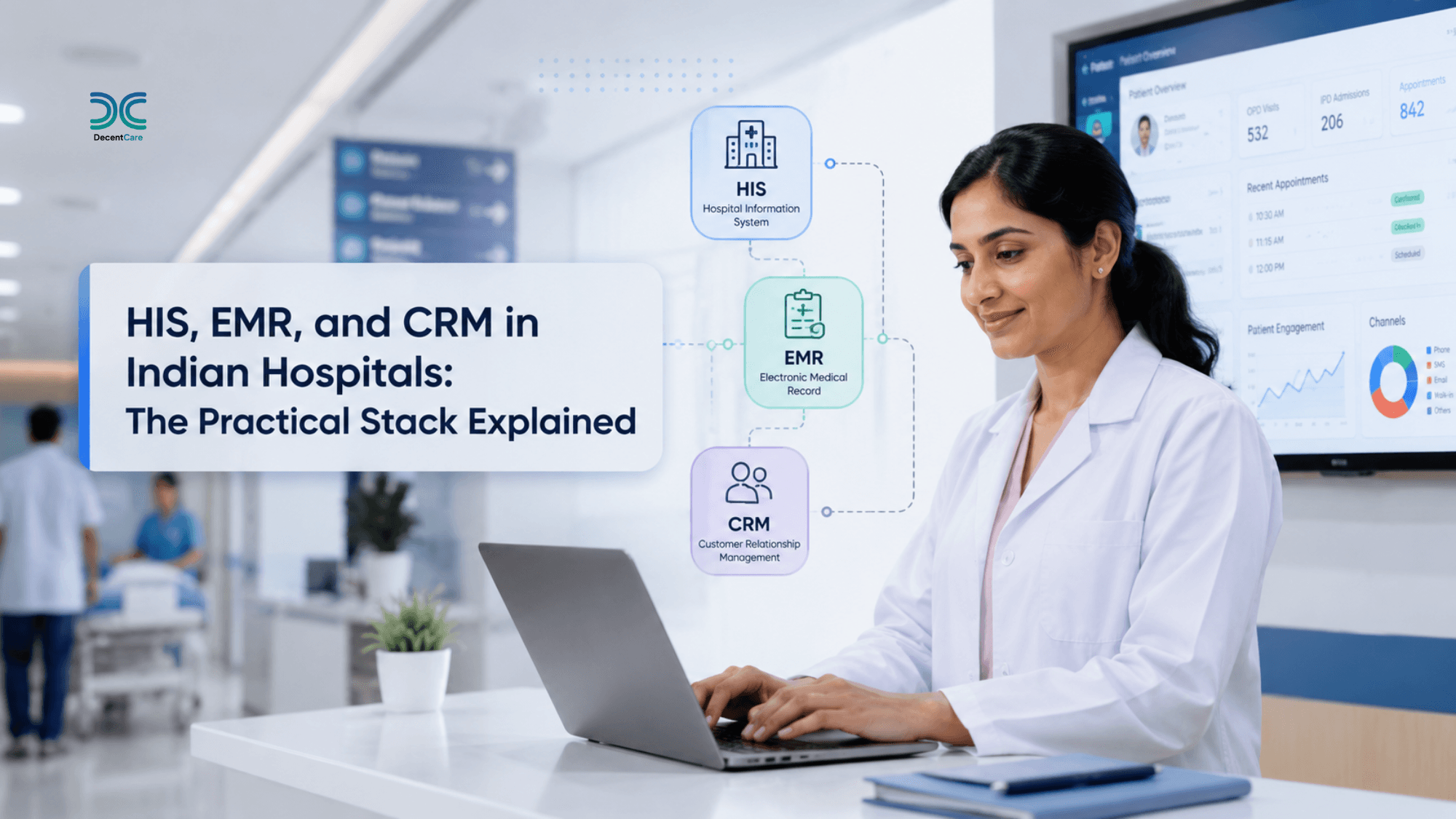
DecentCare is a behavioural intelligence platform that sits as a decision layer between the HIMS a clinic already uses and any CRM already in place. It adds the behavioural signal capture, intent reading, and case-lifecycle tracking that generic systems lack, working alongside existing operational tools rather than replacing them.
Is behavioural tracking compliant with Indian data protection rules?
Behavioural signal capture in India must follow the Digital Personal Data Protection Act, 2023, which requires clear, informed patient consent and purpose limitation. DecentCare is built for consent-based, forward-only capture, so clinics can act on patient behaviour without compromising patient trust.
Take the Next Step With DecentCare
Clinics that keep losing patients despite a fully used CRM are not failing at discipline. They are running a sales tool against a clinical relationship. DecentCare goes live in 48 hours with no IT team needed on the clinic side, and a dedicated Customer Success Manager walks the team through the first case cycle. Understand your patients, grow your hospital.

Creates reader-focused content that simplifies complex topics and delivers valuable insights across healthcare, publishing, and content development.