Patient Experience & Care Journeys
The Behavioural Intelligence Framework: A Layer-by-Layer Walkthrough for Hospitals
Paramraj
Read more 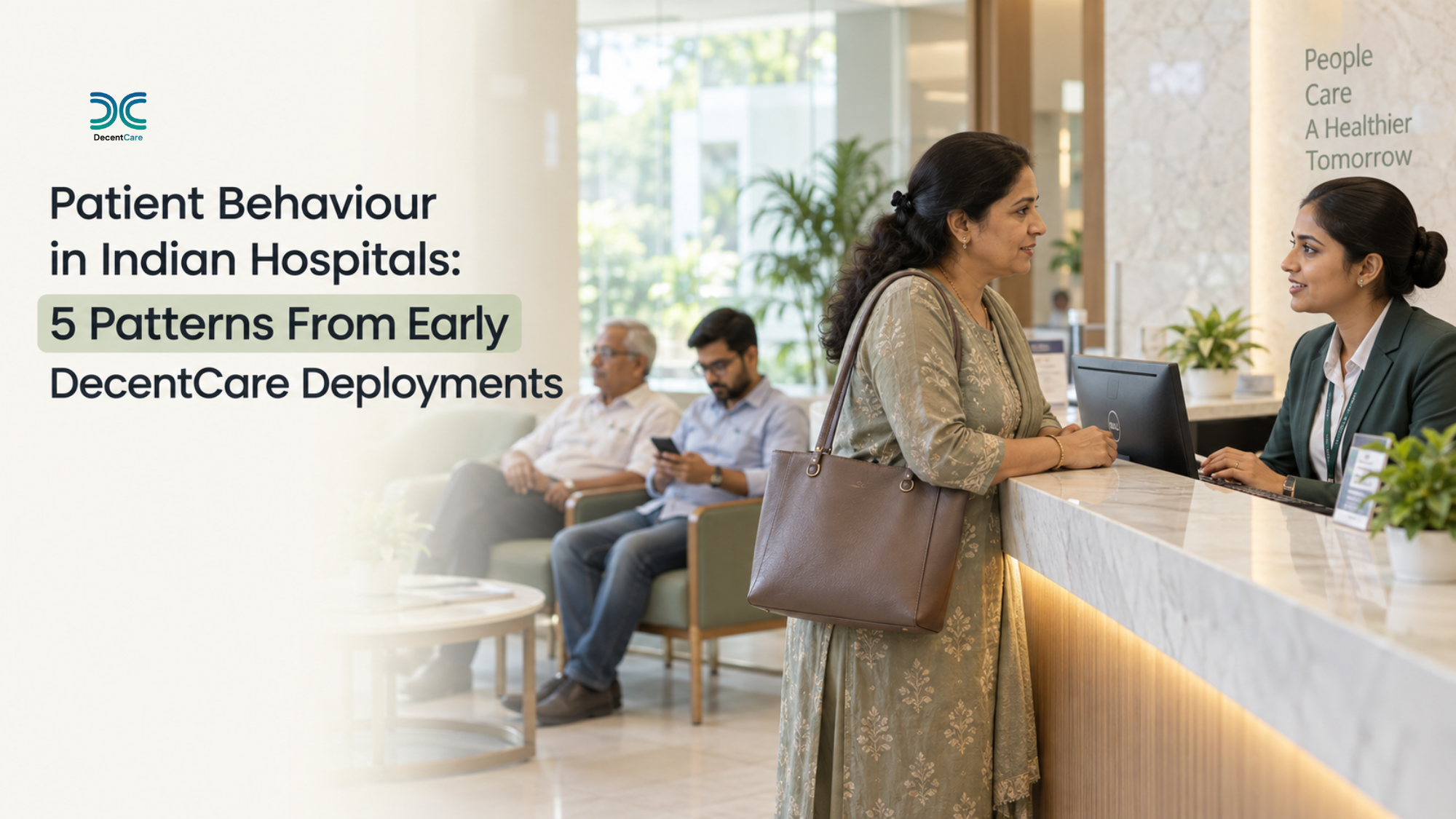


A patient enquiry is rarely the first signal. By the time a phone rings or a form is submitted, most Indian patients have already made several quieter decisions across search, WhatsApp, and word of mouth. Early DecentCare deployments across a handful of Indian clinics and small hospitals have begun to surface how this patient behaviour actually looks when it is finally visible in one place. What follows is a first read of five patterns that keep appearing across settings, and what they mean for a hospital trying to grow patient acquisition without adding staff.
DecentCare has been running as a behavioural intelligence platform inside a small set of Indian clinics and mid-size hospitals over recent months. The deployments span different settings and different departments, but the volume is deliberately modest and the observations here are pattern-level rather than statistical. The point is not to claim a national dataset. It is to name what recurs across settings that share little else in common, so hospital operators can test the same patterns against their own front desks and departments.
By the time a patient calls or messages, the hospital has usually collected several earlier signals it never registered as signals. A Google My Business tap, a treatment-page visit lasting three minutes, a WhatsApp click that never completed into a message, a form started and abandoned at the phone-number field. These sit inside the browser session, the Google Business profile, the marketing pixel, and the WhatsApp business inbox, but they never make it to the front desk. Across the early deployments, the recurring pattern is not that the signals are scarce. It is that they are scattered across systems that were never joined. Once these fragments are pulled into one behavioural timeline, front-desk teams see the same patient's earlier interest before they pick up the call, and the conversation shifts from cold to informed. The visibility is the fix. Nothing else needs to change.
Hospitals routinely track two counts: how many enquiries came in, and how many patients turned up. The middle stretch, from enquiry to confirmed appointment, is almost always invisible. Early deployments are showing that this is where the largest quiet drop-off sits. A patient calls, the receptionist says a doctor will call back, the callback happens or does not, the patient checks a second hospital in the meantime, and the enquiry goes cold within a day. No system flags this loss because no system was watching the transition. The pattern is consistent across clinics and small hospitals, and it is one of the clearest arguments for treating patient follow up as a system responsibility rather than a personal one owned by whoever happens to be at the desk that hour.
Front-desk teams often model an enquiry as a fresh decision: the patient called today, so the decision is being made today. The behavioural timeline says otherwise. Across the early deployments, the majority of patients who eventually converted had multiple earlier interactions with the hospital's digital presence spread over several days: a Google My Business search, a website visit, a comparison with one or two other options, sometimes a repeat visit before a phone call. Indian patients, particularly for planned procedures and chronic care, move through a considered patient journey. The implication is uncomfortable. The pitch a receptionist gives at first ring is often the tenth touch the patient has had with the hospital, not the first, and it should be pitched at that altitude.
When the front desk cannot see the patient's prior interactions, a patient who has read the treatment page three times, watched a testimonial reel, and initiated a WhatsApp chat looks the same as a first-time Google search click. Both receive the same generic response, and both are recorded as one enquiry. The pattern in early deployments is a levelling effect. High-intent patients get treated as low-intent ones, and low-intent patients get treated as high-intent ones. The consequence is not just conversion loss. It is a slow miscalibration of the whole front desk. Once the timeline is visible, the same team begins to prioritise correctly without new training, because the ordering is now obvious in the queue rather than left to the memory of whoever answered.
The pattern most consistent across settings has nothing to do with acquisition at all. After the visit ends, most Indian clinics and small hospitals go quiet. There may be a discharge summary, a follow-up date, a brief WhatsApp acknowledgment. Rarely is there a structured sequence that keeps the patient's next decision visible: the review that was never requested, the second consultation that was never booked, the referral that a satisfied patient never made because nobody asked. In deployment data, the quietest surface is the post-visit window, and it is also the surface that carries the largest untapped patient lifetime value. Retention in these settings is not a marketing problem. It is a workflow problem, and it is solved by the same behavioural view that solves acquisition.
Read together, the five patterns argue that patient acquisition in Indian hospitals is not primarily a spending problem or a marketing-creative problem. Most of the leakage sits inside behaviours the hospital already caused: enquiries it earned but did not connect, patients it saw but did not sequence, visits it completed but did not close a loop on. The signals were being produced all along. The gap was that no single surface was reading them together. Growth, in this reading, starts with unifying what has already happened before adding anything new to the top of the funnel.
A conventional hospital CRM is designed to move stages: enquiry to appointment, appointment to procedure, procedure to closed. It records that the stage changed. It does not read the behavioural signals that caused or prevented the change. When a patient hesitates for three days, when the third missed call is the deciding one, when a WhatsApp read-receipt is followed by silence, the CRM has no field for any of it. DecentCare is designed to sit beyond a hospital CRM as a behavioural layer that reads intent and readiness in the moments the CRM's fields cannot describe. The two are complementary, not competing.
Three internal components produce the observations above. OmniLens is the behavioural data layer. It stitches every interaction across web, calls, WhatsApp, and visits into one patient timeline, so a Google My Business tap and a partial form and a phone call are recognised as the same person's journey rather than three unrelated events. OmniJourney is the AI engine that reads the timeline for intent, scores readiness, and predicts drop-off before it happens, so the front desk sees which enquiries are hot and which are cooling. OmniCare is the patient journey CRM where coordinators, doctors, and counsellors see the same timeline and act on it: assigning follow-ups, closing loops, and triggering the right WhatsApp template at the right stage. The five patterns above are visible only because the three surfaces feed each other continuously.
It captures the full pre-consult and post-consult behavioural trail: Google My Business searches and taps, treatment-page visits, form interactions, WhatsApp messages, missed and answered calls, appointment stages, and post-visit contact. The signals are unified into one patient timeline so the hospital sees intent, hesitation, and readiness in the same view.
No. The five patterns described above were observed across both single-location clinics and small multi-branch hospitals. Smaller settings often benefit more, because their existing systems are lighter and the behavioural gaps are more consequential per patient. Nothing in the mechanism assumes a large IT team or a national footprint to become useful.
A conventional patient journey view records what stage a patient reached: enquiry, appointment, consultation. Patient behaviour records how they got there: which pages they read, which calls they missed, which messages they hesitated on. Stage tells the hospital where the patient is. Behaviour tells the hospital where the patient is going next.
A hospital CRM records stage transitions, not the behavioural signals that cause them. It knows an enquiry became an appointment. It does not know the patient checked a competing hospital in between. DecentCare sits beyond a hospital CRM as a behavioural layer that reads the intent signals a CRM was never designed to capture.
Early deployments have found that pattern-level visibility begins to emerge within the first few weeks, once WhatsApp, calls, Google, and web are all feeding one timeline. Individual patient behaviour is visible immediately. Recurring patterns need enough enquiries to be observable, which usually happens well within the first month of steady use.
The behavioural data DecentCare captures is scoped to signals the hospital already has consent for: form fills, WhatsApp opt-ins, tracked calls, and first-party website analytics. Everything sits inside per-hospital tenant isolation, hosted in AWS Mumbai, with encryption at rest and role-based access. The design is consent-first by architecture, not by afterthought.
The clearest sign is a growing gap between enquiries received and appointments confirmed, with no clear diagnosis of where the loss happens. If the front desk cannot tell high-intent patients from low-intent ones by the second interaction, unifying behavioural data almost always exposes a preventable pattern within the first week of operation.
Five patterns from a handful of early Indian deployments are not a rulebook. They are early signals, offered as observations to test against a hospital's own front desk. The through-line is quieter than the marketing conversation usually is: most of the acquisition and retention loss in Indian hospitals is already visible in signals the hospital produced. It just was not gathered in one place. To see how a behavioural view would look for a specific setting, book a 30-minute demo of DecentCare. Live in 48 hours, no IT team needed, built for Indian hospitals. Understand your patients, grow your hospital.

Creates reader-focused content that simplifies complex topics and delivers valuable insights across healthcare, publishing, and content development.