Hospital Marketing & SEO
Indian Healthcare Marketing in 2026: Where the Field Is Heading Next
Vamshi Kantoju
Read more 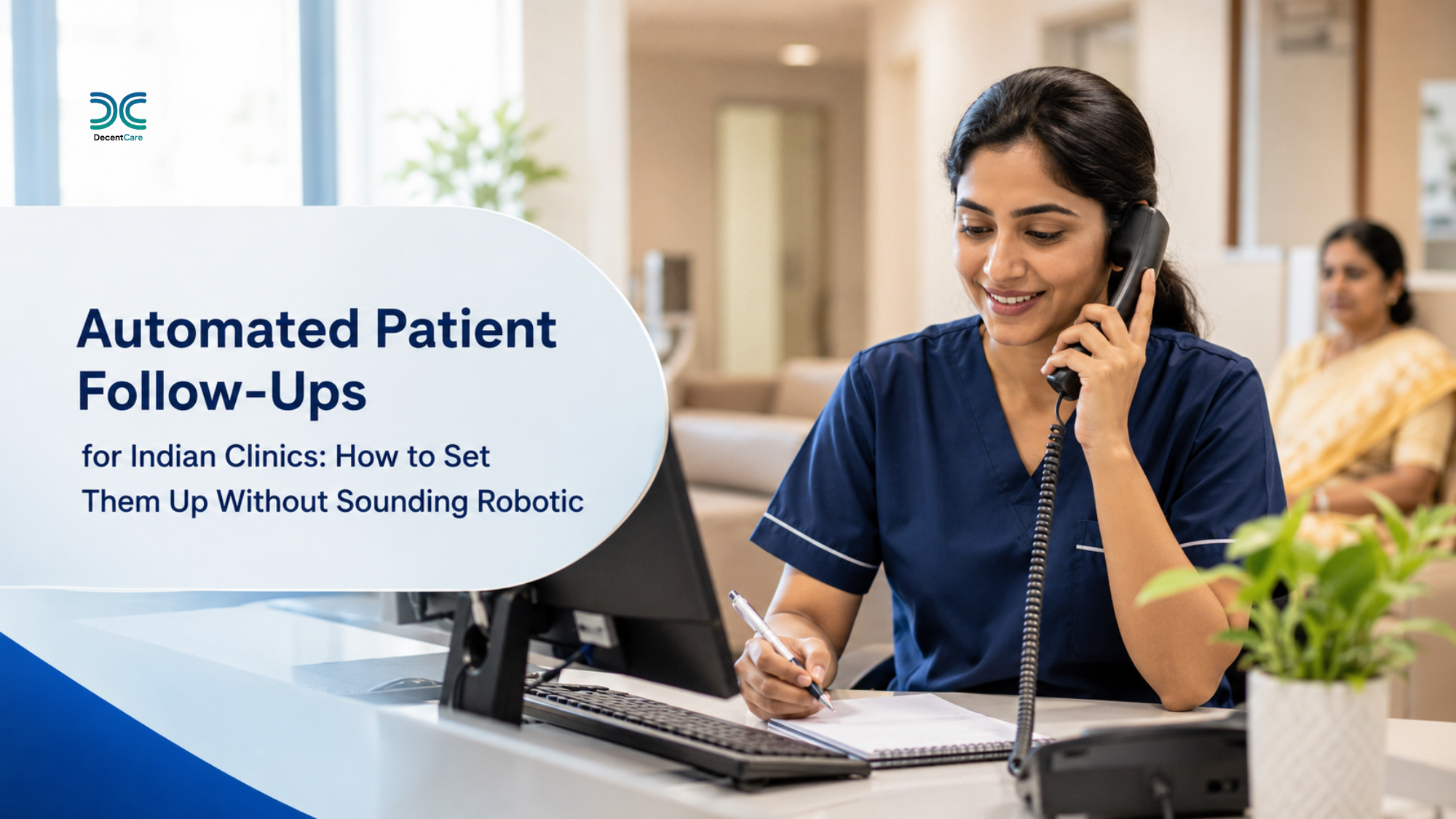


Automated patient follow-ups are a platform decision, not a writing decision. What separates a follow-up sequence that lands as human from one that reads as robotic is what the platform can see about each patient before it sends. DecentCare is a behavioural intelligence platform built for Indian hospitals and clinics that captures every signal a patient sends and triggers each follow-up from that signal, not from a fixed calendar. This piece explains what a follow-up automation platform actually does for a clinic, and how it keeps every message tied to what the patient has just done.
Automated patient follow-up is a platform capability, not a writing exercise. A follow-up automation platform watches every patient’s behaviour across the case lifecycle and sends the right message on the right channel at the right moment, without a coordinator having to remember which patient needs which touch this week.
That is very different from writing better templates or scheduling more reminders. Better templates and more reminders help a clinic get through more sends, but neither knows which patient is drifting, which one is ready to proceed, and which one has already asked the same question three times. A follow-up automation platform is what closes that gap.
At the level of what the clinic actually operates, three things have to work together. The platform has to see the signals a patient sends, decide what to do with them, and send the message. If any of those three is missing, the follow-up ends up as a broadcast.
A follow-up automation platform starts with the signal layer. Before it decides to send anything, it has to be able to see what the patient is actually doing across the case.
OmniLens, DecentCare’s behavioural data layer, turns every patient interaction across web, calls, WhatsApp and visits into one behavioural timeline for the case. When a patient sends a WhatsApp message on Tuesday, reads the treatment page on Wednesday and does not turn up on Thursday, OmniLens sees all three in one place, tied to the same patient, with the source of each event tagged. That single-timeline view is what the follow-up engine reads from.
The signals worth naming for a clinic follow-up platform include the channel and specific question a patient asked at enquiry; the interval between an appointment booking and the appointment itself, with reading and revisit patterns inside it; the outcome recorded at the end of a consultation (conservative, surgical, tests, referral); whether the patient has reviewed but not accepted a cost estimate; silence beyond a normal window for the case type; and whether post-treatment check-ins are being logged on time. Each of these is a case-level trigger, not a calendar trigger.
None of those signals live in a HIMS. A HIMS records medical history. A CRM chases deals. The signal layer that a follow-up platform depends on is what a behavioural intelligence platform captures, above the HIMS and beyond a hospital records system.
Reading signals is not enough. The platform has to decide what to do with them.
OmniJourney, DecentCare’s behavioural AI engine, scores the intent behind each patient’s signals and recommends the next best action for that specific case. Rather than "send day-3 message", the recommendation reads as "send content that answers the surgery FAQ", or "have a counsellor call this afternoon", or "hold silence, this patient responded strongly two days ago". The scoring is what turns a fixed schedule into a response system.
This is where the "sounding robotic" question is settled inside the platform. A platform that scores intent before it fires sends different messages to different patients in the same status, because the intent inside that status is different. Two patients in "consulted" can look identical in the case status but very different in the intent read. The platform sends each of them the message that reads what they actually just did. That is what makes an automated follow-up land as human, and it is not a copywriting choice; it is a signal-processing one.
The decision layer also handles restraint. Silence is a legitimate next best action for a patient who has already been messaged twice this week and responded strongly the last time. A schedule-only automation cannot make that call. An intent-aware one can.
The last piece of the platform is the send layer. Once the signal has been read and the next best action has been decided, the message has to leave the clinic and land in front of the patient, on the right channel.
OmniCare, the patient journey CRM, is where the send happens and where the team sees it happen. WhatsApp sends run through the WhatsApp Business Account using Meta-approved message templates that map to the case stage. SMS is available as a fallback where WhatsApp is not the right channel. Every send is logged on the same case timeline the coordinator, the counsellor and the doctor are already looking at, so the platform never fires twice from two different people, and the next person who opens the case reads the last three touchpoints in three seconds.
The clinic does not compose the message on the fly. The templates are Meta-approved, tied to case stage and channel policy, and the platform selects the right one for the trigger. What the clinic tunes is the trigger logic and the template inventory, not the wording of each send.
Most clinics track the status of a case (enquiry, appointment, consulted, treated, discharged) and hang messages off status changes. That structure sends messages, but it is not an automated follow-up platform. It is a status-triggered message queue.
The difference is what the platform can see inside a status. A generic CRM will move a case from stage to stage cleanly. It cannot tell whether the patient inside that stage is drifting, hesitating, or ready to proceed. A behavioural intelligence layer that sits beyond a clinic CRM is what makes intent visible inside every status, which is what turns a status-triggered message queue into an intent-aware follow-up platform.
Nothing about this replaces the clinic’s HIMS. Records still record. The follow-up platform runs on top and does what the records system was never designed to do.
The first change is that silent cases become visible. The single biggest source of patient loss in most clinics is not an angry patient. It is the patient who went quiet and no one noticed. A platform that reads silence as a signal is one that catches these cases before the patient is gone for good, which is where the full patient journey breaks or holds together.
The second change is that the team stops rebuilding the case from memory. The most common source of "why did we not follow up on that patient" conversations in clinics is that a message went out from one person, a reply came in on a different channel, and nobody joined the two. With a shared case timeline, everyone reads the same case.
The third change is that response rates rise and opt-outs fall. A platform that fires by signal sends fewer messages overall, but each one maps to what the patient just did, which is the difference between a reply and a swipe.
The fourth change is that follow-up becomes something the clinic can measure as a discipline, not just a message send count. A follow-up platform tracks which triggers produced which responses, which triggers produced silence, and where cases dropped out of the sequence. That is what turns follow-up from a routine chore into something the clinic can improve week over week.
What is an automated patient follow-up platform?
An automated patient follow-up platform is a system that watches every patient’s behaviour across the case lifecycle and triggers the right message at the right moment. It is not a template library or a reminder scheduler. It is a signal-and-decision layer that sends WhatsApp, SMS or voice messages in response to what the patient just did.
What does the platform watch to decide when to send a message?
It watches signals across the case: the specific question asked at enquiry, revisit patterns before an appointment, the outcome after a consultation, whether a cost estimate has been reviewed, silence beyond a normal window, and post-treatment check-in activity. Each signal maps to a different follow-up, so no two patients get the same sequence by default.
How is an automated follow-up platform different from a scheduled reminder cadence?
A scheduled cadence sends messages at fixed intervals from an event, and every patient receives the same sequence. An automated follow-up platform reads what the patient has been doing between events and adjusts the next send accordingly. Reminders that read intent are one part of the discipline; the platform is what makes that discipline operational.
Does the platform write the follow-up messages?
No. The messages are Meta-approved WhatsApp templates and standard SMS templates, tied to case stage and channel policy. The platform selects the right template for the trigger and sends it. What the clinic tunes is the trigger logic and the template inventory, not the wording of each send.
Can WhatsApp handle personalised follow-up sends for a clinic?
Yes, through the WhatsApp Business Account and Meta-approved message templates. WhatsApp beats email cleanly on open rates in India and supports two-way conversation, which is what makes it the primary channel for OmniCare sends. Reply threads sit inside the same case timeline the team is already using.
Does DecentCare replace the clinic’s existing HIMS?
No. The HIMS continues to hold clinical records, prescriptions, billing and medical history. DecentCare sits above the HIMS as a behavioural intelligence platform, capturing what the HIMS does not (searches, calls, messages, hesitations and drop-offs) and turning those signals into follow-up actions. Both systems keep doing their own job.
How quickly can a clinic go live with an automated follow-up platform?
DecentCare is designed to go live in 48 hours, with no IT team needed on the clinic side. A dedicated Customer Success Manager sets up departments, doctors and branches and links WhatsApp. Staff get a role-by-role walkthrough. The first real patient is managed from day three onwards, with the KPI dashboard already live.
The one line to hold onto
Automated patient follow-ups are a platform decision. The follow-ups that land as human are the ones triggered by a platform that watches what each patient is doing, decides on the right next action for the case, and sends the right template through the right channel. The wording of the message matters. The platform underneath it matters more.
To see how this works in practice, book a 30-minute demo. Live in 48 hours, no IT team needed. Understand your patients, grow your hospital.

Creates reader-focused content that simplifies complex topics and delivers valuable insights across healthcare, publishing, and content development.