Hospital Marketing & SEO
Indian Healthcare Marketing in 2026: Where the Field Is Heading Next
Vamshi Kantoju
Read more 


Marketing and operations in an Indian hospital work from two different views of the same patient. Marketing sees enquiries, source attribution and campaign spend. Operations sees consults, procedures and outcomes. In most hospitals, the data marketing collects on the patient never reaches operations, so operations meets every enquiry as a stranger and restarts qualification from zero. That is the marketing and operations handoff, and it is where a great deal of hospital revenue disappears every week without anyone noticing.
The marketing and operations handoff is the moment an enquiry stops belonging to the marketing function and starts belonging to the operations floor. Marketing owns everything upstream of that moment: the website visit, the treatment page dwell, the click on a Google ad, the WhatsApp message, the phone call to the enquiry desk. Operations owns everything downstream: the appointment booking, the pre-OPD form, the consult, the counselling session, the admission and the procedure. In most Indian hospitals the handoff is treated as a data-transfer step, a patient name, a phone number, a treatment interest tag and a source label. DecentCare treats the same handoff as a signal transfer, because the behavioural context marketing already collected about that patient is worth more than the demographic fields typed into the CRM.
The two functions have very different views of the same patient. Marketing knows what the patient searched for, how many times they returned to the website, which treatment page they read the longest, whether they left an enquiry and abandoned it, and how long it took them to accept a callback. Operations knows what the patient was diagnosed with, what the doctor said, what the counsellor quoted, and whether the procedure was accepted. Those two views should be one continuous case history, best understood as a behavioural patient timeline. In practice, the handoff strips out the behavioural view and passes on the operational one, and DecentCare exists to prevent that stripping.
Marketing collects behavioural data by default, because every ad platform, every website analytics tool and every WhatsApp Business API is designed to record what the patient does before they identify themselves. Operations software is designed around what the patient tells the doctor after identifying themselves. The two systems record different things and speak different languages. The marketing view is behavioural: intent signals, touch counts, treatment interest, source attribution, drop-off points. The operations view is clinical: vitals, complaints, diagnosis, prescription, procedure, discharge. DecentCare exists because those two views describe the same patient and should sit on the same timeline.
The framing is worth stating plainly. Clinical systems capture medical history. DecentCare captures decision history. Marketing owns the front half of the decision history, but has no place to hand it to; operations receives the back half, the clinical facts, and starts from a data-poor moment on a patient who was in fact well known to the marketing side hours or days earlier. This is not a data-transfer failure at the field level, it is a category mismatch. The marketing and operations handoff breaks in an Indian hospital because the two functions record different kinds of truth about the same patient and there is no shared surface where both can be read together, which is exactly the gap DecentCare fills.
These are the five behavioural signals a marketing team already has on every patient before the operations floor meets them. DecentCare surfaces all five on a single patient journey timeline so operations inherits them by default rather than by heroic manual note-passing.
First, treatment interest: which treatment the patient is exploring, read from what they browsed, what they asked on the call, and what they typed into the enquiry form. Second, intent strength: how serious the patient is, read from depth of engagement across visits, calls and messages. Third, source attribution: which marketing channel or campaign actually brought the patient, distinguished from the last-click that gets credit in a generic CRM. Fourth, interactions: how many touches happened before the patient enquired, and where those touches occurred. Fifth, drop-off points: where the patient hesitated, went quiet and came back, and where they gave up entirely.
Every one of these signals is available to marketing by the time the enquiry is captured. Every one of them changes how the operations team should approach the consult, the counselling and the follow-up. In hospitals without a shared behavioural layer, none of them travel across the handoff, so the operations team runs the case as if the patient walked in cold, and DecentCare is built so none of the five is lost between the two functions.
There are five specific failure points DecentCare consistently sees in Indian hospitals. Each one is worth naming, because it is easier to fix a named failure than a vague sense that the handoff is inefficient.
The first is context loss at capture. The enquiry desk records the patient name, phone number and treatment interest. Every behavioural signal marketing has on that patient is left in the marketing tool and never enters the operations system. The second is delayed contact. Marketing captures an enquiry at nine at night; the operations telecaller sees it the next morning; by then the patient has already spoken to another hospital, and the front desk to CRM handoff has broken before the case was ever opened. The third is misrouted assignment. The case is assigned to a coordinator by round-robin rather than by the treatment interest and intent already visible in the marketing signals. The fourth is duplication. The patient enquires twice on two different channels, and operations opens two cases because the second enquiry looks like a new patient. The fifth is quiet drop-off between marketing capture and operations first response, where the patient shows readiness on the marketing side, hears silence for hours, and moves on. Every missed signal is a patient a competing hospital gets.
These five failure points sit above the hospital information system, and are the reason a standalone CRM cannot close the gap. The HIMS is designed to record what happens once the patient is inside the hospital. A CRM is designed to track deal stages. Neither is built to preserve behavioural context across the marketing and operations boundary. That is why the handoff breaks even in Indian hospitals that have both systems well installed, and why DecentCare adds the signal layer neither of them carries.
The common reflex when the marketing and operations handoff breaks is to install a CRM between the two functions or to bolt the marketing team into the existing hospital CRM. This is the wrong fix, and DecentCare's positioning is built precisely around why. A CRM tracks status, meaning new enquiry, contacted, appointment booked, consulted, procedure scheduled, closed. Status is what the operations floor already knows. What the handoff is missing is not more status tracking but intent-aware tracking, the read on what each patient is about to decide next, which is a different discipline from why healthcare CRMs fail to move Indian hospitals forward on their own.
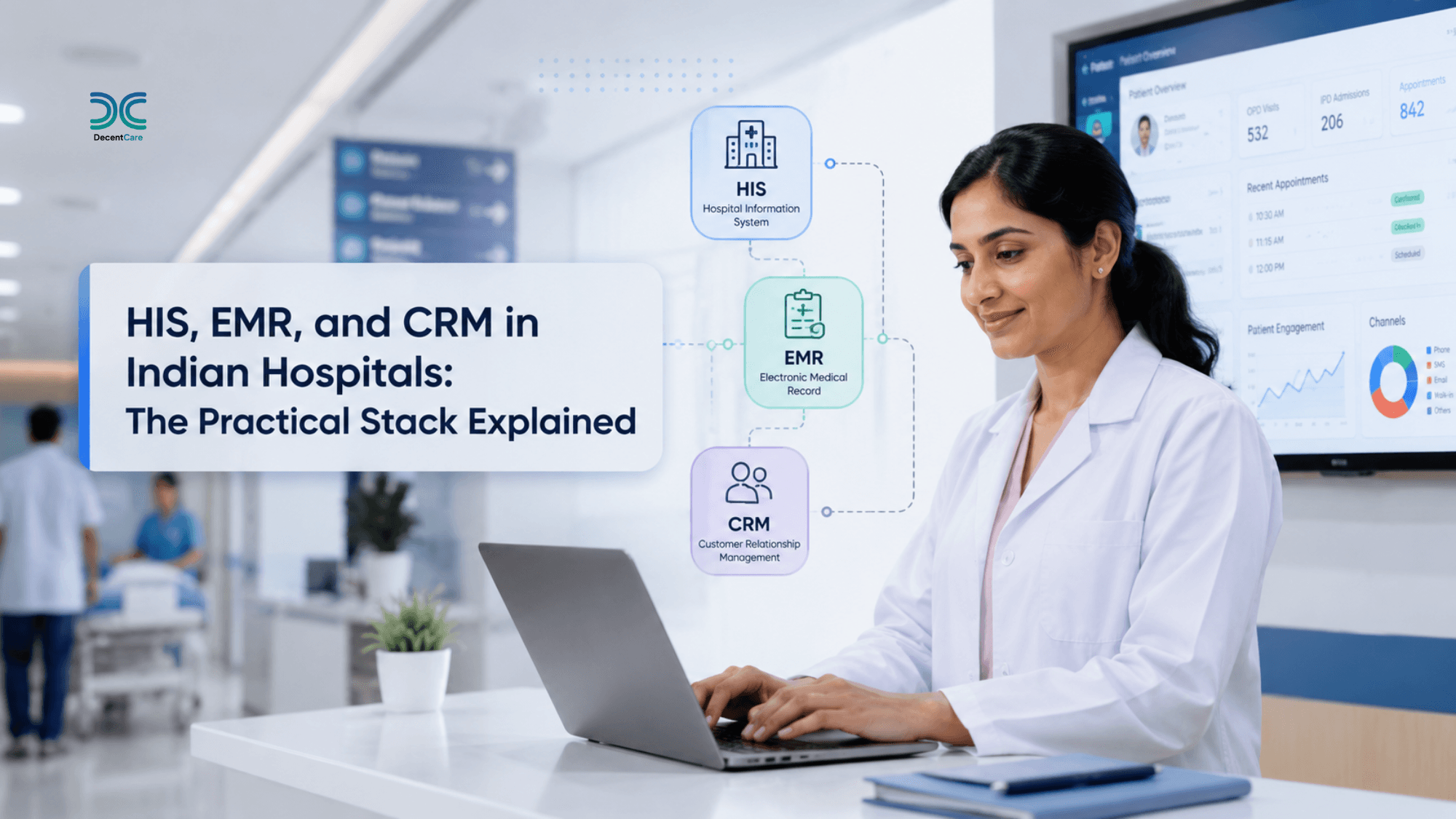
Visibility into what each patient is about to decide, not speed of data transfer, is what closes the handoff in an Indian hospital. Two hospitals can move the same fields across the same handoff at the same speed, and one will still convert twice as many enquiries as the other because it can see intent while the other can only see status. This is where behavioural intelligence sits beyond a hospital CRM. A CRM is a container of records; a behavioural intelligence platform is a reader of signals. The two are not competitors. OmniCare inside DecentCare is itself a patient journey CRM, so the record-keeping surface is preserved, and hospitals that want the full picture of the practical software stack can read the deeper argument in the HIS, EMR and CRM stack piece. What sits above the CRM component is the layer that reads the marketing-side signals, scores intent in real time, and hands the operations team a next best action instead of a blank status pill.
DecentCare closes the handoff by keeping one behavioural timeline per patient, read by both functions from the same case. The platform has three internal modules that operate as one motion: OmniLens, OmniJourney and OmniCare. They are architectural layers of DecentCare, not separate tools the hospital has to stitch together.
OmniLens is the behavioural data layer. It watches every marketing-side interaction, the web visit, the treatment page, the Google My Business tap, the ad click, the WhatsApp message, the missed call, the form submission, and turns each one into a signal on a single patient timeline. Source attribution, treatment interest, intent strength and drop-off points all live in OmniLens, and they persist as the case moves downstream into operations. The marketing team reads them; the operations team reads the same ones. This is the layer where the enquiry-to-appointment conversion funnel stops being two separate funnels and becomes one continuous timeline.
OmniJourney is the behavioural AI engine. It reads what OmniLens captured and places each patient on the journey stage they are actually at, from researching to ready to proceed. It scores intent, flags drop-off before it happens, and recommends the next best action for that specific case, whether that is a piece of content, a call, a counselling touch, or a nudge. This is the layer that turns the marketing-side signals into an operations-side instruction. A coordinator opening a case sees not a name and a phone number but a scored, staged, next-action-ready view of a patient the platform already knows.
OmniCare is the patient journey CRM. It is where coordinators, telecallers, counsellors and doctors act on the intelligence. Every marketing signal is already on the case timeline; every next best action is already suggested; every touch the operations team makes writes back into the same timeline the marketing team reads from tomorrow. This is behavioural intelligence sitting above the hospital information system and beyond a hospital CRM, preserving the CRM surface (OmniCare is one) while adding the signal layer a standalone CRM does not carry.
When the operations floor inherits the behavioural context marketing already collected, three things change at once in a hospital running on DecentCare. The first change is response quality. The coordinator opening a case knows the patient's treatment interest, source and intent score before they dial. There is no cold read of the enquiry form, no chart-hunt before the callback. The second change is routing quality. Cases are assigned based on treatment interest and readiness, not round-robin. A patient with high intent on a surgical treatment reaches a senior counsellor first; a patient at the research stage on an outpatient consult reaches an information touch, not a hard-sell call. The third change is retention discipline. Post-visit follow-ups are shaped by the same behavioural timeline that captured the enquiry: the platform reads whether the patient is engaging, hesitating or going quiet, and shapes the next touch to match.
The wider hospital-level change is that marketing spend can finally be judged by treated patients, not by clicks or enquiries. When every case carries source attribution across the handoff, the finance office can trace revenue back to the specific campaign that brought the patient in. That is a different conversation from the standard cost per lead debate Indian hospitals get stuck in, and DecentCare has argued elsewhere why the hospital marketing metrics that matter sit beyond cost per lead. Closing the marketing and operations handoff is what makes that different conversation possible in the first place.
The fix for the marketing and operations handoff is sequenced, not switched on all at once, and DecentCare recommends a sequence that respects how Indian hospital operations teams actually adopt new tools. The first step is to make marketing-side signals visible on the same surface the operations team already works on, so behavioural context stops being trapped in the marketing tool. The second step is to remove the round-robin assignment logic and let the platform's intent score drive routing for a defined slice of the enquiry base, so the operations team can compare handled and platform-routed cases side by side. The third step is to extend the same behavioural timeline into post-visit follow-ups and reactivation, so retention runs on the same signal layer the acquisition side runs on.
DecentCare is designed to sit above an existing hospital information system and to read the marketing tools the hospital already runs, which is why it typically goes live in a hospital in 48 hours without an IT team. Sequencing is not a technical constraint, it is a change-management choice about which team learns to read the new timeline first and which case types are routed first through the new logic. The hospital that sequences well finishes the first quarter with marketing and operations reading one case, not two.
It is the moment an enquiry stops belonging to the marketing function and starts belonging to the operations floor. Marketing owns the ad, the search visit, the WhatsApp enquiry and the phone call. Operations owns the booking, the consult, the counselling and the procedure. The handoff is where those two views of the same patient must connect.
The two functions record different kinds of data on the same patient. Marketing captures behavioural signals: treatment interest, intent strength, source, drop-off. Operations captures clinical facts: vitals, diagnosis, prescription, procedure. When the handoff strips out the marketing view, operations meets the patient as a stranger and restarts qualification from zero on someone the platform already knows.
A hospital CRM tracks status but does not read behavioural signals, so it holds the operations view and misses the marketing view. Fixing the handoff with more status tracking adds another record surface, not a signal layer. DecentCare is a behavioural intelligence platform that sits beyond a hospital CRM, with a patient journey CRM (OmniCare) inside it.
Five signals matter most: treatment interest, intent strength, source attribution, interaction count, and drop-off points. Each one changes how the operations coordinator, counsellor or doctor should approach the case. All five are available to marketing at the moment the enquiry is captured, and all five should travel across the handoff on a single case timeline read by both functions.
OmniLens captures marketing-side signals on a single patient timeline. OmniJourney reads the timeline, scores intent, and recommends a next best action, whether content, a call, counselling or a nudge. OmniCare is where the operations team acts on that intelligence. The three modules work as one motion: signals become intelligence, intelligence becomes an assigned task.
No. DecentCare is a behavioural intelligence layer that sits above the hospital information system and beyond a hospital CRM. The HIMS keeps recording clinical facts; the CRM component (OmniCare) keeps the record surface for the operations team; DecentCare adds the missing signal layer that reads what each patient is about to decide next, so both functions see one case.
DecentCare typically goes live in 48 hours without an IT team, and a dedicated customer success manager sets everything up. The first slice of behavioural context, source attribution and intent scoring, is visible on operations dashboards from day one. Routing and post-visit follow-up shaping are added in sequence over the first few weeks.
The marketing and operations handoff in an Indian hospital is not a data-transfer problem, it is a category problem. Marketing captures decision history; operations captures medical history. The two describe the same patient and belong on the same timeline. Fixing the handoff means adding a behavioural intelligence layer both functions read the same case from, not installing another CRM that only tracks status. To see how DecentCare closes the marketing and operations gap on a live hospital account, book a 30-minute walkthrough. Every hospital goes live in 48 hours, no IT team is needed, and a dedicated customer success manager sets everything up in the first month. Understand your patients, and grow your hospital.

A healthcare marketing professional with 6 years of experience in developing patient acquisition strategies, managing digital marketing for hospitals and clinics, and creating patient-focused content. Focused on helping healthcare organisations reach the right patients, improve patient engagement, and support sustainable growth through healthcare SEO, content marketing, and compliant digital campaigns.