Hospital Marketing & SEO
Indian Healthcare Marketing in 2026: Where the Field Is Heading Next
Vamshi Kantoju
Read more 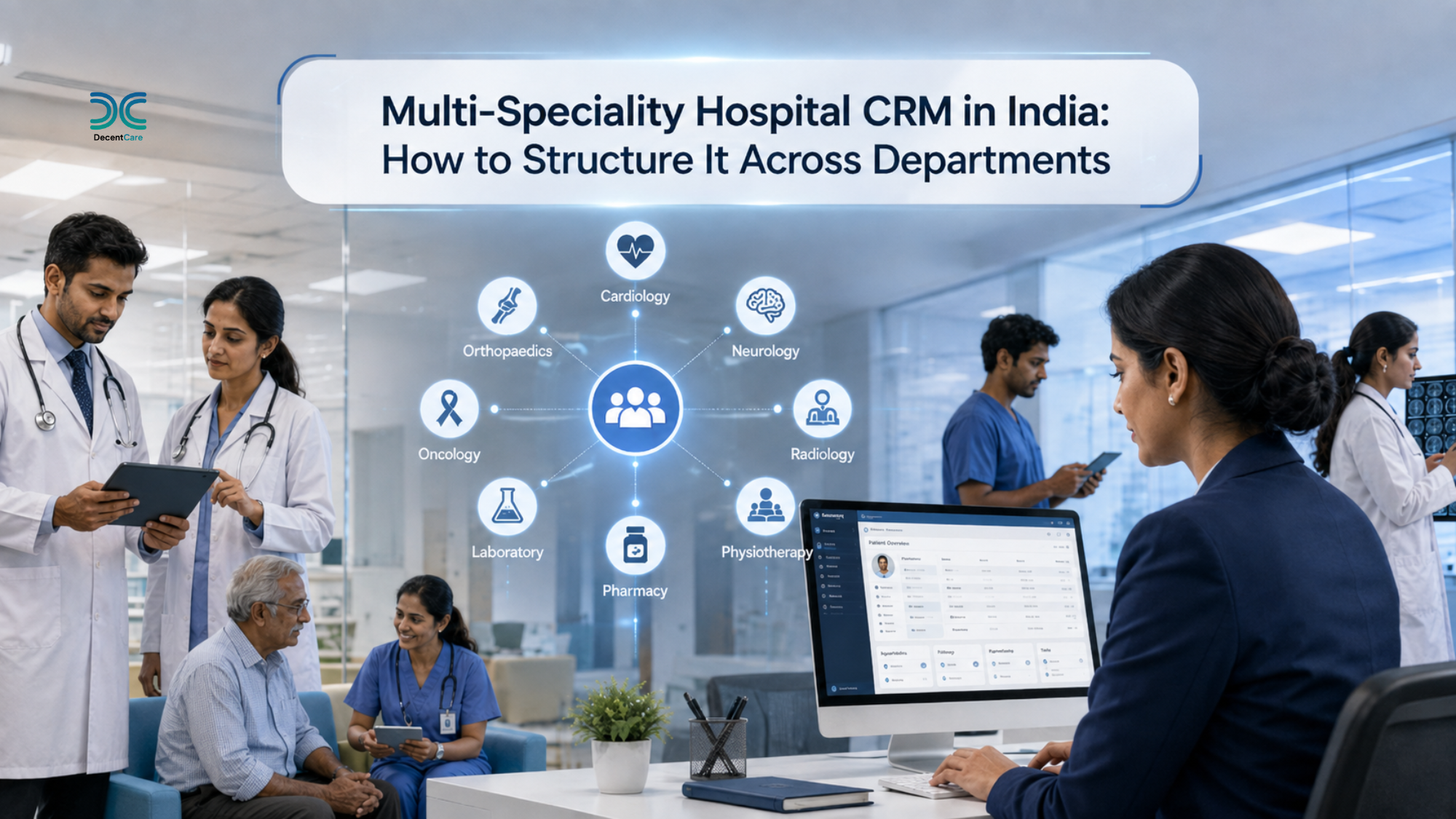


A multi-speciality hospital CRM built as a stack of department pipelines is not a multi-speciality CRM at all. It is several single-speciality CRMs sharing a login. In an Indian multi-speciality hospital, the same patient often moves between departments, and a CRM structured department by department loses that patient at every handover. This article sets out how a multi-speciality hospital CRM should actually be structured: what data belongs to the patient rather than to any single department, how permissions should work, how the journey should be modelled, and how intent should be read across specialties rather than inside them. DecentCare, a behavioural intelligence platform built for Indian hospitals, is the reference point throughout.
Structure in this context is not the shape of the vendor's software. It is how the hospital's own data and workflows are organised inside the CRM after installation. The question is not which multi-speciality hospital CRM to buy. It is: once the CRM is live, how are patients, departments, journey stages, permissions and reporting laid out so that a real multi-speciality operation gets the growth benefit of being multi-speciality? DecentCare treats this as a first-order design question rather than an implementation detail, because the wrong structure quietly caps the hospital's growth ceiling long after the CRM is switched on.
A single-speciality clinic can get away with an unstructured CRM. A multi-speciality hospital cannot. The reason is that cross-specialty patient flow is not an edge case in a multi-speciality hospital; it is the point. Cardiology enquiries become endocrinology cases. Ortho consultations lead to physiotherapy follow-ups. A gynaecology patient's spouse becomes a urology patient. A CRM that does not model these flows explicitly is a CRM that undercounts its own hospital's revenue.
A department-by-department CRM structure fails because the patient does not move department by department. The patient moves as one person with one accumulating history. When each department carries its own pipeline, its own enquiry form, its own coordinator and its own follow-up cadence, the same patient appears three or four times inside the same CRM as three or four separate records, each starting from scratch. The counsellor in the second department does not see the first department's conversation. The billing side does not see that the patient has already been through a financial counselling session under a different specialty. The follow-up sequence resets. The referral vanishes.
The operational cost of this structure is not visible in any single case. It surfaces in the aggregate: the marketing head cannot tell which enquiry source becomes a multi-department patient, because attribution stops at the first department. The consultants cannot see which specialties refer to which, because the referral chain is expressed as separate records rather than one journey. The financial counsellor cannot see a patient's affordability profile across departments. The front desk repeats the same intake questions to the same patient three months apart. The hospital forfeits growth that is genuinely there but never surfaces, because the CRM structure treats each department as a stand-alone shop rather than as part of the same hospital.
This failure mode is not a defect in any particular vendor. It is inherited from generic sales-CRM DNA, where each pipeline belongs to a sales rep or a team, and cross-team handoffs are the exception rather than the rule. In a multi-speciality hospital, cross-department handoffs are not the exception. They are half the reason the hospital is multi-speciality in the first place. DecentCare treats the patient as the primary entity and the department as one dimension of that patient's context, which is the inverse of the sales-CRM shape.
A multi-speciality hospital CRM must be structured across five axes, not five features. These are organisational choices about how the CRM's data model, permissions, journey stages, intent signals and cross-departmental entities are laid out. Get these five axes right and the CRM behaves like a real multi-speciality platform; get them wrong and the CRM behaves like several single-speciality CRMs sharing a database. DecentCare's design across OmniLens, OmniJourney and OmniCare is built around each of these axes.
One patient timeline that spans every department
The patient is the primary record; the department is an attribute of each interaction inside that record. Every enquiry, call, WhatsApp exchange, appointment, consultation, procedure and follow-up sits on one timeline that belongs to the patient, not to the department that captured the interaction. When the patient shifts from cardiology to endocrinology, the endocrinology consultant opens the same timeline the cardiology team has been working with, with the earlier history visible in context. Nothing restarts.
Departmental permissions, not departmental data silos
Departments do need boundaries, but those boundaries belong to the permission layer, not the data layer. Cardiology should not see the gynaecology consultation notes by default; the financial counsellor in a paediatric case should not see the psychiatric consultation history. These are permission questions, resolved by role-based access. They are not reasons to split the patient's timeline across separate data records. In DecentCare, the timeline is one entity; the view of it is filtered by role, department and consent scope.
Journey stages defined by the patient's decision, not the department's process
Every department has a workflow: enquiry, appointment, consultation, procedure, recovery. A CRM structured around each department's workflow produces as many pipeline definitions as there are departments. The alternative is to define the journey stages once, at the hospital level, in terms of what decision the patient is making: exploring, comparing, ready to consult, ready to proceed, in care, in recovery, returning. Departments layer their process on top of this stage model rather than replacing it. This is what makes cross-department reporting coherent.
Intent scoring read across specialties
The intent to proceed with treatment is a patient property, not a department property. A patient researching a knee surgery might also be quietly exploring cardiac risk before the anaesthesia clearance. A patient consulting for diabetes might be a warm intent for an ophthalmology referral because diabetic retinopathy is the next step in that journey. Intent read specialty by specialty misses these signals. Intent read across specialties surfaces them. DecentCare's OmniJourney scores intent at the patient level, then surfaces the specialties for which that intent is most actionable, rather than the reverse.
Cross-departmental referrals and financial counselling on the same surface
Referrals between departments are the single largest source of multi-speciality revenue that leaks in a badly structured CRM. If the cardiology consultant refers the patient to endocrinology and the referral lives as a note in a chat window rather than as a first-class record on the patient's timeline, the endocrinology coordinator has no queue, no follow-up cadence, no attribution back to the referring consultant and no visibility for the marketing head. The same applies to financial counselling: a patient counselled once for a surgical procedure carries an affordability profile that should be visible in every subsequent department without repeating the assessment. Both belong on the patient timeline as structured records, not as free-text notes.
DecentCare provides multi-speciality structure through three modules that together form one behavioural loop rather than three separate systems. OmniLens is the behavioural data layer. It captures every patient interaction across web, calls, WhatsApp and in-person visits, and threads them onto a single timeline that belongs to the patient. Whether the first interaction is a cardiology page view or a paediatric enquiry call, subsequent interactions across other specialties merge into the same record rather than creating parallel records. Treatment interest, intent strength, source attribution, drop-off points and readiness signals are all read against the patient, not the department, so that a multi-speciality hospital sees the same patient's activity across departments in one view.
OmniJourney is the behavioural AI engine. It reads the signals OmniLens captures and scores each patient's intent, predicts drop-off before it happens and recommends the next best action. In a multi-speciality context, this means the next best action can be a referral into a different specialty when the timeline says the patient's intent has shifted, not just a follow-up on the specialty that first captured the enquiry. Journey stage sits at the patient level; specialty-specific processes layer on top rather than replacing the stage.
OmniCare is the patient journey CRM. It is the surface where department coordinators, consultants, nurses, financial counsellors and administrators work. Every role sees the same underlying patient timeline, filtered by the role's permissions and the department's scope. Cross-department referrals appear as first-class records on the timeline with queues, cadences and attribution. Financial counselling outcomes carry across specialties without being repeated. Follow-ups are owned at the patient level, not the department level, which is why nobody is forgotten when a case moves between departments.
A conventional multi-speciality hospital CRM tracks status: which department has the case, which stage the case is in, who owns it today. Status is useful for logistics and load balancing, but it is a department-side artefact. Intent is patient-side. The patient's intent to proceed does not change because the case moved from cardiology to endocrinology; the intent is the same signal expressed in a different specialty. A CRM that tracks status without tracking intent shows the front desk what is happening operationally but does not show the marketing head or the administrator which patients are actually growing revenue and which are drifting away.
DecentCare's structure carries both status and intent on the same timeline. OmniCare has stages, and each stage is read through intent. This is what it means to go beyond a hospital CRM without abandoning the discipline of stages that a real multi-speciality operation requires.
Four things change once the CRM is structured around the patient rather than the department. Cross-specialty growth becomes visible: the marketing head can see, for the first time, which enquiry sources become multi-specialty patients rather than single-visit patients, and attribution stops collapsing at the first department. Referrals stop leaking at handoffs, because a referral is a record on the patient timeline, not a message that can be missed. Financial counselling stops repeating, because the affordability profile carries across departments. And the full patient journey is legible to the administrator, so decisions about where to invest in departmental capacity are based on real cross-departmental patient flow, not each department's siloed pipeline. DecentCare surfaces all four of these changes on the same dashboard.
Five questions surface whether a CRM has actually been structured for multi-speciality or is a rebadged single-department CRM. Ask to see one patient's full timeline across three departments, live, without opening separate records. Ask to see a referral between departments as a first-class record on the timeline, with attribution back to the referring consultant. Ask to see how intent is scored across specialties for a single patient. Ask to see a financial counselling outcome carry across from a surgical case to a subsequent unrelated case in a different specialty. Ask how quickly the platform goes live: DecentCare is live in 48 hours, no IT team needed, with a dedicated Customer Success Manager handling the configuration across departments.
If any of these demos cannot be produced without opening a spreadsheet or promising a future release, the CRM has been structured around departments, not around patients, and the multi-speciality growth benefit will not appear.
What is a multi-speciality hospital CRM?
A multi-speciality hospital CRM is the layer that captures every patient's enquiries, calls, WhatsApp messages, appointments, consultations and follow-ups across all departments and holds them as a single timeline. It is different from a HIMS, which records what happened clinically. DecentCare positions this layer inside a wider behavioural intelligence platform for Indian hospitals.
Why do department-by-department CRM structures fail in multi-speciality hospitals?
Because the same patient often moves between departments, and a CRM structured department by department creates a fresh record at every handover. The earlier department's history is not visible, the referral chain breaks, financial counselling repeats and marketing attribution stops at the first department. The multi-speciality growth benefit disappears because it is never captured in one place.
How is a multi-speciality hospital CRM different from a HIMS?
A HIMS records clinical events: diagnoses, prescriptions, billing, medical history. It answers what happened. A multi-speciality hospital CRM captures pre-clinical and post-clinical behaviour across all departments: enquiries, calls, decisions, drop-offs, follow-ups, referrals. It answers what a patient is about to decide. DecentCare sits above the HIMS as a behavioural layer.
Is DecentCare a multi-speciality hospital CRM?
DecentCare is a behavioural intelligence platform built for Indian hospitals, with OmniCare as the patient journey CRM inside it. OmniCare is the surface a multi-speciality hospital uses to manage cases across departments, but the wider platform sits above the CRM layer and includes the behavioural data and AI engine that a generic CRM does not have.
Can each department keep its own workflow if the CRM is restructured this way?
Yes. Departments keep their own workflows through the permission layer and the department-scoped view. What changes is that the underlying patient timeline is shared. Departmental workflows layer on top of one patient record instead of creating parallel records. Cardiology's process runs alongside endocrinology's process, both against the same patient timeline in DecentCare.
How long does it take to go live?
DecentCare is live in 48 hours, no IT team needed. A dedicated Customer Success Manager configures departments, doctors, branches and WhatsApp templates during the first three days. Role-by-role staff training runs on days four and five. The hospital manages its first real multi-departmental case from day five onwards, with a live KPI dashboard visible to the administrator.
How is patient data protected across departments?
DecentCare enforces tenant isolation at the data layer, field-level encryption at rest and in transit, and role-based access with nine configurable roles. Cross-department visibility is controlled by the permission layer, so consultants only see what their role and department scope allow. The platform is hosted on AWS Mumbai and aligned with DPDP, DISHA and ABDM requirements.
Conclusion
A multi-speciality hospital's growth ceiling is set less by the CRM the hospital chooses and more by how the CRM is structured after installation. Structured around departments, the CRM behaves like several single-speciality CRMs sharing a database, and the cross-specialty growth that multi-speciality was meant to unlock stays invisible. Structured around the patient, with departments as a permission and view layer on top, the CRM begins to show the referrals, cross-departmental cases and returning patients that were always there but never legible. DecentCare is built for exactly that shift.
To see how DecentCare structures a multi-speciality hospital CRM around the patient's cross-departmental journey, book a 30-minute demo. Live in 48 hours, no IT team needed. Understand your patients, grow your hospital.

Creates reader-focused content that simplifies complex topics and delivers valuable insights across healthcare, publishing, and content development.