Hospital Marketing & SEO
Indian Healthcare Marketing in 2026: Where the Field Is Heading Next
Vamshi Kantoju
Read more 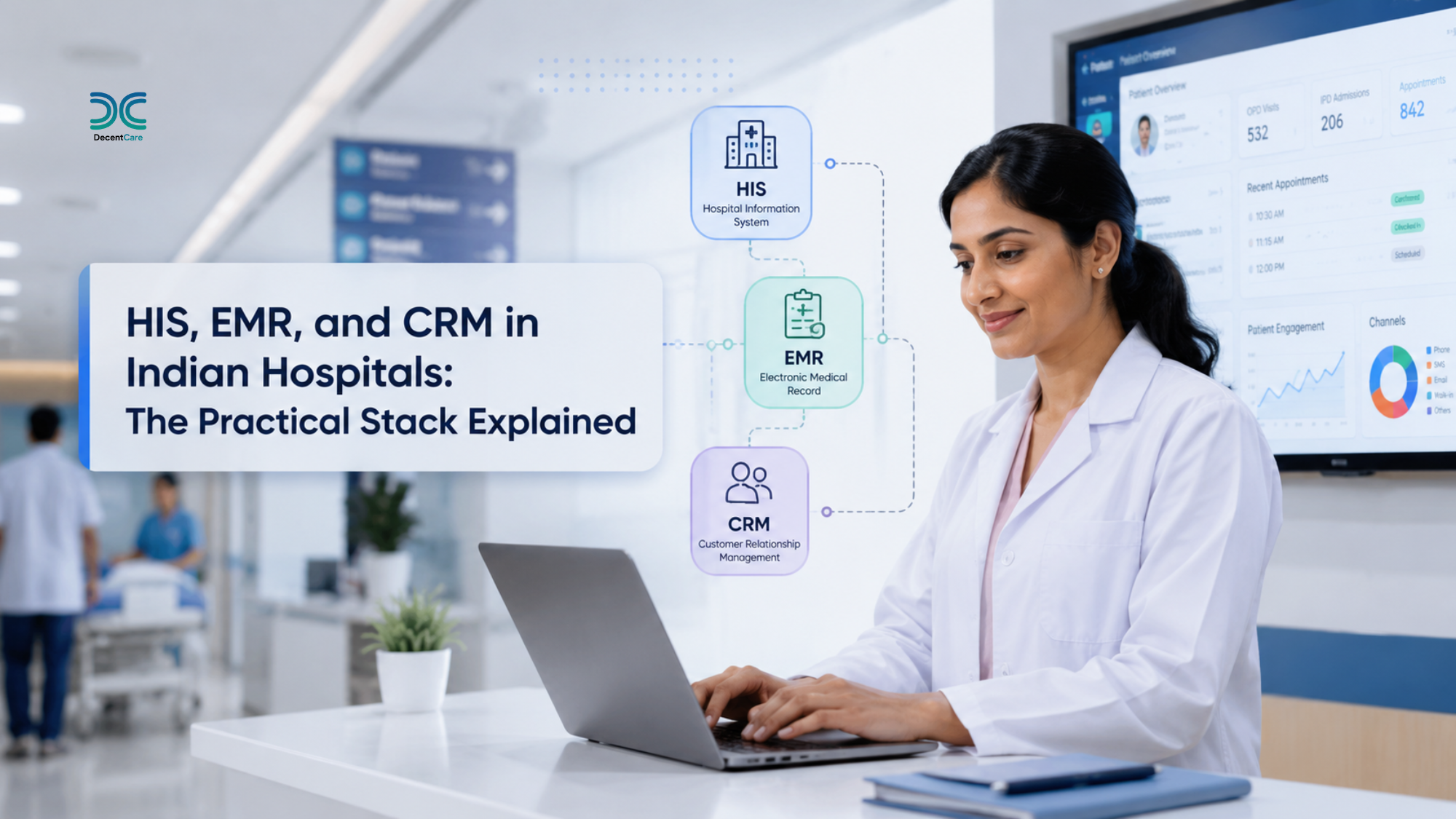


Every Indian hospital runs on software. The three pieces that most hospitals build around are the HIS, the EMR, and a CRM. Together these make up the practical hospital software stack that keeps the front desk open, the doctor’s screen ready, and the follow-up call going out on time. This guide explains what each layer does, where each one stops, and the fourth layer that most Indian hospitals still do not have.
HIS stands for Hospital Information System. It is the software that runs the day-to-day work of the hospital: registration, appointments, billing, pharmacy, laboratory, radiology, admissions, discharge, insurance and staff records. In many Indian hospitals it is also called HMS or HIMS. The name changes but the job is the same.
EMR stands for Electronic Medical Record. It is the digital clinical record for one patient at one hospital: doctor’s notes, diagnoses, prescriptions, lab reports, allergies, and procedures done. Most HIS software includes an EMR module, but an EMR is not the same as an HIS. An HIS runs the hospital. An EMR records what happened to a patient.
CRM stands for Customer Relationship Management. In a hospital, the CRM is the software that manages how the hospital talks to patients before they arrive and after they leave. It handles enquiries from the website, WhatsApp and calls, sends appointment reminders, runs follow-up messages, and tracks which marketing source brought which patient.
The three layers each own a different part of hospital life. The HIS owns the operations. The EMR owns the clinical record. The CRM owns the conversation with the patient. Together they cover what the hospital does, what the doctor decides, and what the front office says.
A working stack shares one patient identity across all three layers. When a patient books an appointment through the CRM, the HIS reserves the slot. When the doctor writes a note, the EMR stores it. When the treatment ends, the CRM sends the follow-up. If the layers do not talk to each other, the hospital has three sets of software but no single view of any patient.
An HIS keeps the hospital running. Its core modules cover patient registration and UHID creation, OPD and IPD workflows, bed management, billing under GST, pharmacy, inventory, laboratory (LIS), radiology and PACS, insurance and TPA, HR and payroll, and management reports. Most Indian hospitals of any size run on an HIS from vendors such as Napier, Suvarna, Insta by Practo, MocDoc, Attune, Birlamedisoft, KareXpert or the government’s own eHospital.
An HIS is a system of record. It tells the team what has already happened in the hospital: who registered, who was admitted, what was billed, what is in stock. It does not tell the hospital what a patient is about to decide, or which enquiry from last Tuesday is still worth a call today.
An EMR turns the paper case sheet into a structured clinical record. It stores the doctor’s consultation notes, the diagnosis, the prescription, the lab and imaging results, the medication history, allergies, and procedures. A good EMR carries the record across every OPD visit and IPD stay, so a patient’s diabetes progression or blood pressure history is visible at a glance.
EMR adoption in India is uneven. According to Medical Buyer, about 35% of Indian hospitals use an EMR system today, compared with over 90% in the United States and the United Kingdom. That number is now rising quickly because of the Ayushman Bharat Digital Mission (ABDM), which asks hospitals to share records across facilities with patient consent. But an EMR is still a clinical record, not a communication layer. It tells the doctor what treatment happened. It does not tell the team what the patient is thinking about next.
A hospital CRM does the work the HIS and the EMR were not built for. It captures every enquiry the hospital receives, from Google Ads, from the website, from WhatsApp Business, from calls, and from walk-ins. It assigns each enquiry to a team member, sends appointment reminders, runs follow-up messages after discharge, tracks referrals from other doctors, and reports on which marketing source brought which patient into the OPD.
A CRM answers questions the HIS and the EMR cannot answer. Which advertising campaign brought the most surgery patients last month. How many enquiries from Friday’s Instagram post ended up in an OPD chair. Which telecaller closed the most consults this week. This is the growth question, and neither the HIS nor the EMR is built to answer it.
But a hospital CRM has a limit too. Most hospital CRMs were built on sales-CRM foundations, where the patient is treated like a deal moving through a pipeline. The CRM knows the status of the enquiry: contacted, booked, missed, done. It does not always know what the patient is about to do next: hesitate, drop off, ask a family member, or quietly go to another hospital.
Between the clinical layers and the CRM sits a layer that most Indian hospitals do not yet have. This layer reads patient behaviour, not patient records. It sees what a patient is doing across the website, the phone line, WhatsApp and the physical visit, and it works out what the patient is likely to do next. This is behavioural intelligence, and it is what DecentCare is built for.
DecentCare is a behavioural intelligence platform built for Indian hospitals. It is not an HIS, and it is not a CRM. It sits above the stack as a decision layer, and it works through three modules that share one patient timeline.
OmniLens is the behavioural data layer. It captures every signal a patient gives across web searches, calls, WhatsApp messages and hospital visits, and turns them into one single patient timeline. It shows the treatment the patient is interested in, how strong that interest is, which marketing source brought the patient, how many touches happened before the consult, and exactly where the patient went quiet.
OmniJourney is the behavioural AI engine. It reads the signals OmniLens captures, places each patient on a journey from “researching” to “ready to proceed”, scores the intent, flags patients about to drop off before they vanish, and recommends the single best next step: a call, a WhatsApp nudge, a counselling session, or a piece of content.
OmniCare is the patient journey CRM at the acting end of the loop. It is where the front desk, the telecaller, the nurse, the doctor and the financial counsellor see one shared timeline and act on it. It captures enquiries, assigns them by role, tracks the full patient journey from first call to post-op follow-up, and closes the loop by sending the outcome back into OmniLens.
The four layers each do one job well. The HIS keeps the operations running. The EMR carries the clinical record. The CRM manages the conversation with the patient. Behavioural intelligence reads the decision the patient is about to make. Together they cover what the hospital did, what the doctor decided, what the front office said, and what the patient is about to do.
This is where DecentCare sits beyond a hospital CRM. A hospital CRM tracks the status of an enquiry: contacted, booked, missed, done. A behavioural intelligence platform tracks the intent behind that status: interested and price-sensitive, worried about surgery, waiting on a family member, comparing two hospitals, ready to proceed. The pipeline stages are the same. What changes is what the team sees at each stage, and what the platform tells the team to do next.
The Ayushman Bharat Digital Mission has changed what an Indian hospital software stack must do. The National Health Authority announced 90 crore ABHA numbers created by May 2026, up from about 72 crore in 2024. Every one of those ABHA numbers is a patient identity that can carry records between hospitals with patient consent. To take part, a hospital’s software must be certified across three ABDM milestones: M1 for identity, M2 for sharing records, M3 for fetching them.
NABH, the national accreditation body, released its 6th edition standards in January 2025. The 6th edition strongly recommends that hospitals run an EMR and integrate with ABDM. Hospitals with digital records now score better in NABH assessments. Both ABDM and NABH pressure lands on the clinical layers of the stack, the HIS and the EMR, not on the CRM. But without a CRM, the hospital cannot reach the patient. And without behavioural intelligence, the hospital cannot see which patient is about to leave.
The order in which hospitals adopt the stack matters. Most Indian hospitals start with the HIS, because without it the front desk, the pharmacy and the billing counter cannot open. The next step is to deepen the EMR inside the HIS, or add a dedicated EMR module, because ABDM and NABH now demand it, and because a proper clinical record protects the doctor and the patient. The third step is to add the CRM, because acquisition and retention become the growth question once operations are stable.
The fourth step, which most hospitals have not yet taken, is to add behavioural intelligence above the CRM. Without it, the CRM sees status but not intent. With it, the hospital sees which patient is about to drop off, which enquiry is worth a second call, which marketing source is bringing surgery patients rather than window shoppers, and which follow-up will bring a repeat visit. DecentCare goes live in 48 hours, needs no IT team, and comes with a dedicated Customer Success Manager. It reads signals from the existing HIS, EMR and CRM through simple integrations, and it turns them into a live view of every patient in the hospital.
What is the difference between HIS and EMR?
An HIS runs the operations of the hospital: registration, billing, pharmacy, lab, admissions and discharge. An EMR is the clinical record for one patient at one hospital, with doctor’s notes, diagnoses, prescriptions and results. Most HIS software includes an EMR module, but a standalone EMR does not run the hospital’s operations. An HIS is broad; an EMR is deep.
Is HMS the same as HIS?
Yes, in Indian practice HMS and HIS mean the same product. Vendors and hospitals use the terms interchangeably. HMS is used more often by small and mid-size hospitals and clinics. HIS is more common in large multi-specialty and teaching hospitals. There is no meaningful functional difference between the two. Both refer to the software that runs the hospital’s operations.
Why does a hospital need a CRM if it already has HIS and EMR?
An HIS records what the hospital did. An EMR records what the doctor decided. Neither of them records the conversation with the patient before arrival or after discharge. A hospital CRM captures enquiries from the web and WhatsApp, assigns them to a team member, sends appointment reminders, runs follow-up messages, tracks referrals, and links marketing spend to patients actually treated.
What is behavioural intelligence in a hospital software stack?
Behavioural intelligence is the layer that reads what a patient is about to do. It watches signals across search, calls, WhatsApp and visits, and works out which patient is ready to proceed, which is hesitating and which is about to drop off. It sits between the clinical systems and the CRM as a decision layer.
Is DecentCare a hospital CRM?
No. DecentCare is a behavioural intelligence platform built for Indian hospitals. It is not a CRM at the platform level, and it is not an HIS. OmniCare, one of the three modules inside DecentCare, is a patient journey CRM. The platform sits above the CRM as a decision layer, reading intent a generic hospital CRM cannot see.
What is ABDM’s role in the hospital software stack?
The Ayushman Bharat Digital Mission (ABDM) sets the national interoperability standard for hospital records in India. Its M1, M2 and M3 milestones require an Indian hospital’s software to handle patient identity through the ABHA number, share records with patient consent, and fetch records from other facilities. ABDM pressure lands mainly on the HIS and the EMR layers.
How long does it take to add a new layer to an existing stack?
Adding a new HIS or EMR typically takes three to six months for a small or mid-size Indian hospital, and longer for a large hospital chain. Adding a behavioural intelligence layer such as DecentCare is much faster. DecentCare goes live in 48 hours, needs no IT team, and connects to the hospital’s existing systems.
Conclusion
The Indian hospital software stack has three well-known layers: the HIS that keeps operations running, the EMR that carries the clinical record, and the CRM that manages the conversation with the patient. Each does one job well, and each has a clear limit. What most Indian hospitals still miss is the layer that reads what the patient is about to decide.
DecentCare adds that layer. It goes live in 48 hours, needs no IT team, and works alongside the hospital’s existing systems. Book a 30-minute demo to see how a behavioural intelligence platform fits into an Indian hospital’s stack. Understand your patients, grow your hospital.

Creates reader-focused content that simplifies complex topics and delivers valuable insights across healthcare, publishing, and content development.