Hospital Marketing & SEO
Indian Healthcare Marketing in 2026: Where the Field Is Heading Next
Vamshi Kantoju
Read more 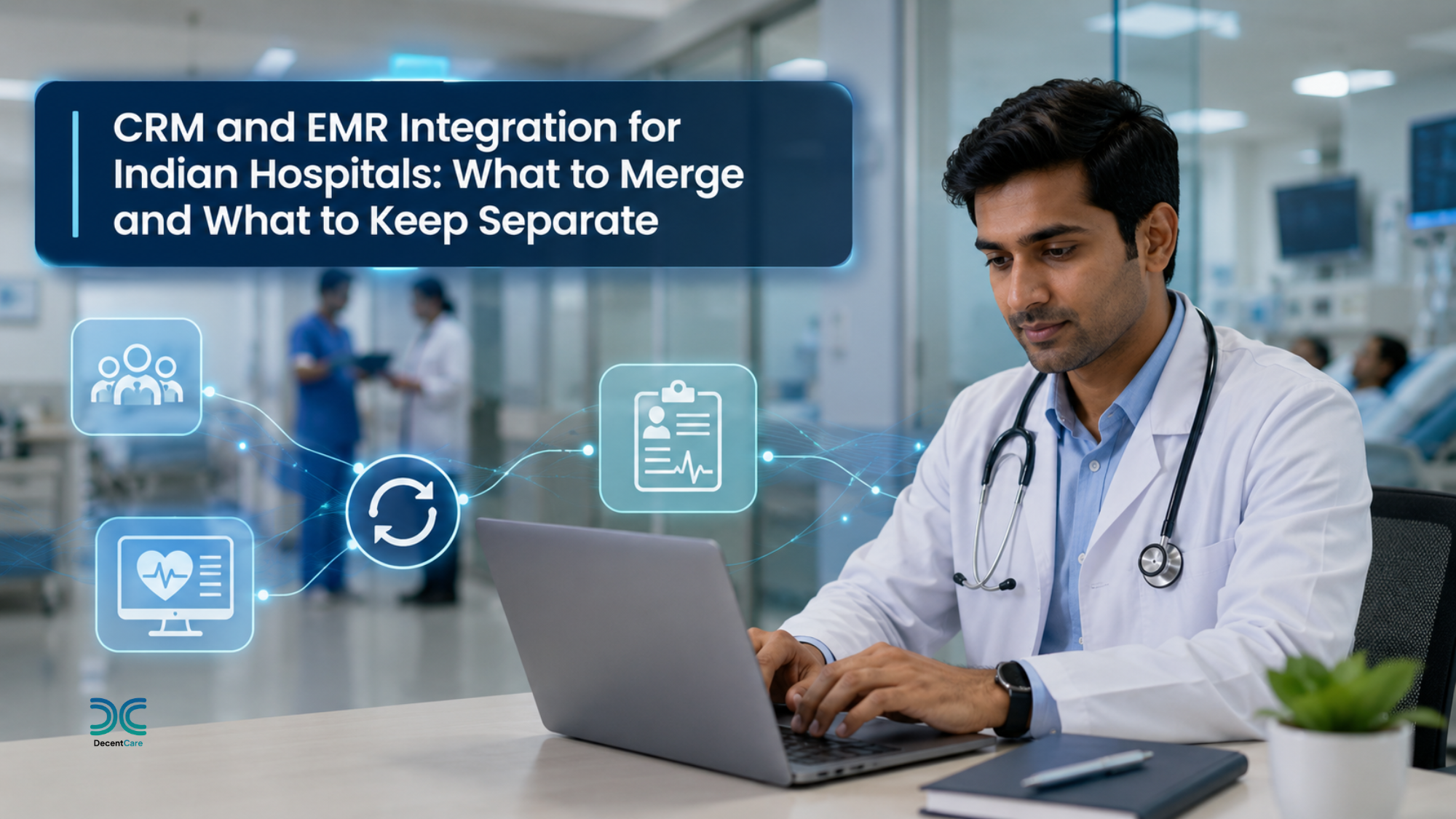


Ask an Indian hospital administrator whether the hospital CRM and the EMR should be integrated, and the room will split. The IT vendor argues for full integration, one platform, one login, one patient view. The clinical head argues for separation, two systems that do two different jobs. The finance head asks about switching cost. Both sides have serious arguments, and the CRM and EMR integration debate is now a live conversation in almost every hospital IT committee in India in 2026. The debate is real, but both sides are answering the wrong question. This piece is a practical guide to what to merge, what to keep separate, and what neither side is looking at.
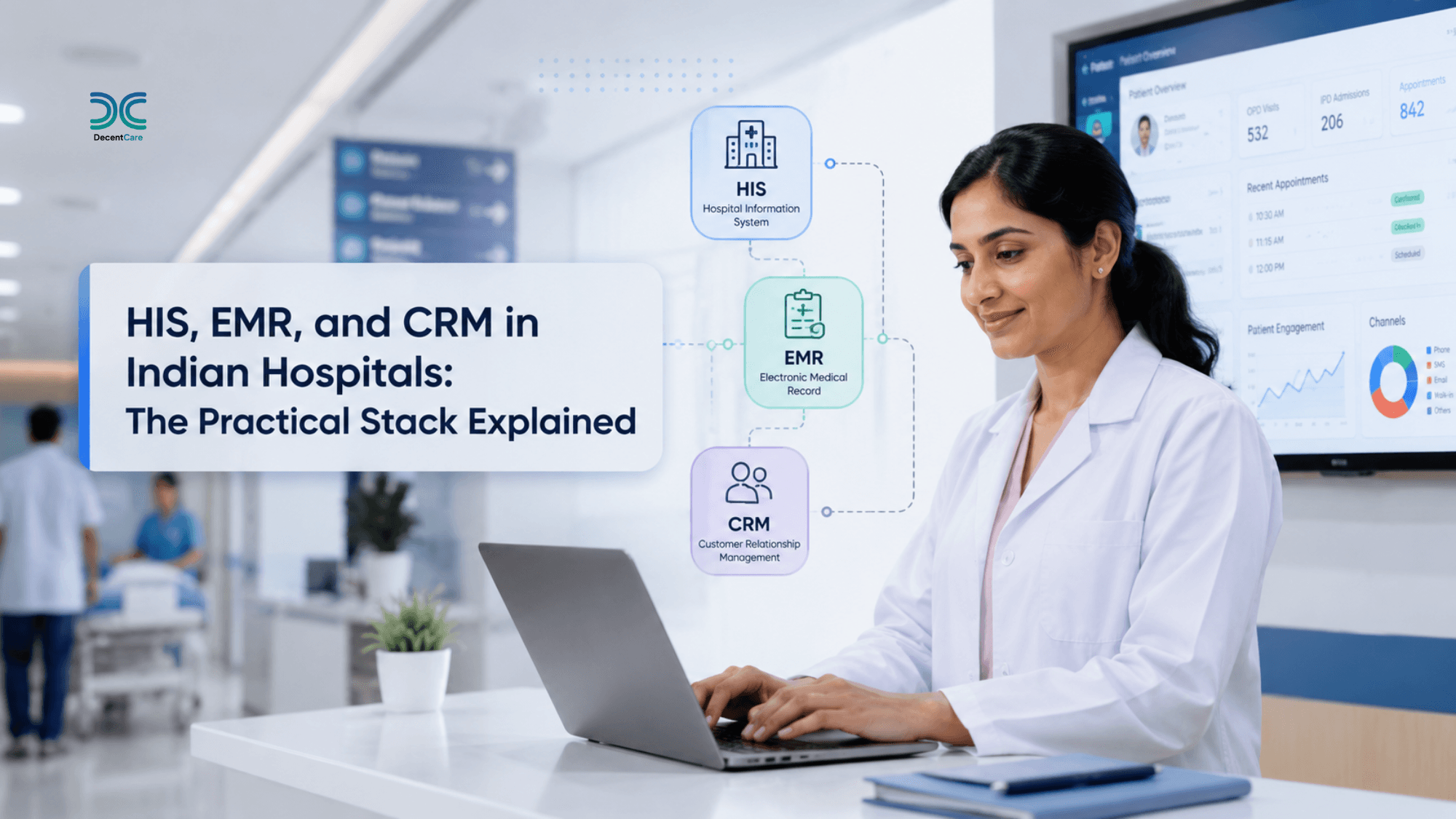
CRM and EMR integration is the practice of connecting the hospital's enquiry-and-follow-up system with the hospital's clinical record so that patient context flows across both. The EMR is the clinical record. It holds diagnosis, prescription, vitals, investigations, procedure notes and discharge summaries. It is the source of truth for care delivered, and it is regulated for that reason. A hospital CRM is the operational tracking system for enquiries, appointments and follow-ups. It carries who is assigned to what, what the next task is, and when the next follow-up is due.
There are three ways the two systems live together. They can be fully integrated inside one platform, running off one database. They can be independent, connected by a middleware bridge that passes context each way. They can be fully separate, updated by hand where they need to meet. The debate in 2026 has intensified because the Ayushman Bharat Digital Mission has moved from pilot to scale, NABH's 6th edition of hospital standards (released January 2025) formally recommends EMR and ABDM alignment, and the vendor market has consolidated. Every administrator is now being pitched a version of the integration story.
It is worth being precise about the three layers, because the debate collapses without this distinction.
The EMR records what happened clinically. It answers the question of what was found and what was done. It is a closed system for good reason.
The hospital CRM tracks the status of a case in the funnel. It answers the question of where the case is right now, who owns the next action, and when that action is due. It is a workflow tool for the front desk, telecaller, and follow-up team.
Neither of them reads the behavioural signals that decide whether a case moves forward. Which department page the patient read, and how many times. How long the front desk took to answer the first call. Whether the WhatsApp message sat unopened for eight hours. Whether the patient asked for a specific doctor by name. Whether the patient cancelled once from one number and rebooked from another. These signals sit outside both systems, and they carry more information about the outcome than either system does. The distinction between clinical data and behavioural data is not stylistic. It is architectural.
The pro-integration case rests on four claims that are genuinely worth taking seriously.
A single patient view across enquiry and consultation
When enquiry data and clinical data sit in one platform, the front desk sees what the doctor prescribed at the previous visit, and the doctor sees why the patient came in this time. Duplicate records fall. UHIDs stay clean. Handoffs stop leaking context.
Cleaner ABDM and ABHA alignment
A single system makes it easier to link every case to the patient's ABHA identifier. As per NHA data cited in mid-2026, more than 90 crore ABHAs have been generated, up from about 72 crore in 2024. Hospitals with connected records find it operationally easier to meet M1, M2 and M3 milestones of ABDM.
Fewer handoff gaps for the front-desk team
When the telecaller books an appointment and the receptionist confirms arrival, an integrated system carries context through automatically. No paper slip. No re-entry. Fewer places for a case to fall through.
A stronger signal for NABH accreditation
The 6th edition of NABH standards, released January 2025, recommends integrated digital records for accreditation. Hospitals with digitally connected records score better on the digital-health chapters, and NABH Digital Health Standards certification (introduced September 2024) is now a formal category.
The anti-integration case is not obstruction. It rests on four hospital-specific concerns that vendors often understate.
Vendor lock-in that compounds across two categories
When one supplier owns both the clinical record and the enquiry system, switching either becomes very expensive. Clinical records must be migrated with legal chain of custody. Enquiry data must be re-modelled. Bundling raises the exit cost of every future decision the hospital wants to make.
An expanded security surface
The EMR is tightly regulated. The CRM sits closer to the outside world, including marketing tools, WhatsApp, campaign data, and third-party integrations. Fusing them into one platform puts clinical records adjacent to a wider attack surface. Serious hospitals treat this as a real risk, not a hypothetical one.
Different lifecycles for two different systems
EMRs are regulated and update slowly. CRMs must update quickly to keep pace with campaigns, channels, and patient behaviour. Forcing a shared release cycle slows the fast side and destabilises the slow side. This is a real operational problem inside NABH-accredited hospitals with active marketing programmes.
Cost and switching risk
Deep integration is not free. Custom middleware, ongoing maintenance, and the political cost inside the IT committee often make the total cost of ownership higher than running the systems side by side with a clean interface between them.
Both sides of the debate treat the question as a question about records. Integrate the records, or do not integrate the records. Whichever side wins that argument, the hospital ends up with a better view of what has already happened.
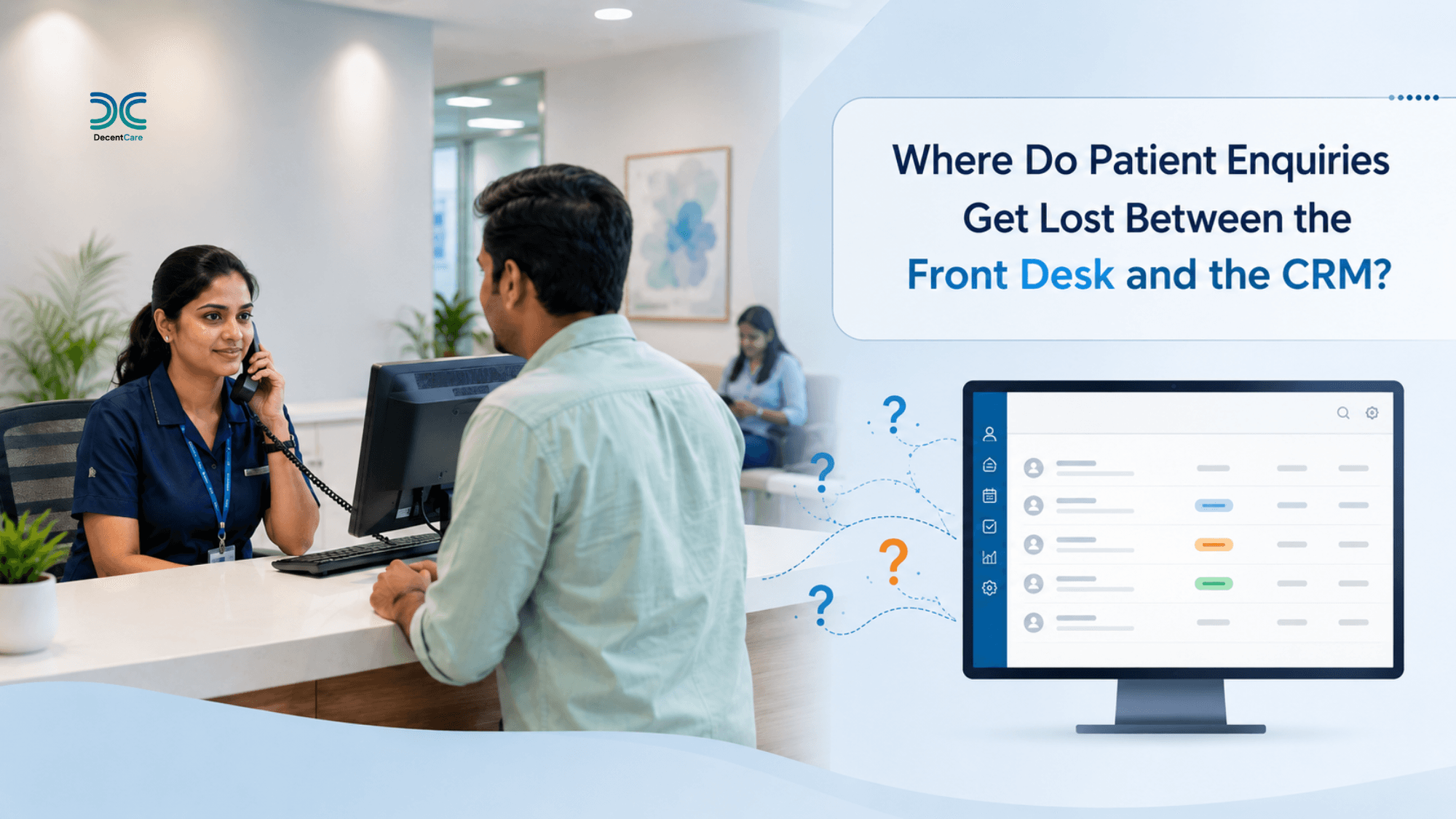
The problem is that nothing has happened yet for most of the patients the hospital is losing. A patient who reads a department page three times, calls the front desk, waits nine minutes for pickup, gets an appointment, does not turn up, and never comes back has generated almost no EMR record and only a thin CRM record. Neither system has read the signals that decided the outcome. Every missed signal is a patient a competing hospital gets. The debate about how to merge the two systems does not reach that patient. Visibility into what the patient is about to decide, not speed of record integration, is what changes the outcome.
DecentCare is a behavioural intelligence platform built for Indian hospitals and clinics. It is not an EMR. It is not a hospital CRM. It sits above the HIMS as a decision layer, and beyond a hospital CRM as a signal-reading layer, capturing the behavioural data neither of the two systems in the debate is designed to record. Clinical systems capture medical history. DecentCare captures decision history. How DecentCare works for hospitals is best understood through its three modules.
The OmniLens behavioural data layer turns every patient interaction across web, calls, WhatsApp and visits into one behavioural timeline. Treatment interest, intent strength, source attribution, interactions, drop-off points and readiness signals sit in one record next to the patient's basic details. Signals that used to be scattered across a marketing tool, a call log, a WhatsApp inbox and a spreadsheet now live together.
The OmniJourney behavioural AI engine reads that timeline. It scores intent, predicts which cases are about to go silent, and recommends the next best action. That next best action is one of four things: a piece of content, a call, counselling, or a nudge. The engine does not decide clinical questions. It decides operational ones: who to reach, when, on which channel, with what.
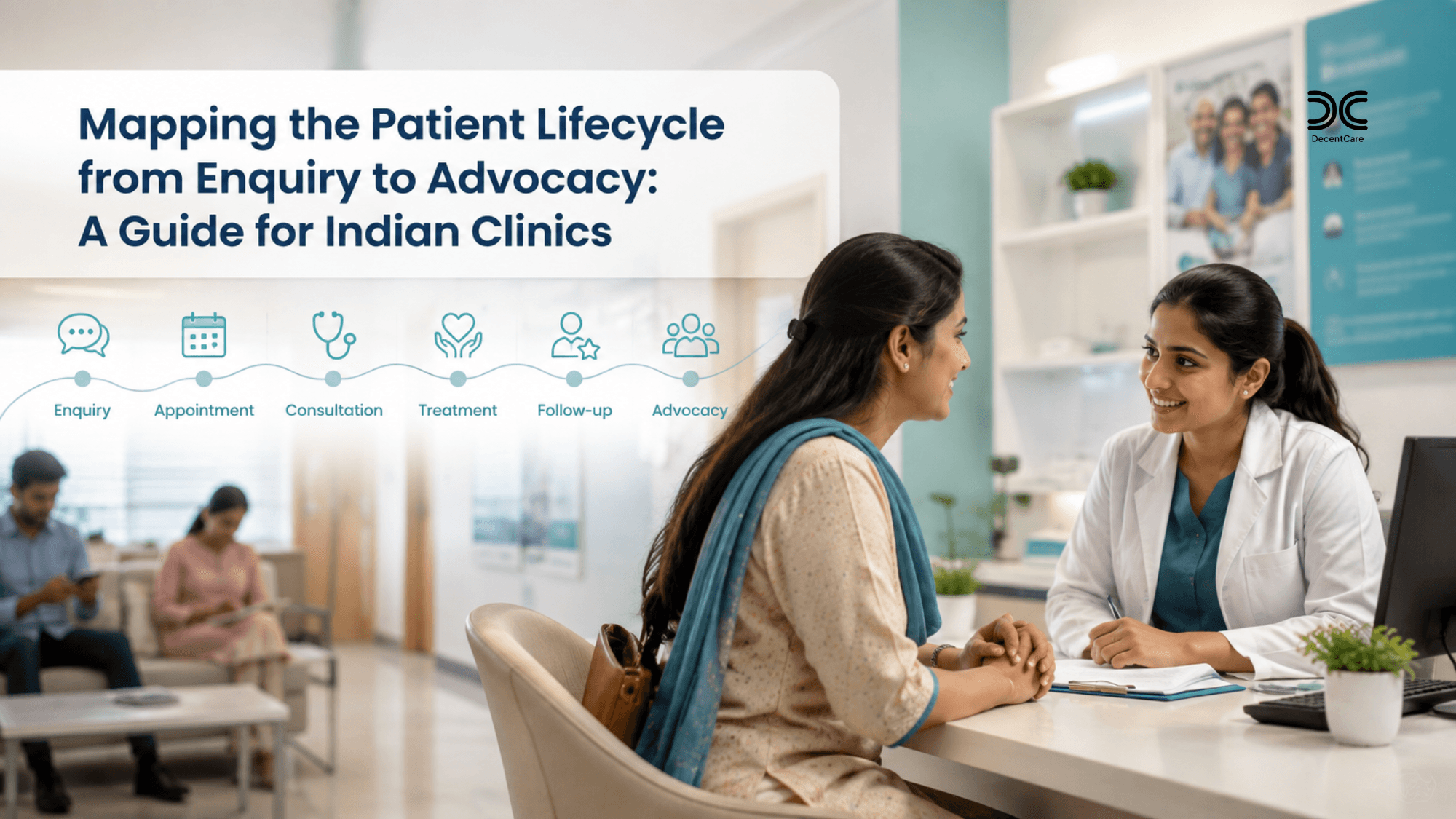
The OmniCare patient journey CRM is where the team sees the full patient journey and acts on it. Enquiry, appointment, consultation, procedure, post-op. The five case stages of a hospital case are treated as one continuous journey, not as five disconnected systems. The front desk, the telecaller, the nurse, the financial counsellor and the doctor all see the same timeline, filtered by role. This is why DecentCare sits beyond a hospital CRM: a generic CRM tracks status, DecentCare reads intent, and status only tells the team what state the case is in while intent tells them what state the patient is in.
The compliance direction in India is clearly toward interoperable records. ABDM's M1, M2 and M3 milestones formalise identity, sharing of records, and fetching of records across hospitals. NHA data cited in mid-2026 puts ABHA generation past 90 crore. NABH's 6th edition, released in January 2025, recommends EMR and ABDM integration for accreditation, and NABH Digital Health Standards certification, introduced in September 2024, is now a formal category.
None of this settles the CRM and EMR integration debate. All of it settles something else: the direction on EMR interoperability. Interoperability of records is a good thing, and hospitals should pursue it. But interoperability is not the same as visibility into intent. A record that moves between hospitals is still a record. The signals that decide whether the patient completes the case still sit outside the record, and no ABDM milestone changes that.
The practical answer for most Indian hospitals is not a single yes or no. It is a sequence.
First, keep the EMR as the clinical system of record. Do not compromise regulated clinical data for operational convenience. Where ABDM interoperability is required, meet it through the EMR's standard connectors.
Second, choose a patient journey CRM that respects clinical data boundaries. The CRM should carry the workflow of enquiry, appointment, consultation, procedure and post-op, and it should hand off cleanly to the EMR where clinical data begins. A CRM that tries to become a shadow EMR is a warning sign, not a feature.
Third, add a behavioural intelligence layer that reads across both. This is the layer that surfaces which patient is about to go silent, which enquiry is not being read, which case is drifting and why. DecentCare provides this layer with an inbuilt patient journey CRM, so hospitals can adopt it without ripping out their existing EMR, and the Understanding the Patient Journey framework becomes operational rather than aspirational.
Approached this way, the CRM and EMR integration debate stops being a binary. The question is no longer whether to merge two systems. The question is what layer is missing between them, and how quickly the hospital can add it.
Should the hospital CRM and EMR be integrated in Indian hospitals?
It depends on what problem the hospital is solving. If the goal is a clean single patient view across enquiry and consultation, some form of connection helps. If the goal is fewer drop-offs and stronger case completion, integration alone will not solve it. The layer that reads patient intent, missing from both systems, is what changes case outcomes.
What is the difference between an EMR and a hospital CRM?
An EMR is the clinical record. It stores diagnosis, prescription, vitals, procedure notes and discharge summaries, and it is regulated for that purpose. A hospital CRM tracks the operational status of an enquiry or case. It manages assignment, follow-up and next task for the front-office team. The two systems answer different questions and hold different kinds of data.
Does ABDM require CRM and EMR integration in Indian hospitals?
ABDM focuses on interoperability of clinical records through the ABHA identity and the M1, M2, M3 milestones. It does not mandate that CRM and EMR live inside one platform. What ABDM requires is that clinical records can be linked, shared and fetched. That obligation sits on the EMR side of the stack.
Is DecentCare an EMR or a hospital CRM?
Neither. DecentCare is a behavioural intelligence platform for Indian hospitals and clinics. It sits above the HIMS as a decision layer. OmniCare, one of its three modules, is a patient journey CRM, but the platform as a whole is not a CRM or an EMR. It reads behavioural signals across web, calls, WhatsApp and visits.
What happens if a hospital keeps its CRM and EMR separate?
Kept separate, the two systems stay fit for their own purpose and are easier to secure and to switch. The hospital loses a single view of the case across enquiry and clinical stages, and neither system reads the behavioural signals that decide case completion. A behavioural intelligence layer above both closes that gap without forcing a merger.
How is behavioural intelligence different from CRM and EMR integration?
CRM and EMR integration is about merging two record-keeping systems. Behavioural intelligence is about reading the signals that sit outside both. Page views, call wait times, WhatsApp response gaps, cancellations and re-bookings, doctor name searches, form drop-offs. These signals decide whether a case moves forward, and they live outside the records the debate is arguing about.
What should a hospital ask before integrating its CRM and EMR?
The most useful questions are: what problem is this integration solving, and would a behavioural intelligence layer solve it more directly. If the honest answer is drop-off, follow-up quality, or enquiry conversion, the answer is almost never a records merger. It is a layer that reads intent across both systems and prompts the team at the right moment.
Conclusion
The CRM and EMR integration debate in Indian hospitals is real, and both sides have serious points. Integration helps with compliance, clean records and front-desk efficiency. Separation protects clinical data, keeps switching costs sane, and limits the security surface. Both sides are arguing about the wrong layer. The signals that decide whether a case completes sit outside both the EMR and the CRM, and every missed signal is a patient a competing hospital gets. The hospitals that grow through the next three years will not be the ones that win the integration debate. They will be the ones that add the behavioural intelligence layer the debate ignores.
DecentCare is live in 48 hours, needs no IT team to deploy, and every hospital is supported by a dedicated Customer Success Manager. To see what the behavioural layer looks like on top of an existing EMR and CRM, book a 30-minute demo and understand your patients, grow your hospital.

A healthcare content specialist with 3 years of experience in content creation, healthcare SEO, and digital marketing for hospitals and clinics. Focused on creating clear, informative content that helps healthcare organisations get found online and makes complex healthcare topics easier for patients and hospital teams to understand.