Hospital Marketing & SEO
Indian Healthcare Marketing in 2026: Where the Field Is Heading Next
Vamshi Kantoju
Read more 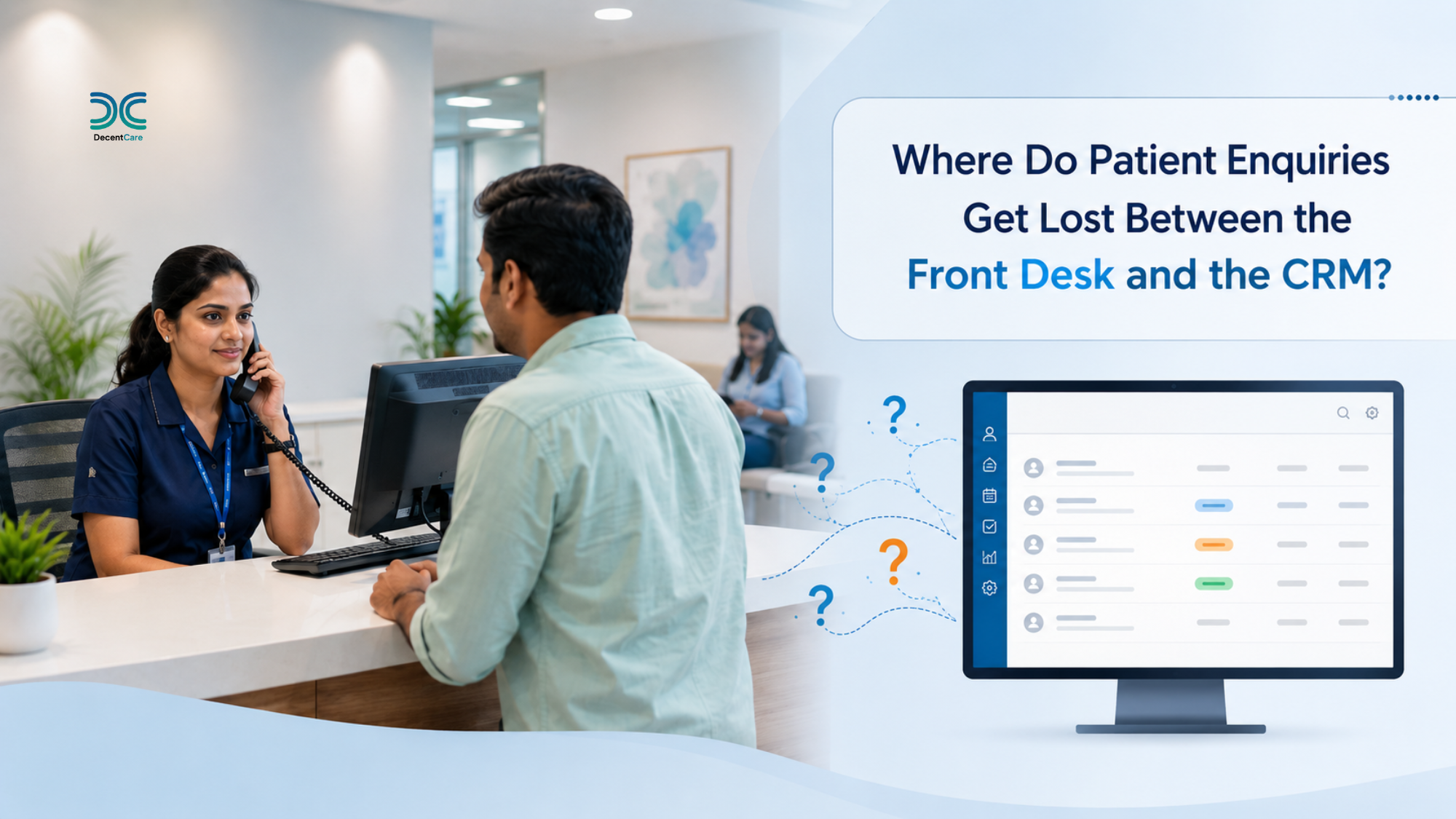


Between the front desk and the CRM, many patient enquiries simply go missing. The clinic spent money to bring them in. The receptionist picked up the call. But then the enquiry became a slip on the counter, a note in a shared inbox, or a memory in someone’s head. By the time anyone acted, the moment had passed. This is how clinics lose patients they have already paid to attract. It is also what a behavioural intelligence platform is built to fix. DecentCare is not a CRM. It sits above the hospital information system and works beyond a hospital CRM. It watches the signals a patient sends the second they reach out. It decides what the case needs next. And it sends the reply on the channel the patient really uses.
The handoff is the second an enquiry stops being a conversation and becomes a record. It sounds like a small admin step. It is not. A patient who calls to ask if the orthopaedic surgeon is free on Saturday has already shared four things: the speciality, the urgency, the preferred day, and the fact that they are shopping right now. Write that on a slip and drop it in a tray, and most of the meaning is gone by the time anyone reads it. DecentCare treats the handoff as a behavioural moment. An enquiry is not a form waiting to be filed. It is a set of signals with a very short shelf life. Patients researching a clinic on a phone expect a fast reply, at the speed of the app in their hand. A paper slip cannot reply that fast. Nor can a database that waits for someone to remember to type in the details. To see why this moment matters, it helps to hold in mind the patient-first thesis, and to notice that the patient journey begins the second someone reaches out, not the second they walk into reception.
Six failure points cover almost every enquiry that leaks. The first is the unrecorded enquiry. A call, a walk-in question, or a message gets answered helpfully, but nobody logs it. So the system never learns it happened. The second is delay. The record exists, but nobody replies while the patient is still keen. Once the enquiry cools, the odds of a real conversation drop sharply, and manual queues almost always cause this. The third is lost context. The record survives, but the meaning does not. A follow-up call opens with a generic greeting to a patient who already explained everything. The fourth is the wrong channel. The clinic replies by a method the patient does not check. The fifth is the unowned queue. The enquiry lands in a shared inbox or a distribution list that belongs to nobody. No single person picks it up, and no clock runs. The sixth is decay and duplication. The same patient is entered twice, or a record ages silently until the phone number no longer works. These are the exact leaks DecentCare is built to catch. They also explain why owners find enquiries die inside 24 hours even when the reception desk feels busy all day.
DecentCare closes the handoff through three parts that work as one motion. That is what makes it a behavioural intelligence layer, not just a place to store contacts. The watching is done by OmniLens, the behavioural data layer. It captures each enquiry as a set of signals, not a static row: the channel it came from, the speciality and intent behind it, how quickly the patient replied, whether they have interacted before, and where they are in their journey. Because OmniLens records behaviour the moment it happens, the unrecorded enquiry and the lost-context failures close at the source. Nothing depends on a staff member remembering the details later. The deciding is done by OmniJourney, the behavioural AI engine. It reads those signals and works out what this case needs next: an instant confirmation, a nudge, a routing to a named owner, or a hold because the patient asked for time. This is how the unowned queue and the delay failures close. Every enquiry now has an action, an owner, and a clock. The sending is done by OmniCare, the patient journey CRM. It sends the decided action on the channel the patient actually uses, most often WhatsApp. And it follows India’s consent rules. Under Section 6(1) of the Digital Personal Data Protection Act, 2023, consent must be free, specific, informed, unconditional, unambiguous, and limited to the stated purpose. So OmniCare only sends what the patient agreed to, for the purpose they agreed to. Read together as one motion: DecentCare watches the behaviour, decides the next step, and sends it, at the speed of the enquiry. Clinics that have looked at why their CRM keeps failing usually find the real problem was never storage. It was this missing behavioural motion at the handoff.
Buying another database does not fix the handoff. The handoff fails because of human behaviour under pressure, not because of missing fields to fill. When a reception team is registering walk-ins, taking payments, and answering the phone at the same time, the enquiry with no patient standing at the desk is the one that slips. Software installed under a manual habit does not change this. The cost shows up later, in attendance. One Indian government hospital study of 375 diabetes patients found that more than seven in ten had missed at least two of their last six appointments (Basu et al., Perspectives in Clinical Research, 2020). The setting is specific, but the message is plain. Patient contact leaks badly when it is left to memory and manual chasing. DecentCare’s view is simple. The fix has to change behaviour at the moment of contact. A passive record store cannot do that. A behavioural layer can. A clinic that treats the handoff as behavioural starts to see the patient timeline as a live thing to act on. It also starts to choose its communication stack around the channel patients already trust.
Start by measuring. The handoff leak is invisible until it is counted. Owners and administrators can send a test enquiry to the clinic on an evening or weekend, and time how long the real reply takes. Then pull the last ninety days of enquiries, and count how many reached a live conversation. The next step is to stop relying on memory. Capture every enquiry as behaviour the moment it arrives, not as a slip to be typed up later. That is exactly what OmniLens inside DecentCare is built to do. The third step is to give every enquiry an owner, a channel, and a clock. So no case sits unowned. That is the decide-and-send job OmniJourney and OmniCare do together. None of this needs the existing hospital information system to be replaced. DecentCare sits above the HIMS as a behavioural layer, not underneath it as a replacement. The honest benchmark is this. If the ninety-day contact rate is low, fixing the handoff comes before spending more on advertising. More enquiries into a leaking handoff just means more patients lost in silence. DecentCare exists to close that leak. Understand your patients. Grow your hospital.
What is the front desk to CRM handoff in a clinic?
It is the moment a patient enquiry moves from a person at the front desk into the system meant to act on it. DecentCare treats this as a behavioural moment because urgency, speciality, and intent are signals with a short shelf life. A paper slip or a late entry cannot keep them alive.
Why does the handoff fail so often at Indian clinics?
The handoff fails in six repeatable ways that DecentCare watches for: the unrecorded enquiry, delayed reply, lost context, the wrong channel, the unowned queue, and quiet record decay. Each one depends on a busy human remembering to act under pressure. The leak stays invisible until real conversations are actually counted.
Is DecentCare a CRM that stores patient contacts?
No. DecentCare is a behavioural intelligence platform. It sits above the hospital information system and works beyond a hospital CRM. It watches enquiry signals through OmniLens, decides the next action through OmniJourney, and sends on the patient’s channel through OmniCare. The handoff becomes an action, not a filing task.
How quickly should a clinic reply after a patient enquiry?
As fast as possible, while the patient is still keen. Once an enquiry cools, the odds of ever having a real conversation drop sharply. That is what makes manual queues risky. DecentCare acts at the speed of the enquiry, not at the speed of a person remembering to type up a note later.
Does DecentCare respect India’s data-consent rules on WhatsApp?
Yes. India’s Digital Personal Data Protection Act, 2023 says under Section 6(1) that consent must be free, specific, informed, unconditional, and unambiguous, with a clear affirmative action, and limited to the stated purpose. The OmniCare layer inside DecentCare only sends what a patient agreed to, on the patient’s chosen channel.
Will DecentCare replace the clinic’s existing HIMS?
No. DecentCare is a behavioural layer that sits above the hospital information system. It is not a rip-and-replace system. It watches the signals around each enquiry, decides the next step, and sends it. The HIMS continues to hold clinical and operational records. The handoff closes without disrupting the system below.
What is the first step to fixing the handoff with DecentCare?
Measure the leak. Send a test enquiry to the clinic on an evening or weekend, and time how fast the real reply comes back. Then count how many of the last ninety days of enquiries reached a live conversation. If the contact rate is low, fix the handoff before spending more on ads.

A healthcare marketing professional with 6 years of experience in developing patient acquisition strategies, managing digital marketing for hospitals and clinics, and creating patient-focused content. Focused on helping healthcare organisations reach the right patients, improve patient engagement, and support sustainable growth through healthcare SEO, content marketing, and compliant digital campaigns.