Hospital Marketing & SEO
Indian Healthcare Marketing in 2026: Where the Field Is Heading Next
Vamshi Kantoju
Read more 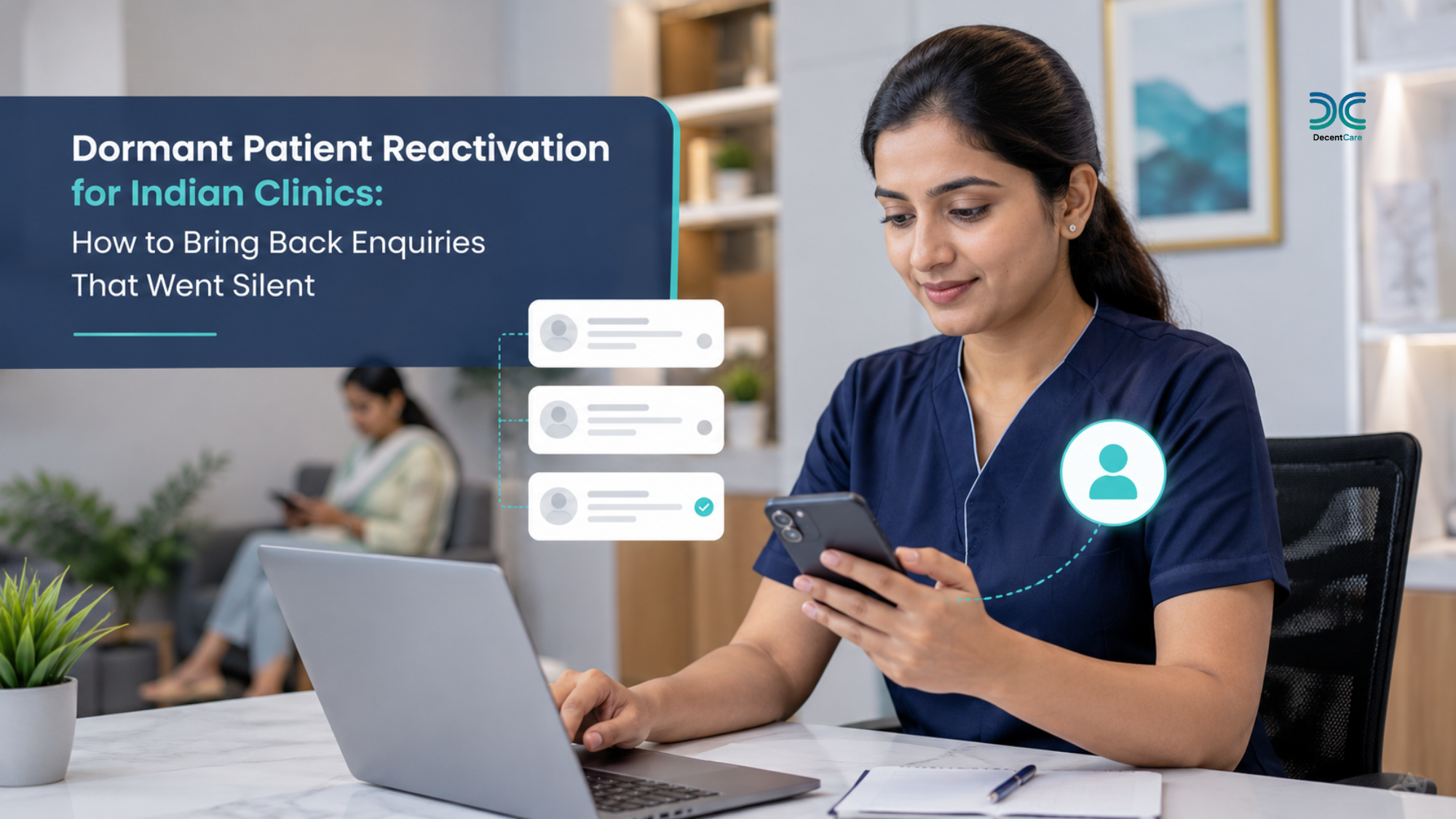


Dormant patient reactivation is a platform decision, not a cadence decision. Every clinic in India carries a silent cohort of enquiries and past patients whose intent went quiet weeks or months ago, and the standard response is to send more messages faster to bring them back. That instinct works on the freshest enquiries and quickly breaks down on everyone else. What separates recoverable silences from unrecoverable ones is whether the platform can still read the behavioural signal that survives inside them, and match the next send to what that signal actually says.
Dormant patient reactivation is the discipline of bringing back enquiries and past patients who stopped responding long enough that the clinic team has given up on them. The word that matters is dormant. A dormant patient is not a fresh enquiry that has not yet been called back. A dormant patient is one whose last meaningful interaction sits weeks or months in the past, whose case has effectively been closed in the operator's mind, and whose behavioural signal has gone quiet for long enough that the standard follow-up sequence has already run its course.
The dormancy threshold varies by specialty. In dental and dermatology, a single missed recall cycle often marks the beginning of dormancy. In IVF and elective surgery, the decision window itself is measured in months, so the line between a slow-burning consideration and a dormant enquiry is harder to draw. In chronic care, dormancy shows up as a series of missed follow-up milestones rather than a single stopping point. Across every specialty, the operational reality is the same. The clinic has a growing list of names that used to be active and are no longer generating any visible engagement.
Reactivation is different from live-enquiry follow-up. Live follow-up handles the enquiry that came in this morning and has not yet been dispositioned. Reactivation handles the enquiry that came in three months ago, was followed up appropriately at the time, and then went silent. The distinction matters because the two require different mechanisms: one is about matching speed to a live intent, the other is about reading what is left of an intent that may or may not still be alive. DecentCare treats the two as separate disciplines with separate signals and separate triggers. The techniques used in automated patient follow-ups are the correct starting point for the first cohort. They are not sufficient for the second.
The default response to a silent enquiry list is to add cadence. A fifth WhatsApp template. A follow-up call from a second telecaller. A discount prompt at day thirty. This approach treats reactivation as a volume problem and rests on an assumption that the silent patient simply needs a louder reminder. On the freshest end of the enquiry list this can occasionally work. On the dormant cohort it produces a predictable set of failures: opt-outs climb, WhatsApp templates get marked as spam by Meta, and the clinic's reputation with its own patient database erodes.
The underlying error is diagnostic. Cadence responds to a problem that assumes the intent is alive and the message has not landed. In a dormant cohort, the intent may be alive, decayed, or gone. A cadence-only approach cannot distinguish between the three, so every message is sent as if the intent is still active. The result is that a small subset of the list who were quietly still interested come back, and a large subset who had already moved on are pushed further away. DecentCare works from the other end of the diagnosis: the platform reads whether the intent is alive before deciding whether to send anything at all.
The research on Indian clinical follow-up points in the same direction. A 2023 study of noncommunicable disease clinics in rural Ballabgarh, Haryana, found that adequate follow-up at the NCD clinic was significantly associated with six-month blood pressure control (adjusted odds ratio 2.3, 95% CI 1.4 to 4.0). Control rose from 37.1% at three months to 53.6% at six months, and the improvement tracked with follow-up quality rather than with message volume. The finding travels beyond hypertension. Follow-up outcomes in Indian clinical settings are driven by whether the follow-up is the right one at the right moment, not by how much of it there is.
Intent does not vanish the day a patient stops replying. It decays, and the shape of that decay is what a behavioural intelligence platform is designed to read. A patient who enquired about a knee replacement three months ago and then went silent is not in the same behavioural state as a patient who enquired three months ago, browsed the clinic's website twice last week, and looked up the surgeon's GMB listing on Sunday. Both look identical on a status-tracking view. They are not identical on a behavioural view.
Six residual signals typically survive inside a long silence. A repeat visit to a treatment page. A fresh search for the clinic's name or the doctor's name on Google. A return visit to Google My Business, sometimes with a direction request. An opened WhatsApp template that received no reply. A referral link click from a family member's phone. A missed call that was not returned. Any of these can appear weeks or months after the last active conversation, and each is a discrete data point that suggests the intent has decayed rather than disappeared.
These signals are not evenly weighted. A GMB direction lookup is a stronger revival cue than a website revisit. A fresh doctor-name search from a new device is a stronger cue than either. What matters for reactivation is that the platform can see each of them, place them on the same timeline as the original enquiry, and use the pattern to decide whether the case is worth reopening and, if so, with what message. This is where behavioural data does what a records system cannot: it captures what the patient did after they stopped talking. DecentCare is built to hold this behavioural residue on the same case timeline that carried the original enquiry, so the silence and what happens inside it read as one continuous story rather than as two disconnected records.
Not every dormant patient is recoverable, and treating them as if they were is the fastest way to burn a WhatsApp Business Account. The dormant cohort separates into three practical groups: intent decayed but still alive, intent gone, and intent that was never strong in the first place.
Intent decayed but alive is the recoverable group. These are patients whose behavioural signal has not gone flat. The clinic's site or GMB listing is still occasionally receiving their attention. A related search happens once a month. The intent is quieter than at first enquiry but is still moving. This group responds well when reactivation reaches them at the moment the signal reappears, with a message that acknowledges the earlier conversation rather than restarting it from scratch.
Intent gone is the group that has stopped signalling entirely. No revisits, no adjacent searches, no template opens. Reactivation attempts on this group produce very low returns and disproportionate opt-outs. They are best left at rest, revisited only if a specific trigger reappears or if the clinic has a genuinely new reason to reach out that goes beyond the original enquiry.
Intent that was never strong is the group that filled in a form but never showed the depth of engagement that a real decision requires. The recovery logic here is different from the first group. The task is not to re-enter the earlier conversation, since there was not much of a conversation to re-enter. It is to test whether a fresh, low-commitment prompt draws any signal at all. The behaviour that follows the prompt tells the platform whether to invest further.
A silent list treated as one cohort produces the cadence trap. A silent list sorted into these three groups produces a reactivation programme that has some chance of working, because it stops spending message volume on patients the platform can see are not there. The sorting is not a manual exercise for the coordinator. DecentCare's behavioural signal reading is what makes the difference between the three groups visible in the first place, since a status view cannot see the difference at all.
DecentCare is a behavioural intelligence platform built for Indian hospitals and clinics. Its role in reactivation runs across three layers: capturing the behavioural signal that survives inside a silence, deciding whether that signal indicates a recoverable intent, and sending the right message on the channel the patient still uses. Each layer is a distinct piece of the system, and each does something a records system on its own cannot.
The signal layer runs on OmniLens, the behavioural data layer. It stitches web visits, calls, WhatsApp interactions, GMB engagement, and in-clinic touchpoints into one timeline for every patient. When a dormant patient revisits the treatment page they originally landed on, or searches for the doctor's name from a new device, or clicks a family member's referral link, the visit is added to the same timeline that already holds their original enquiry. Nothing about the silence removes what came before. The behavioural signal that appears after months of quiet is placed exactly where it happened, alongside every earlier signal from the same case.
The decision layer runs on OmniJourney, the behavioural AI engine. It reads the pattern of decay and revival in the timeline and scores the strength of the surviving signal. The same intent scoring that tells a coordinator which live enquiry is close to booking tells the platform which dormant record has enough residual signal to be worth reopening. Behavioural segmentation then places the case into the group it fits, and OmniJourney recommends a next best action tuned to what the signal actually shows. That recommendation might be a specific WhatsApp template, a counsellor call, or a return of the earlier price conversation.
The send layer runs on OmniCare, the patient journey CRM. It triggers the recommended action through the clinic's WhatsApp Business Account using Meta-approved templates, with SMS available as fallback when the channel is right. The shared case timeline sits across coordinator, counsellor and doctor, so a dormant case that reactivates does not restart from a blank slate. The counsellor who takes the returning call sees every signal that came before and after the silence, in the order it happened. The reactivation conversation begins in context rather than in the dark.
A patient's status is the last state a coordinator wrote down. Enquired. Not contactable. Dropped. Status tracking is useful for auditing where each case sits, but it has nothing to say about what the patient has done since that status was written. A status-tracking view of a dormant list will return exactly the same thing today as it did three months ago, because nothing about a status changes on its own.
Intent is different. Intent is what the patient is signalling now, regardless of what status was last recorded against the case. A patient marked as Not contactable can be actively browsing the clinic's fees page this week and revisiting the doctor's GMB listing. On a status view, nothing about that patient warrants attention. On an intent view, the opposite is true. Reactivation works or fails on the difference. This is where DecentCare sits beyond a clinic CRM: a records-based CRM stores where the case was left; DecentCare reads what the patient is doing now, and triggers the send that matches the signal rather than the send that matches the status.
The outcomes of an intent-led reactivation programme move in specific directions rather than to specific numbers. Four are worth naming.
First, the silent-but-alive cohort becomes visible. Patients whose intent was decaying quietly, invisible to a status-tracking view, appear in the reactivation queue as soon as their behavioural signal reappears. The queue shrinks in size but grows in workable density, because it stops carrying the intent-gone group.
Second, opt-out rates fall on WhatsApp. A cadence-heavy programme accumulates opt-outs from patients being messaged after their intent has gone. Reducing the volume sent to that group protects the WhatsApp Business Account and the deliverability of every future template the clinic sends.
Third, the reactivation queue becomes assignable. It moves from a long, thin, low-response list to a shorter, denser one where each case carries a specific reason for being flagged. A counsellor picking up the case sees why the platform reopened it, and can talk to the patient about what has actually happened.
Fourth, reactivation stops depending on institutional memory. In a cadence-only programme, whether a dormant patient gets a fifth attempt depends on which telecaller happens to remember them, which coordinator chose to keep the file open, or whether the last review of the dormant list flagged their record. In an intent-led programme run on DecentCare, the return of a behavioural signal is what reopens the case, and it does so whether the team remembers the patient or not.
The setup for an intent-led reactivation programme does not require a data migration project or an IT team. Departments, doctors and branches are configured in the first two days. The WhatsApp Business Account is linked into the platform so approved templates can be triggered by behavioural signals. Staff receive a role-by-role walkthrough so that when the first dormant case reopens, the counsellor or coordinator picking it up already knows what the timeline shows and what the next best action means.
DecentCare's onboarding is designed to be live in 48 hours, with no IT team needed, and a dedicated Customer Success Manager working alongside the clinic for the first month. From the moment the platform is live, every fresh signal a past enquirer or returning patient produces begins accumulating on the full patient journey, so the first dormant returns become visible as soon as their behaviour reappears, rather than waiting for a scheduled campaign.
What counts as a dormant patient at an Indian clinic?
A dormant patient is one whose last meaningful interaction sits weeks or months in the past and who no longer responds to standard follow-up. The exact threshold varies by specialty: dental recall cycles, IVF decision windows, and chronic-care follow-up milestones each define dormancy differently. What is common is that the case has effectively been closed in the clinic's mind.
How is reactivation different from an automated follow-up sequence?
Follow-up sequences work on live enquiries where intent is presumed to be active. Reactivation works on patients whose intent has been silent long enough that a standard sequence has already run and failed. The mechanism differs because the task is different: reading what is left of an intent rather than matching speed to an intent that is still moving forward.
Why do dormant patients respond poorly to more messages?
A silent list contains three cohorts: intent decayed but alive, intent gone, and intent that was never strong. Adding message volume treats all three the same, so it reaches the small alive group and irritates the larger gone group. Opt-outs rise, WhatsApp deliverability falls, and the cost of the next campaign goes up.
What behavioural signals show that a dormant patient is worth reactivating?
The most useful signals are a repeat visit to the original treatment page, a fresh doctor-name or clinic-name search on Google, a return visit to the clinic's Google My Business listing, an opened WhatsApp template that received no reply, or a click on a referral link from a family member. Each is a discrete data point that suggests the intent has decayed rather than disappeared.
Does dormant patient reactivation replace the clinic's HIMS or existing CRM?
It does not. The HIMS continues to store clinical records and billing. A records-based CRM continues to hold case status. DecentCare sits alongside both and adds the layer neither captures: what each patient is doing now, and whether that behaviour suggests the intent recorded weeks or months ago is still alive.
How long does it take to see reactivation results at an Indian clinic?
The platform is live in 48 hours, and behavioural capture begins from that day forward. The first dormant cases become visible in the initial weeks, when a past enquirer or returning patient produces a fresh signal the platform can now read. Later cases wait on the patient's behaviour, so the timeline of results is set by the patient rather than by a rollout.
Which specialties benefit most from an intent-led reactivation approach?
Specialties with long decision windows benefit most. IVF, elective surgery, dental implants and cosmetic dermatology carry large dormant cohorts because the underlying decision is drawn out. Chronic-care specialities benefit differently, using intent-reading to distinguish patients who have genuinely lapsed from those who have simply missed a milestone and remain engaged.
Bringing Silent Patients Back Without Sending More
The dormant cohort at an Indian clinic will not respond to more cadence. It responds to a platform that can see which silences still carry a live signal, which have decayed to a state that can still be recovered with the right prompt, and which are best left at rest. That distinction is not a content problem or a copy problem. It is a platform problem, and the platform that reads it is the one that can reactivate patients without burning the clinic's channels in the process.
To see how DecentCare reads intent decay across an existing dormant list, book a 30-minute demo. The clinic's first cases can be reopened within the first week.
Understand your patients. Grow your hospital.

A healthcare content specialist with 3 years of experience in content creation, healthcare SEO, and digital marketing for hospitals and clinics. Focused on creating clear, informative content that helps healthcare organisations get found online and makes complex healthcare topics easier for patients and hospital teams to understand.