Hospital Marketing & SEO
Indian Healthcare Marketing in 2026: Where the Field Is Heading Next
Vamshi Kantoju
Read more 


Every month, a familiar number lands on the desk of a hospital's marketing head: cost per lead. It looks clean, it looks comparable, and it looks like progress when it falls. Yet among all the hospital marketing metrics a management team reviews, cost per lead is the one most likely to reward the wrong behaviour. It prices an enquiry. It does not confirm the arrival of a patient. And it goes quiet at exactly the point where a hospital's economics actually begin.
A hospital does not earn revenue from leads. It earns revenue from booked consultations, from treated cases, and from patients who return and refer others. Cost per lead was borrowed, almost word for word, from generic B2B and e-commerce playbooks that were built for a world where a lead and a sale sit close together. In a hospital, they sit weeks or months apart, separated by clinical intent, specialty, location, trust, and a front desk that either converts the enquiry or loses it in silence. The number that runs most hospital marketing reviews was never designed for a hospital.
Cost per lead is a lead-generation metric with a simple formula: total marketing spend divided by the number of leads. In software sales or online retail, that division is defensible, because leads are relatively uniform and the buying journey is short. The metric travelled into healthcare through agencies that carried their existing dashboards from one industry to the next without changing the assumption underneath them.
That assumption breaks in a hospital for one reason: a lead is not a unit of value. Two enquiries that cost the same rupee amount can be worth almost nothing and several lakh rupees respectively. A cheap enquiry, for a service the hospital does not prioritise, from a patient in the wrong catchment, with no real intent to book, still lowers the average cost per lead and still looks like a success on the report. A more expensive enquiry from a patient quietly researching a joint replacement or a cardiac procedure can carry a case value that is orders of magnitude higher, and yet it pulls the same average upward and looks like a problem to be fixed.
The consequence is subtle and damaging. Optimising to bring cost per lead down nudges a marketing team, campaign by campaign, toward the cheapest and most abundant enquiries, which are usually the lowest in intent. The metric quietly trains the team to buy volume that the hospital cannot convert. This is the same reason it helps to understand how clinical data differs from behavioural data: the record of an enquiry is not the same as the signal of an intention.
The deeper issue is not that cost per lead is inaccurate. It is that it is blind to almost everything that decides whether marketing spend becomes revenue.
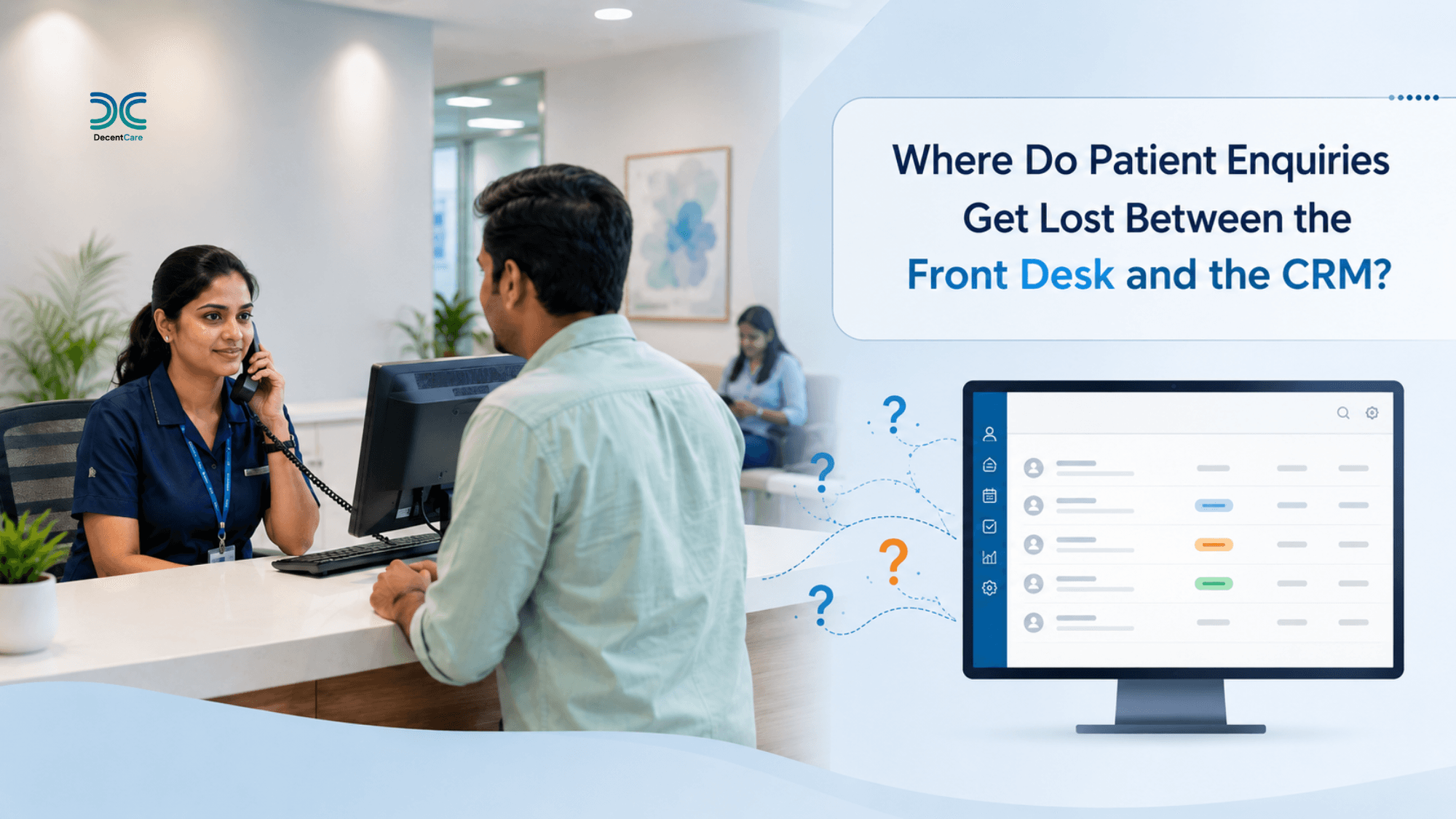
It cannot see treatment interest, so an orthopaedic surgical enquiry and a general query about visiting hours are counted as the same event. It cannot see intent, so a patient ready to book this week is indistinguishable from one who is casually comparing three cities. It cannot see the drop-off point where an enquiry died: the WhatsApp message left unread through the afternoon, the call that rang out, the follow-up that a busy front desk never made. It cannot trace a source through to an actual treatment, so the marketing budget can never honestly tell the finance office which spend produced which case. And it cannot see patient lifetime value, which is where the real return on a hospital's marketing sits.
These blind spots are not academic. Missed signals do not simply disappear. Every enquiry a hospital cannot see clearly, and therefore cannot act on, is a patient a competitor gets instead. Cost per lead reports a tidy average while the most valuable cases leak out through gaps the metric was never built to detect.
Revenue in a hospital is concentrated in cases, not contacts. An outpatient consultation contributes modestly. A high-acuity surgical case contributes a great deal more. The financial reality of the sector is measured in case value and in revenue per occupied bed, not in the count of enquiries at the top of a funnel.
The scale of that difference is visible in the sector's own numbers. According to credit-rating agency ICRA, Apollo Hospitals Enterprise recorded average revenue per occupied bed of ₹60,588 per bed per day in FY2025, up from ₹45,327 in FY2022. In the same reporting, Apollo's average revenue per inpatient stood at roughly ₹1.75 lakh, reflecting a premium and complex case mix. A single treated case, in other words, can be worth what a marketing team might otherwise chase across hundreds of low-intent enquiries. The unit of value in a hospital is a treated case with real clinical and financial weight. It is not a form fill.
Once that is accepted, the flaw in cost per lead is obvious. A metric that treats every enquiry as equal is measuring the wrong denominator. It is counting the cost of raising a hand, while the business runs on the value of a case completed.
If cost per lead sits too far up the funnel, the useful measures sit further down, closer to revenue. A hospital that wants marketing to be a growth engine rather than an expense line should build its reporting around numbers it can actually bank.
Cost per booked consultation, which counts only enquiries that became a scheduled appointment, makes marketing and the front desk jointly accountable for the same outcome. Cost per treated case connects spend to a completed episode of care. Cost per case by specialty exposes which departments genuinely repay their marketing, so an orthopaedics or oncology programme is judged on its own economics rather than hidden inside a blended average. Source-to-revenue attribution lets the finance office see which channel produced which case, not merely which channel produced the most enquiries. Drop-off point mapping shows exactly where interested patients disengage, turning guesswork into a fixable list. And patient lifetime value, the correct long-run denominator, captures the returns, referrals and future episodes that a single-visit view will always miss.
None of these metrics is exotic. What stops most hospitals from using them is not willingness. It is visibility. The data required to calculate them honestly is scattered, unlabelled, or simply never captured.
A hospital already runs on software, so the natural question is why these numbers are so hard to produce. The answer is that the existing systems were built for other jobs. A HIMS records what happened clinically and administratively; it is an excellent system of record, but it does not explain why a particular enquiry did or did not become a treated case. A hospital CRM chases activity and logs status, but it cannot see the behavioural signals that reveal intent before a status ever changes. Between the record of what happened and the chasing of what is open, the decision itself, the moment a patient chose or drifted away, goes unobserved.
This is the gap DecentCare was built to close. As a behavioural intelligence platform for Indian hospitals, it sits above the HIMS and reaches beyond a hospital CRM, capturing the decision signals that neither system was designed to see. The idea it works from is deliberately plain: understand your patients, grow your hospital.
It does this through three modules. OmniLens is the behavioural data layer that captures the signals a hospital is currently blind to, turning scattered enquiry behaviour into visible, structured data. OmniJourney is the intelligence engine that scores intent, predicts where a patient is about to drop off, and recommends the next best action, so the team acts on the enquiries most likely to become cases. OmniCare, the patient journey CRM, moves a hospital from status tracking, where a lead is simply open or closed, to intent-aware tracking, where the team can see who is ready, who is hesitating, and why. Together they make cost per booked consult, cost per treated case and source-to-revenue attribution measurable rather than aspirational. For the wider picture, it is worth seeing how DecentCare works for hospitals as a single connected view rather than three separate tools.
None of this is an argument against capturing leads, and it is not an argument that leads are bad. Lead management is a genuine and necessary part of the work, and cost per lead is a reasonable efficiency check on the top of the funnel. The error is one of rank. Cost per lead has been promoted to the headline measure of marketing success, a position it cannot support, because it cannot see whether an enquiry ever became a patient.
Demote it, and the picture clarifies. Let cost per lead sit where it belongs, as one early efficiency signal, and let cost per booked consult, cost per treated case and patient lifetime value run the review. The behaviour of the whole marketing programme changes: the team stops buying cheap volume and starts protecting the enquiries that convert. For the operational decisions that sit underneath these numbers, understanding the patient journey and the reasons why most clinic enquiries die in 24 hours are the natural next reads, because a metric only improves once the behaviour it measures becomes visible.
Cost per lead is not evil. It is simply the wrong headline for a hospital, because it measures the price of interest rather than the value of a case, and it stops seeing at the exact moment a hospital's economics start. The hospital marketing metrics that matter, cost per booked consult, cost per treated case, source-to-revenue attribution and patient lifetime value, all depend on one thing the average hospital does not yet have: visibility into patient behaviour and intent. To see what a case-based, behaviour-led view of marketing looks like for a specific hospital, explore how DecentCare makes the patient journey visible.
Q: Is cost per lead a bad metric for hospitals?
A: Not bad, just misranked. Cost per lead is a fair top-of-funnel efficiency check, but it prices an enquiry rather than a patient. It cannot see intent, specialty value or whether a lead became a treated case, so it should never be the headline measure of hospital marketing success.
Q: What should a hospital measure instead of cost per lead?
A: Measure outcomes closer to revenue: cost per booked consultation, cost per treated case, cost per case by specialty, source-to-revenue attribution, drop-off point mapping and patient lifetime value. These connect marketing spend to cases the hospital actually treats and banks, rather than to the raw count of enquiries at the top of the funnel.
Q: Why is a cheap lead sometimes a bad patient for a hospital?
A: Because a low cost per lead often reflects low intent. A cheap enquiry may be for a non-priority service, from a patient outside the catchment, or with no real plan to book. It lowers the average and looks efficient, yet it rarely converts into a treated, revenue-generating case.
Q: How is a hospital's marketing economics different from B2B or e-commerce?
A: In B2B and e-commerce, a lead and a sale sit close together, so cost per lead works. In a hospital, revenue comes from cases and lifetime value, and the journey from enquiry to treatment spans weeks and multiple touchpoints. Value is concentrated in a few high-acuity cases, not spread evenly across enquiries.
Q: Why can a HIMS or a hospital CRM not show marketing ROI properly?
A: A HIMS records what happened clinically and administratively, and a CRM tracks activity and status. Neither captures the behavioural signals that reveal patient intent or the exact point where an enquiry dropped off. That decision layer stays invisible, which is why source-to-treatment attribution and true marketing ROI are so hard to produce.
Q: How does DecentCare help a hospital track cost per treated case?
A: DecentCare captures behavioural and intent signals through OmniLens, scores intent and predicts drop-off through OmniJourney, and tracks the journey through OmniCare. This connects a source to a booked consult and then to a treated case, making cost per treated case and source-to-revenue attribution measurable rather than estimated.
Q: Does DecentCare replace a hospital's existing HIMS or CRM?
A: No. DecentCare is a behavioural intelligence platform that sits above the HIMS and reaches beyond a hospital CRM. It adds the decision and intent layer those systems were never built to capture, so a hospital keeps its record and activity systems while finally gaining visibility into why enquiries do or do not become patients.

Creates reader-focused content that simplifies complex topics and delivers valuable insights across healthcare, publishing, and content development.