Hospital Marketing & SEO
Indian Healthcare Marketing in 2026: Where the Field Is Heading Next
Vamshi Kantoju
Read more 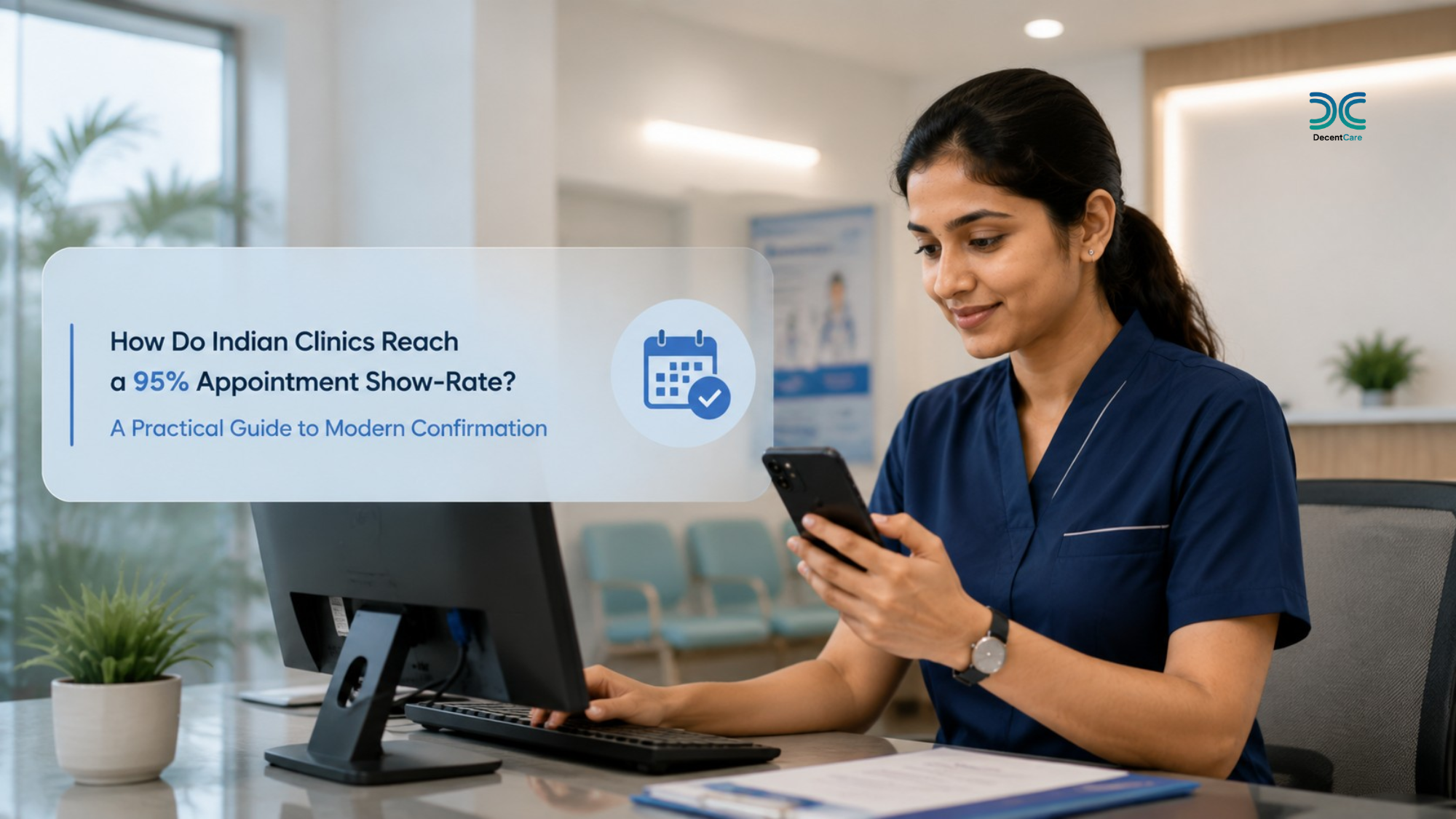


The best-run Indian clinics do not reach a 95 percent appointment show-rate by sending more reminders. They reach it by treating appointment confirmation as the start of a system rather than the end of a booking. This is a practical guide to what that system actually looks like inside a clinic: the signals a booked patient gives, the way modern confirmation reads them, and how DecentCare, the behavioural intelligence platform built for Indian hospitals and clinics, turns those signals into arrivals rather than empty chairs.
A booking system records that a slot was requested. It does not record whether the patient will attend. Industry estimates place OPD no-shows in urban Indian clinics somewhere between 20 and 30 percent, which for most clinics translates into close to a full working day of empty capacity every week. The appointment confirmation, sent the moment the slot is booked, does not close that gap on its own. It only marks the beginning of an interval in which the clinic loses sight of the patient.
DecentCare exists to make that interval visible. Between the moment a slot is booked and the moment the patient walks through the front door, the patient sends signals. Some acknowledge the confirmation, some ignore it. Some complete a pre-appointment form, some do not. Some are still researching alternatives, some have already committed. A clinic that only sees the booking record cannot separate these cases from each other. A clinic that reads the behavioural signals in between can.
The instinct, when missed appointments climb, is to send another reminder. That instinct plateaus quickly, and it is the pattern DecentCare is built to replace. A broadcast reminder, delivered identically to a committed patient and a wavering one, cannot solve a problem that is rooted in intent. The reminder addresses forgetfulness. It does not address hesitation about cost, uncertainty about the treatment plan, or a booking made three weeks in advance and never revisited since.
DecentCare's approach begins from the opposite direction. Every reminder, every call, every nudge is calibrated to what the patient has already signalled. A patient who tapped confirm, completed the pre-appointment form and made the UPI payment needs a light touch. A patient who booked three weeks in advance, ignored two confirmations and has a history of dropping off needs something quite different. Inside DecentCare, the reminder becomes one instrument among several, deployed where it is most likely to change the outcome.
The interval between confirmation and arrival is not empty. It is full of readable behaviour. OmniLens, the behavioural data layer inside DecentCare, is what stitches these signals into one live timeline for each booked patient, drawing from web, calls, WhatsApp and visits.
The signals worth reading are specific. Whether the patient acknowledged the appointment confirmation. How far in advance the booking was made, because slots booked many weeks out and never revisited carry more risk than same-week bookings. The patient's past attendance history at the clinic. Whether pre-appointment tasks have been completed, from the digital form to the UPI payment. What the patient searched for and read on the clinic's website before booking. How many touchpoints across WhatsApp, calls and web preceded the appointment. Whether the tone of an earlier call or message suggested hesitation about affordability, the diagnosis, or the treatment plan.
Each of these signals, taken alone, is weak. Read together as part of the patient's journey history, they tell the clinic something no confirmation status can: how likely this particular patient is to arrive on the day.
Reading the signals is the first job. Deciding what to do about them is the second. Inside DecentCare, that job belongs to OmniJourney, the behavioural AI engine. OmniJourney scores intent for every booked patient, predicts which patients are most likely to drop off before the appointment, and recommends the single next best action for each one. For a low-risk patient, that action might be a scheduled reminder the day before. For a high-risk patient, it might be a personal call from the front desk, an earlier outreach on WhatsApp, or a message that addresses a specific concern already raised earlier in the journey.
OmniCare, the patient journey CRM inside DecentCare, is where those recommendations become work the team can act on. Every scheduled patient sits on one screen with the confirmation status, the risk read, and the next best action visible at a glance. The front desk stops guessing which of tomorrow's forty patients to call. The system already knows. This is what places DecentCare beyond a clinic CRM in the ordinary sense: clinic management software records what happens, a CRM chases a deal, and neither reads the interval where the arrival is actually decided.
A show-rate that consistently sits near ninety-five percent is not the result of one sharp feature. It is the product of several parts working together, and DecentCare is designed so those parts live inside a single platform rather than being stitched across separate tools.
Appointment confirmations and reminders flow natively through WhatsApp via approved templates, on the channel Indian patients read most reliably. The pre-OPD digital form lets the patient complete registration on a phone before arriving at the clinic, which removes one of the most common friction points at the front desk. UPI payment through the appointment link clears in seconds. QR check-in at the clinic removes the queue at reception. Missed calls are logged automatically inside OmniLens and surfaced through OmniJourney with a recommended next best action for the team.
Every completed case, and every missed appointment, feeds back into the model. Over time the risk read gets sharper, the reminder cadence gets leaner, and the front desk spends less of its energy chasing patients who never intended to arrive.
The immediate change is capacity. A clinic operating with a twenty-five percent no-show rate is quietly returning close to a full working day of appointments to nobody every week. Pulling that number toward five percent, which is what a DecentCare-powered appointment system is built to do, recovers that capacity without new marketing spend, without new staff, and without new consulting rooms. The revenue lift is not a projection. It is what was already booked.
The second change is operational. Days become predictable. The front desk stops firefighting and starts working from a screen that already knows which patients need the most attention. Inside DecentCare, that screen is OmniCare, and it sits at the centre of the clinic's day. Doctors see a summarised history before the consult begins. Financial counsellors know which patients need a longer conversation about payment options.
The third change is quieter but more consequential over time. Every patient who arrives is a patient the clinic can treat, follow up with, retain, and eventually be recommended by. A clinic that reliably converts bookings into arrivals also converts arrivals into loyalty, and loyalty into referrals. This is the compounding effect DecentCare is built to produce, because the same behavioural signals that lift the show-rate today also inform the clinic's understanding of the patient across months and years.
What is a normal no-show rate for Indian clinics?
Rates vary by specialty and setting. Industry estimates place OPD no-shows between twenty and thirty percent for many urban private clinics and government hospitals, though individual studies at Indian tertiary centres have reported lower figures. Most clinics that do not actively manage the problem sit inside this band, which represents roughly one working day of lost capacity every week.
Does an appointment confirmation guarantee the patient will arrive?
No. A confirmation records that the patient acknowledged the slot at the moment of booking. It does not read the patient's intent in the hours and days that follow, when hesitation, forgetfulness, transport barriers and cost concerns tend to surface. DecentCare exists to read that interval, and to convert confirmations into arrivals at much higher rates.
Do WhatsApp appointment reminders reduce no-shows in India?
They help, because WhatsApp is the channel most Indian patients read reliably, but they help most when they are part of a system rather than a broadcast. A reminder addresses forgetfulness, not intent. Attendance improves when reminders are calibrated to each patient's risk of missing and paired with the right channel, tone and timing, which is what DecentCare does.
Can a clinic predict which patients will miss an appointment?
Yes, with useful accuracy. OmniJourney inside DecentCare reads the behavioural signals around each booking, including lead time, confirmation status, past attendance, engagement with pre-appointment tasks and journey history, and produces a risk score. The clinic does not need perfect prediction. It needs to know which handful of tomorrow's patients deserve a personal call today.
How is DecentCare different from clinic management software?
Clinic management software records what happens. Scheduling tools store the booking. Neither reads the behavioural interval between the booking and the arrival, which is where the show-rate is actually decided. DecentCare is a behavioural intelligence platform that captures the signals patients give, scores intent, and directs the team toward the patients most likely to miss.
Does DecentCare handle appointment reminders itself?
Yes, natively. Appointment confirmations, reminders, reschedule notifications and post-appointment follow-ups all flow through WhatsApp, SMS and voice inside DecentCare, using approved templates. The cadence is tiered by risk rather than sprayed evenly, so a low-risk patient receives a light touch and a high-risk patient receives an earlier, warmer intervention on the channel most likely to work.
How quickly can a clinic start using DecentCare?
DecentCare goes live in 48 hours. No IT team is needed. A dedicated Customer Success Manager configures departments, doctors and branches, links WhatsApp, and walks the staff through the platform role by role. The first real patient is managed inside the first week, with the KPI dashboard live from that point onward.
See the appointment system that actually delivers arrivals
A ninety-five percent show-rate is not a lucky number. It is what happens when the clinic can finally see what patients are doing between the booking and the arrival, and can act on it before the slot goes empty. Book a demo to see DecentCare running on a real clinic's schedule, live in 48 hours, with no IT team needed. Understand your patients, grow your hospital.

A Product Owner and Customer Success Manager at DecentCare, leading the onboarding and setup of the Patient Care Journey platform for hospitals and clinics. Works closely with hospital teams across product and operations, making sure HIMS setups and integrations run smoothly so that care teams can spend more time on patients.