Hospital Marketing & SEO
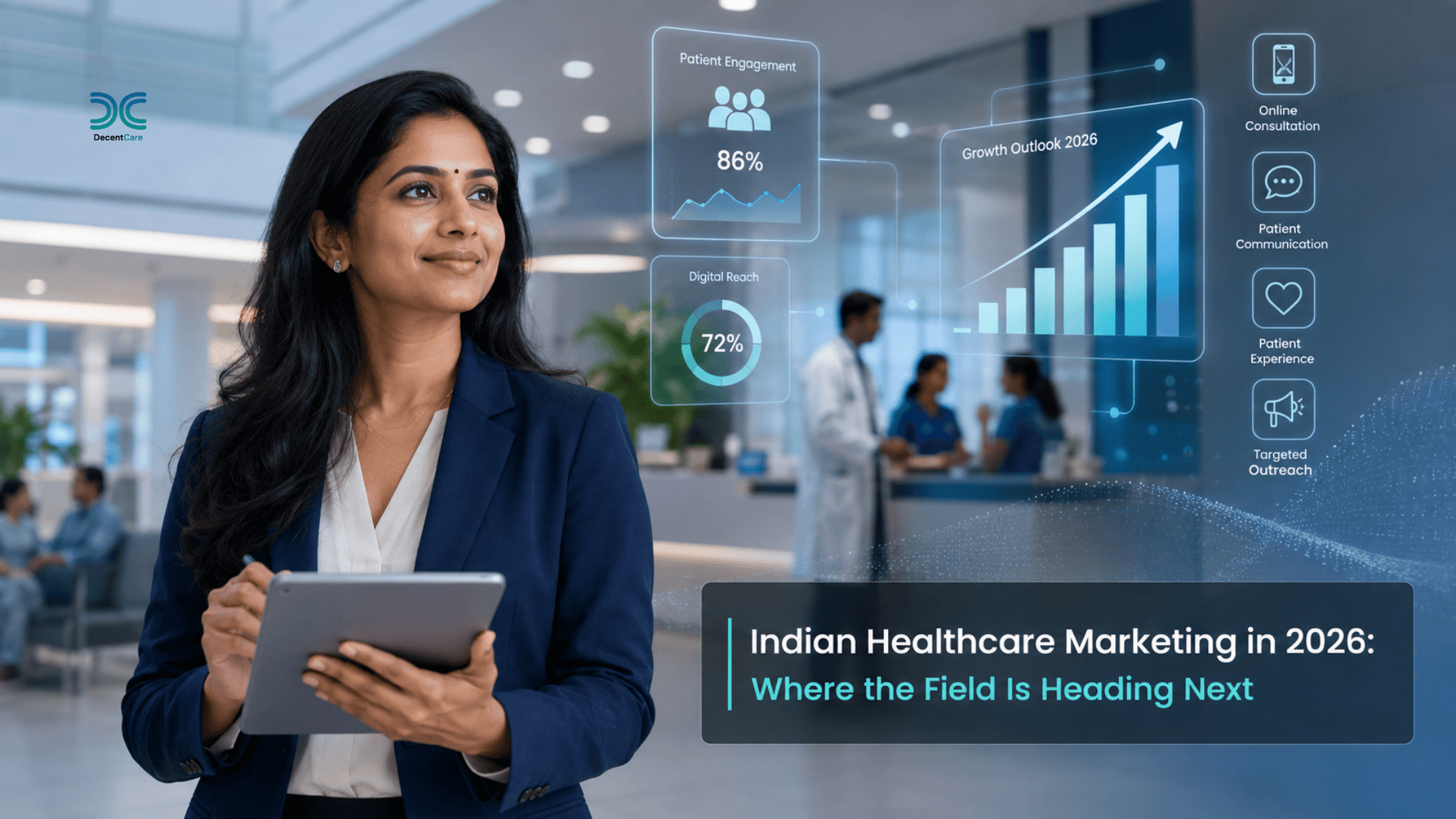
Indian Healthcare Marketing in 2026: Where the Field Is Heading Next
Vamshi Kantoju
Read more 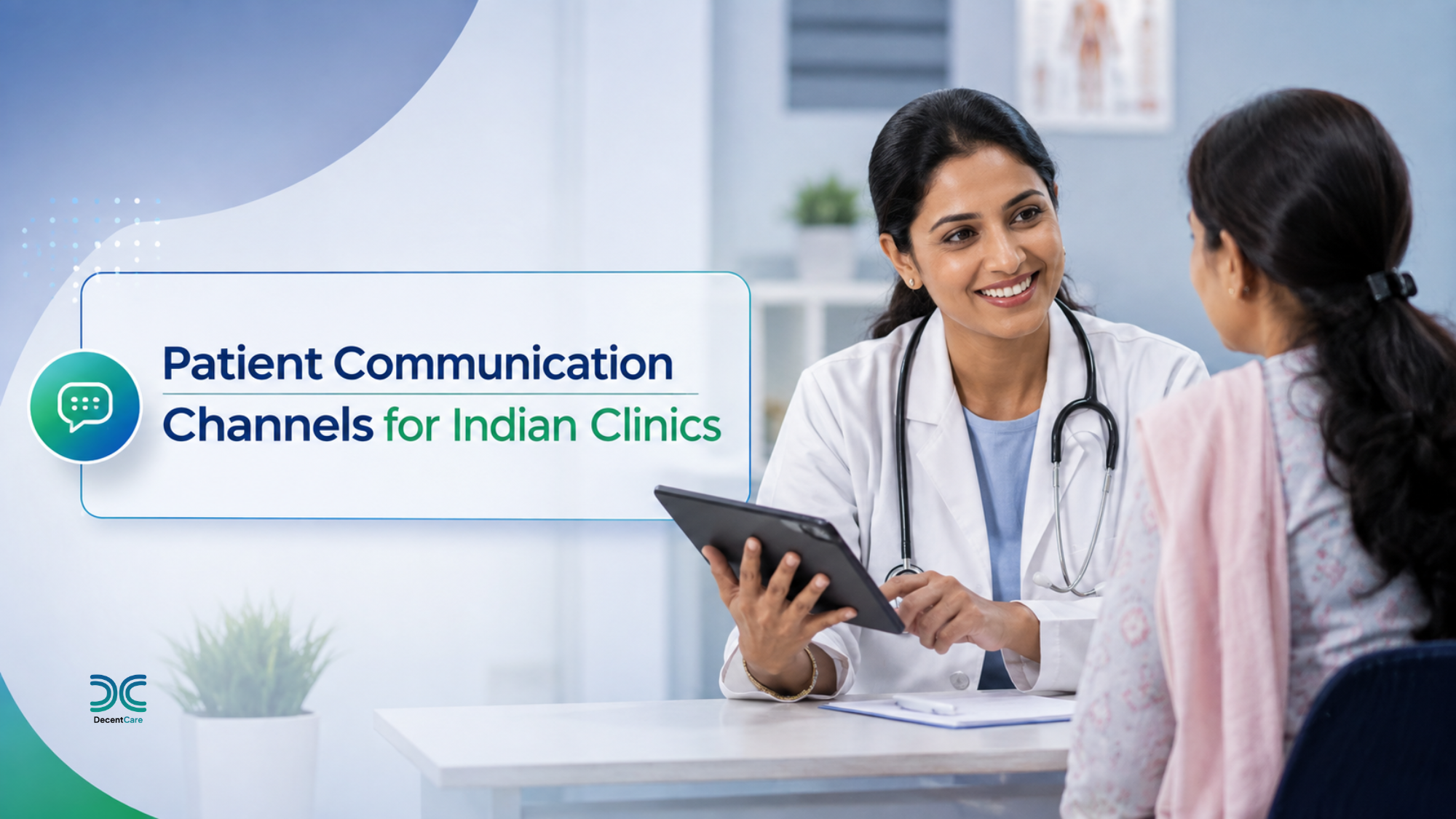


Patient communication channels for an Indian clinic are not three apps to pick between. They are three signal-response paths, each with its own delivery reality, its own read behaviour, and its own reason for existing. Choosing whether a patient hears from the clinic on WhatsApp, SMS or email is a platform decision made per case, not a policy decision made once for everyone. DecentCare, a behavioural intelligence platform built for Indian hospitals and clinics, reads what each patient just did and picks the channel most likely to be read and answered for that specific case.
What patient communication channels actually are in a clinic setting
Patient communication channels are the delivery routes a clinic uses to reach a patient outside the consulting room: WhatsApp, SMS, email, voice calls, and increasingly voice notes and in-app notifications. From the platform's point of view, each channel is a delivery layer plus a reading environment. WhatsApp lives inside a chat thread the patient checks all day. SMS lives in an inbox that mostly holds OTPs and bank alerts. Email lives in a longer-form space with attachments, subject lines and a slower rhythm.
Three things separate a channel from a message. First, the delivery contract: what the network or the app will let the clinic send, when, and after what consent. Second, the reading behaviour: how quickly and how carefully the patient will actually look at what arrives. Third, the reply path: whether the patient can respond in the same medium, and whether that reply comes back into the clinic in a way anyone reads.
A clinic that treats these three as one collapses the channel question into a preference question ('we use WhatsApp for everything'), which is where most channel policies quietly fail.
Why the channel question is a signal question, not a preference question
Choosing a channel by policy assumes every patient reads the same way. The evidence from any operating clinic contradicts that. A 62-year-old post-surgical patient in Vijayawada may open every SMS from the clinic within an hour and never see a WhatsApp because the family shares the phone. A 34-year-old cosmetology enquiry in Bengaluru may have blocked SMS as promotional and reply to WhatsApp inside two minutes. A first-time IVF enquiry may prefer email precisely because it offers privacy from the household inbox.
None of that is a channel preference. It is a behavioural signal the platform can read: what the patient responded to last time, what silence looked like on which channel, what device the enquiry came from, what language the patient typed in, what time of day the reply arrived. A follow-up channel that reads those signals lands as considerate. A follow-up that ignores them and defaults to WhatsApp because the clinic likes WhatsApp gets muted, marked as spam, or ignored.
The platform frame reframes the question. It is not 'which is the best channel for Indian clinics' but 'which channel is most likely to be read and answered by this patient right now, given what the platform has observed about this case.' Every follow-up cycle across the full patient journey refines the answer.
What WhatsApp, SMS and email each actually do for a follow-up in India
Each channel has a strong role, an honest weakness and a wrong use.
WhatsApp is the strongest channel for two-way engagement in Indian healthcare. Read rates for opt-in programmes sit well above email, and more importantly, patients actually reply on WhatsApp, in their own language, at a pace that lets a coordinator hold a real conversation. The channel is best used for follow-ups that need a response: appointment confirmation, symptom check-in, decision counselling, doctor Q and A. Its weakness is that WhatsApp Business messages are template-gated by Meta outside a 24-hour session window, so a nurture message sent seven days after a consultation must ride an approved template, not free text.
SMS is the strongest channel for guaranteed delivery. It clears networks WhatsApp cannot always reach, needs no app, and reads on any handset in any village in India. Its weakness is engagement: SMS in India sits inside an inbox dominated by OTP traffic and bank alerts, so opens are comparable to WhatsApp but replies are rare. SMS is best used for transactional confirmations, one-way reminders and time-critical notifications where the goal is delivery, not conversation. It is the wrong channel for a message that needs a reply.
Email is the strongest channel for long-form context, attachments and formal correspondence. Discharge summaries, insurance pre-authorisation copies, treatment plans, invoices, and second-opinion documents belong here. Open rates for cold outreach cluster around 20 to 25 per cent, but for opt-in transactional email from a hospital the numbers are considerably better. Email is best used where documents matter more than immediacy. It is the wrong channel for a same-day appointment reminder or a rescheduling nudge.
Any single-channel policy ('WhatsApp only', 'SMS only', 'email only') trades one strength away for another. The right question is not which of the three wins, but which of the three fits the case at hand.
What the platform reads before it chooses a channel
The signal layer captures everything the patient has already done, so channel choice is grounded in evidence rather than assumption. In DecentCare, this is OmniLens, the behavioural data layer. It turns every touch, meaning a form fill on the website, a missed call at reception, a WhatsApp reply, an email open, a paid-search click, a Google Business Profile tap-to-call, into one behavioural timeline per patient.
For channel selection specifically, OmniLens surfaces the signals that matter: which channels the patient has actually opened and replied on for prior messages from the clinic; the device type behind the enquiry (feature phone versus smartphone versus desktop); the language of the last patient-typed message; the time-of-day rhythm the patient reads at; whether SMS to that number has bounced or been marked promotional; whether WhatsApp opt-in has been recorded; whether an email address the patient supplied has ever responded.
None of this is guesswork. Each of these signals is captured naturally as the patient interacts with the clinic. A HIMS records diagnoses and prescriptions. A generic CRM records lead status. Neither records the channel history that decides whether the next follow-up will be read.
How the platform picks the channel for this patient, this moment
Once the signals are in place, the decision layer chooses. In DecentCare this is OmniJourney, the behavioural AI engine. For a given case at a given stage, OmniJourney places the patient on the journey (enquiry, appointment, pre-OPD, consultation, procedure, post-op, retention), reads the intent behind their most recent behaviour, predicts whether the patient is drifting or ready to proceed, and recommends the next best action. That recommendation includes the channel the action should ride on.
The recommendation is not a static rule ('always send WhatsApp'). It is a per-case, per-moment call. A first-time enquiry that came in through a paid-search click and left a mobile number on a Sunday evening might get a WhatsApp confirmation with a short question, because that patient is already inside a chat context. A silent post-op patient at day three who has opened previous SMS reminders but never replied on WhatsApp might get an SMS symptom check with a callback offer. A patient who submitted an insurance pre-authorisation query and never came back might get an email with the pre-authorisation form attached and a WhatsApp nudge that references the email.
The mechanism is the same in every case: read what the patient has done, decide what the case needs next, choose the channel most likely to deliver that specific next step.
How the message actually goes out at the send step
The send layer executes the decision. In DecentCare this is OmniCare, the patient journey CRM, connected to a WhatsApp Business Account through Meta-approved templates. WhatsApp is the primary channel because engagement is highest and the platform can hold a real conversation thread. SMS is available for time-critical transactional messages and for cases where WhatsApp opt-in is not on record. Email sits alongside these as one of the four channels OmniJourney can recommend for personalised outreach, used most often for long-form and document-bearing messages.
OmniCare does not write the message. It selects the correct Meta-approved template for the stage the patient is in, populates the fields OmniJourney fed forward (patient name, treatment interest, appointment date, coordinator name, city), and sends. When the patient replies, the reply lands in the same case timeline the coordinator, the doctor and the counsellor can see. A HIMS view of the same patient shows the diagnosis; a CRM view shows the deal stage; the OmniCare case timeline shows what was said, on which channel, at what stage, and with what response.
Because every channel routes through the same case timeline, the clinic never has to reconcile three inboxes. One case, one timeline, three channels used as needed.
Why status tracking is not the same as intent-aware channel selection
Most tools a clinic already has can move a status: mark the appointment confirmed, tick the reminder as sent, close the follow-up task. Going beyond a clinic CRM means moving from status tracking (the message went out) to intent-aware channel selection (the message went out on the channel most likely to be read and answered by this patient right now). The two look identical on a dashboard until a patient stops responding. Then the difference shows.
Status-tracking systems will happily mark ten WhatsApp follow-ups as sent to a patient who has not opened WhatsApp in a month. Intent-aware channel selection notices the silence at message two, reads it as a signal, and switches the channel by message three. The behavioural intelligence layer is what turns a message-sending workflow into a channel-choosing workflow.
That is where OmniCare's Lead management sits differently from a generic CRM's lead management. Both capture the enquiry. Only the intent-aware version routes the next message through the channel the patient's own behaviour suggests will actually reach them.
What changes when channel choice is per case, not per policy
Three visible outcomes tend to follow when channel choice becomes per-case:
None of these are promised percentages. They are the direction of change a clinic sees when the channel decision moves from a policy typed into a settings page to a signal read from the patient's own behaviour. The size of the change depends on how many patients the clinic sees, how many channels it already uses, and how disciplined the signal capture is at the start.
Frequently asked questions
Which is the best channel for patient follow-up in India: WhatsApp, SMS or email?
There is no single best channel; the right choice depends on the patient, the stage of the case, and the intent of the message. WhatsApp is strongest for two-way conversations, SMS for guaranteed delivery of transactional messages, and email for long-form and document-bearing communication. A platform picks per case, not per clinic.
Does DecentCare send WhatsApp messages to patients on the clinic's behalf?
Yes. OmniCare connects to a WhatsApp Business Account (WABA) through Meta-approved templates and sends follow-ups on the channel OmniJourney recommends for each case. The platform selects the correct template, populates the fields, and routes replies into the same case timeline the coordinator, doctor and counsellor can see.
Is WhatsApp allowed for medical follow-ups in India under the DPDP Act?
WhatsApp messaging using Meta-approved templates and recorded patient opt-in aligns with the DPDP Act 2023's principle of purpose-limited, consent-based processing. Clinics should validate their specific consent-capture workflow with their DPO or counsel, but the underlying architecture (templated messages plus explicit opt-in) is standard practice in Indian healthcare.
Why send SMS at all when WhatsApp is more engaging?
SMS delivers to any handset without an app, does not depend on data connectivity in the same way, and is the safe default when WhatsApp opt-in is missing or a message is time-critical. A platform switches to SMS when the signal read tells it the patient will not receive or open a WhatsApp message quickly enough.
Can email still work for patient follow-up in India?
Email works well for messages where documents and long-form context matter more than immediacy: discharge summaries, insurance pre-authorisation, treatment plans, second-opinion correspondence. It underperforms for real-time nudges. A platform routes email for the message types it is strong for, and other channels for the rest.
How does the platform decide which channel a patient prefers?
Through behavioural signals, not a stated preference. The platform reads which channels the patient has opened and replied on for prior clinic messages, which numbers or addresses have bounced or been marked promotional, and the time-of-day rhythm the patient tends to respond at. Preference is inferred from action, not asked.
Does the clinic have to configure the channel logic itself?
No. DecentCare goes live in 48 hours with the WhatsApp Business Account linked and the template library set up by a dedicated Customer Success Manager. No IT team is needed. The channel-selection logic runs on the behavioural signals the platform captures automatically as patients interact with the clinic.
Conclusion
A follow-up that lands is not a follow-up sent on the right channel by policy. It is a follow-up sent on the right channel for the patient it is going to, read from what that patient has already done. When channel choice moves from settings to signals, reply rates rise, opt-outs fall, and the follow-up itself starts to feel considerate rather than automated.
DecentCare puts that logic in one place. To see how a clinic can pick between WhatsApp, SMS and email per case rather than by policy, book a 30-minute demo. Live in 48 hours. No IT team needed. Understand your patients, grow your hospital.

Creates reader-focused content that simplifies complex topics and delivers valuable insights across healthcare, publishing, and content development.