Hospital Marketing & SEO
Indian Healthcare Marketing in 2026: Where the Field Is Heading Next
Vamshi Kantoju
Read more 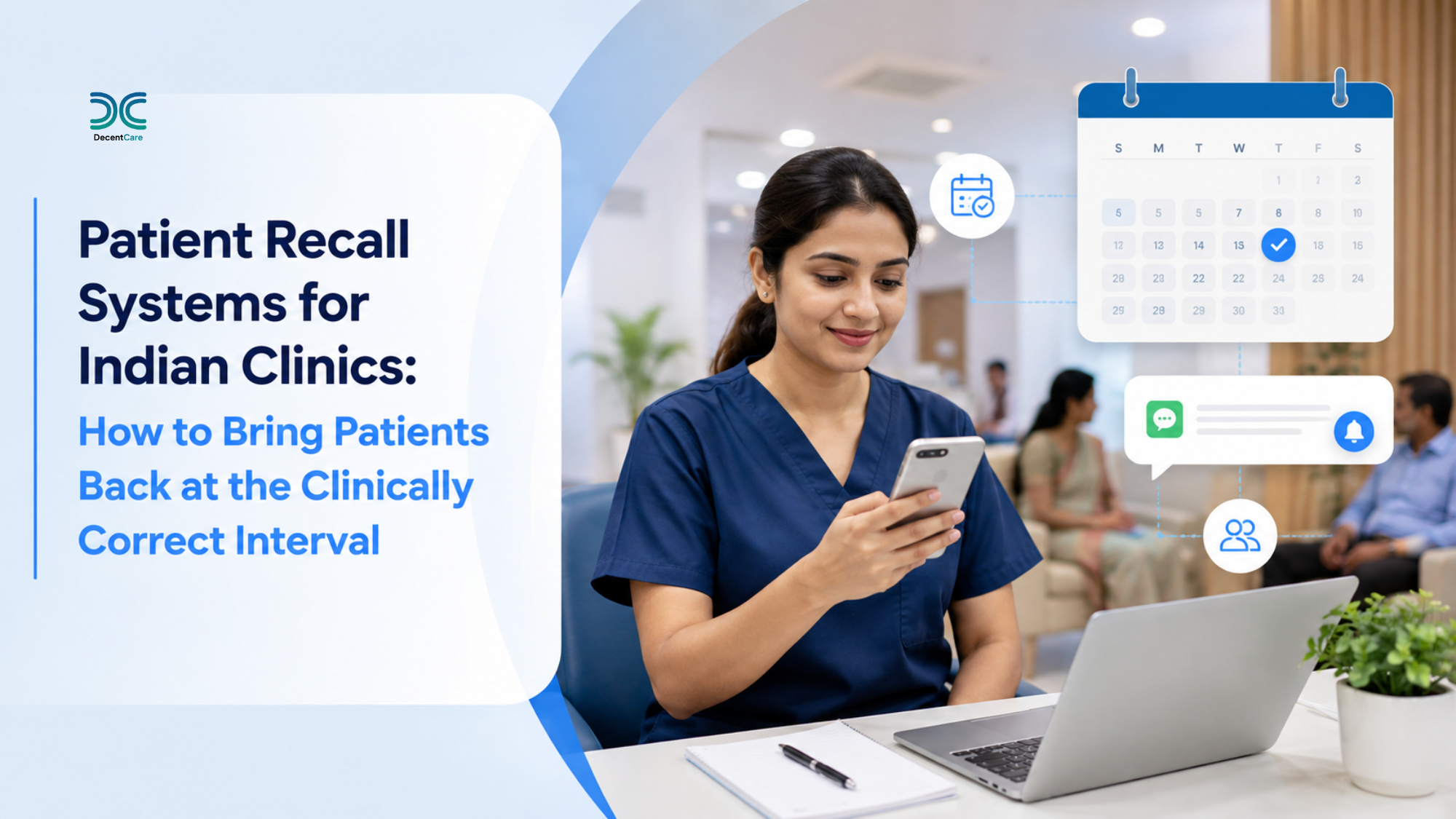


A patient recall system is what a clinic uses to bring back patients whose next visit is due, before that visit slips past the interval when it clinically matters. Every clinic has some form of recall already: a diary, a pending list, a WhatsApp broadcast before Diwali. What most Indian clinics do not have is a system, in the strict sense, which is why so many patients drift from due to overdue to eventually gone. Recall is a different problem from reactivation. Recall reaches a patient the clinic still expects to see; reactivation fights to recover a patient whose intent has already faded. Getting recall right shrinks the reactivation list before it forms.
This piece is for clinic owners, administrators and managers who want to understand what a working patient recall system looks like in Indian conditions, how it differs from reminders and follow-ups, and why running recall as a behavioural discipline stops losing revenue to intervals that quietly expire. DecentCare sits behind this discipline for clinics that want recall to run on read signals rather than on someone remembering.
What a patient recall system is, and what it is not
A patient recall system is the operational discipline of tracking each active patient against the clinically correct interval for their next visit, and reaching out with a specific action when that interval opens, is due, or is at risk of slipping past. It sits between two practices Indian clinics already run. It is not an appointment reminder, which addresses a patient with a booked appointment. It is not a reactivation campaign, which addresses a patient who has gone silent. Recall is the interval in between: the patient is expected back, no appointment is booked, and the return window is either approaching, open, or closing.
Each of the three practices has a different failure mode. Reminders fail when a booked patient does not show up. Reactivation fails when a lapsed patient does not respond to a win-back. Recall fails when the clinic did not know the interval had opened, or knew but did not act on it in time. Most Indian clinics have some version of the first two; the third quietly determines how large the reactivation pile becomes.
A working recall system does three things the calendar and the broadcast cannot. It holds the clinical interval per patient rather than per campaign window. It reads whether that interval is on schedule, running late, or so overdue that a plain recall message is no longer the right action. And it triggers the specific action that fits the case: a WhatsApp template, a coordinator call, a nudge to review a report, or a handoff to reactivation. DecentCare, a behavioural intelligence platform built for Indian hospitals and clinics, runs recall on this shape rather than on batch calendar sweeps.
Why patient recall is not patient reactivation
Recall and reactivation are treated as the same activity in most Indian clinic-marketing content, and the conflation is expensive. The two share a channel and often a template, but they address different cohorts and require different reads. A patient three weeks overdue for a six-month dental cleaning still expects the clinic. A patient fourteen months silent after an IVF cycle the clinic did not respond to has already made a decision, and needs a different kind of outreach.
Treating both as one activity produces two failures. Recall gets absorbed into the reactivation calendar: a Diwali win-back push sweeps everyone overdue and treats a patient thirty days past due for a retinopathy screening the same as a patient eighteen months silent. The thirty-day patient did not need a win-back; a clinically framed recall would have booked the visit. The opposite also happens: recall messaging is sent to the dormant list, and patients who long ago stopped considering the clinic are treated as if the interval were still live. Both patterns reduce message trust and waste template sends.
The boundary is held by defining recall around the clinical interval and reactivation around the intent state. Recall runs while the interval is open, on-time or moderately overdue, and the patient is still in the return window a clinician would call reasonable. Reactivation begins where the interval is far enough past that clinical continuity is broken and the case must be re-established from behavioural signals rather than protocol.
Why recall is chronically weak in Indian clinics, and where the interval leaks
Most Indian clinics run recall from three fragile sources. The first is the memory of the front-desk team, sharpened by a diary or a broadcast list. The second is a HIMS rule that generates a list of patients due in the next thirty days. The third is the clinician remembering a specific patient during a review. Each source works for the cases it can see, and each fails for reasons that compound.
Front-desk memory fails because the team turns over and handovers slip. HIMS lists fail because a records system captures what has happened, not the behavioural signals that show a patient drifting from the interval. Clinician-driven recall fails because it is not systematic. Peer-reviewed India evidence is consistent. A 2025 prospective study of post-operative follow-up at a tertiary South India hospital, published by Abraham and colleagues in BMC Musculoskeletal Disorders, found only 53.7 per cent of two hundred and forty patients fully compliant with their follow-up schedule, with adherence to the specific appointment date a statistically significant factor. The interval itself, not the intention to return, decides whether the patient comes back.
Interval leaks also come from how clinics classify recall. Many run a single recall list across all specialties and intervals, flattening the difference between a dental six-month recare, an ophthalmology annual review, a post-operative day-three call, a chronic-care three-month check, and an IVF cycle-two window. Each has a different clinical rhythm and a different action that fits when it opens. A single-list approach treats them as one queue, worked in whatever order the front desk has time for. This is the gap a behavioural recall system, run through OmniLens, is designed to close.
How to classify a recall list by clinical interval state
A recall list becomes usable when every patient on it is classified by where their interval stands, not by when the clinic last spoke to them. Four states cover most cases an Indian clinic will hold. The platform reads the underlying signals; the clinic uses the four states to decide what happens next.
Interval on-schedule
The patient is inside the expected interval and the return date is approaching. Nothing has drifted. The recall action is a clinically framed prompt shortly before the interval opens, with a specific booking mechanism. This is the largest cohort in a healthy practice, where a well-timed WhatsApp template does most of the work before the interval is at risk.
Interval just opened
The interval has arrived, no appointment has been booked, and the patient has not initiated. This is the state most clinics call "due", and it is where recall discipline matters most. A behavioural read here answers a question the calendar cannot: is the interval opening quietly (no signal) or noisily (the patient has been reviewing the site, opened a previous message, called and hung up).
Interval overdue
The interval has passed by a clinically meaningful margin, but the return is still appropriate. The patient is not yet dormant. The recall action here needs to acknowledge the delay honestly rather than pretend the interval has just opened, and the framing usually shifts to a specific reference: the last report, the last conversation, the specific review that is now waiting.
Interval lapsed
The interval is far enough past that clinical continuity is broken. This is the boundary between recall and reactivation. A case in this state should be handed off to the reactivation workflow, because a plain recall message no longer fits and continuing to send one wastes the trust earlier messages built. The clean handoff is missing in almost every Indian clinic that runs recall from a single list.
The sorting is not a manual exercise for the coordinator. DecentCare's behavioural signal reading makes the difference between the four groups visible in the first place, because a status view of the HIMS cannot see whether an interval-just-opened patient has been quietly reviewing the site for four days or has not touched the clinic's presence at all.
How the platform reads a recall interval and turns it into a specific action
Once the list is classified by interval state, the mechanism for reading each case and choosing the next action becomes the deciding factor. In a DecentCare-run clinic, three modules divide the work; each does a documented job, and the value comes from how the three feed into each other.
OmniLens (SEE) is the behavioural data layer. For a recall case, it consolidates the signals across every touch produced since the last visit: return visits to the clinic's website, WhatsApp template opens, calls placed and dropped, GMB direction lookups, opened previous reports, treatment pages browsed. These are the same behavioural sources OmniLens already captures for every case, brought to bear on the recall cohorts so the coordinator can see which patients are producing signal and which are silent.
OmniJourney (UNDERSTAND) scores the strength of that signal and recommends the next best step. The same intent scoring that tells a coordinator which live enquiry is close to booking tells the platform which recall-due patient has enough residual signal for a warm coordinator call, and which is best served by an interval-appropriate WhatsApp template. Behavioural segmentation groups the recall cohort by urgency, concern, affordability and engagement. OmniJourney produces next-best-action outputs across content, calls, counselling and nudges; recall uses the same closed set.
OmniCare (ACT) is the patient journey CRM where the recall action lands. It sends the Meta-approved WhatsApp template through the WhatsApp Business Account, tracks the response, escalates to a call when silence passes a defined threshold, and shows the coordinator, counsellor and doctor one timeline of what has been sent, read, replied to, and what happens next. When the interval crosses into the lapsed state, OmniCare hands the case off to reactivation with the recall history intact.
Why status tracking is not the same as interval-aware tracking
Most Indian clinics track the recall list by status: "called", "no response", "message sent", "to be followed up". A status view records what the clinic did. It is not a read of where the patient is. Two patients with the same status can sit in entirely different behavioural states and need different next actions. Status tracking makes them look identical; interval-aware tracking, running on the behavioural signals OmniLens captures, does not.
Consider two ophthalmology patients marked 'message sent' on the recall list. Patient A opened the WhatsApp template, spent seven minutes on the retinopathy page, called reception, and hung up when the line was engaged. Patient B was sent the same template three days ago and has not opened it, visited the site, or called. In a status view, both are pending. In an interval-aware view, patient A is producing readiness signals and needs a coordinator call within the day; patient B needs a differently framed message before human time is spent.
This is where the behavioural discipline goes beyond a clinic CRM. A CRM will hold the list, capture the status of each contact attempt, and produce a report of how many were called this week. What it cannot do, because a CRM is built to close deals rather than to read decisions, is tell the clinic which of the two patients above deserves the next hour of coordinator time.
What changes for the clinic once recall is run on a system rather than on memory
When recall runs on behavioural signals against clinical intervals rather than on a shared diary, four things change. These are shifts in direction rather than promised percentages; the magnitude depends on the specialty, the interval structure, and the state of the current recall list.
The interval-just-opened cohort begins to book on time. Patients who would have drifted to overdue because nobody remembered the interval was open are reached with a clinically framed prompt at the point the interval is due. This cohort most contributes to protecting the reactivation list from growing.
The overdue cohort becomes visible as a distinct list. The clinic can see, at any point in the year, how many patients are within recall reach but not yet dormant, and can allocate coordinator time to them without pulling attention from the on-schedule cohort. The list stops being a backlog the team dreads and becomes a running tally the platform maintains.
The recall-to-reactivation handoff becomes clean. Cases that cross the interval-lapsed threshold move to reactivation with their recall history intact. The reactivation team stops sending recall-shaped messages to a dormant list, and the clinic stops annoying patients who made a different decision long ago.
The recall system stops depending on the memory of a specific person. When the coordinator who kept the list in her head leaves, the recall discipline does not leave with her, because the interval read, the signal read and the next-best-action recommendation live in OmniCare, not in her diary.
How an Indian clinic can start running recall as a system without a new IT project
A clinic that wants to install a recall system does not need to replace its HIMS, hire a data team, or run a change-management programme. The clinical intervals are already defined in some form: a per-specialty protocol, a doctor's standing rule, or a set of habits the front desk has learned. What is missing is the behavioural read against those intervals and the mechanism that turns the read into the specific action for each patient.
The onboarding shape most Indian clinics run with DecentCare is standard: departments, doctors and branches configured in the first three days, WhatsApp Business Account linked, and a role-by-role walkthrough on days four and five. From day five the platform is live, and fresh signals begin accumulating on the behavioural timeline. A dedicated Customer Success Manager works through the recall configuration for the first thirty days, so the clinic's actual interval structure is captured rather than an off-the-shelf template imposed.
DecentCare runs alongside the HIMS as the behavioural layer. The HIMS keeps recording what happened at each visit. The recall system reads what the patient is doing between visits, decides which cases are due, overdue or lapsed, and triggers the interval-appropriate action. This is the shape of a working recall system in Indian conditions: behavioural intelligence built for Indian hospitals and clinics, live in forty-eight hours, no IT team needed.
Frequently asked questions
What is the difference between a patient recall system and appointment reminders?
A reminder addresses a patient who has already booked; a recall system addresses a patient whose interval is due but who has not yet booked. Reminders reduce no-shows on booked cases. Recall protects the interval before there is anything to remind about. Clinics that run only reminders leave the recall interval leaking.
When does a recall case become a reactivation case?
When the interval is so far past that clinical continuity is broken and a plain recall message no longer fits. There is no universal threshold; it is set by the specialty. In DecentCare, the handoff moves the case with its full history, so the reactivation team can see what has already been tried.
Do we need to change our HIMS to run a recall system?
No. DecentCare runs as the behavioural layer alongside the HIMS. The records system continues to hold clinical history. The recall system reads the behavioural signals between visits, classifies each patient by interval state, and triggers the interval-appropriate action. The clinic keeps the HIMS and adds the discipline the HIMS was never built to run.
How is a recall system compliant under the DPDP Act 2023?
DecentCare is DPDP 2023 aligned. Data is hosted in AWS Mumbai. Tenant isolation is enforced at the data layer, encryption applies at rest and in transit, access runs through nine configurable roles with MFA, and personal health information is stripped before AI processing. Recall messages go through Meta-approved WhatsApp templates with consent captured up front.
Does the recall system replace the front-desk team?
No, it changes what the team spends time on. The routine list-checking, message-sending and status-updating moves to the platform. The team spends its time on cases where a human call is the right action, which the platform surfaces from the interval-just-opened and overdue cohorts producing readiness signals. Coordinator time gets spent where it converts.
What sizes of Indian clinic does patient recall work for?
A recall system is easier at a single-branch clinic and more valuable at a multi-branch or multi-specialty clinic, because the number of intervals to hold grows faster than the front desk can memorise. DecentCare is built for both; interval maps are configured per specialty, per branch, per doctor as needed.
How is patient recall different from a WhatsApp broadcast?
A broadcast sends the same message to a list at a moment the clinic chose. A recall system sends a specific, clinically appropriate message to a specific patient at the moment their interval is at risk. Broadcasts confuse recall with promotion, tire out the recipient list, and reduce trust in later, better-timed messages.
Bringing patients back at the right interval is the practice that shrinks the reactivation list
Patient recall is the discipline of reaching an active patient at the clinically correct interval, before the case has drifted far enough to become a reactivation case. It has its own list, its own signals, its own four interval states, and its own boundary with reactivation. Clinics that run recall as a system, on behavioural signals against interval maps rather than on memory and diaries, spend less time chasing the lapsed and see more patients return at the interval where the return is still worth making.
To see how a working recall system runs across the specialties and intervals of a specific clinic, book a 30-minute demo with the DecentCare team. Live in 48 hours, no IT team needed, built for Indian hospitals and clinics. Understand your patients, grow your hospital.

A Product Owner and Customer Success Manager at DecentCare, leading the onboarding and setup of the Patient Care Journey platform for hospitals and clinics. Works closely with hospital teams across product and operations, making sure HIMS setups and integrations run smoothly so that care teams can spend more time on patients.