Hospital Marketing & SEO
Indian Healthcare Marketing in 2026: Where the Field Is Heading Next
Vamshi Kantoju
Read more 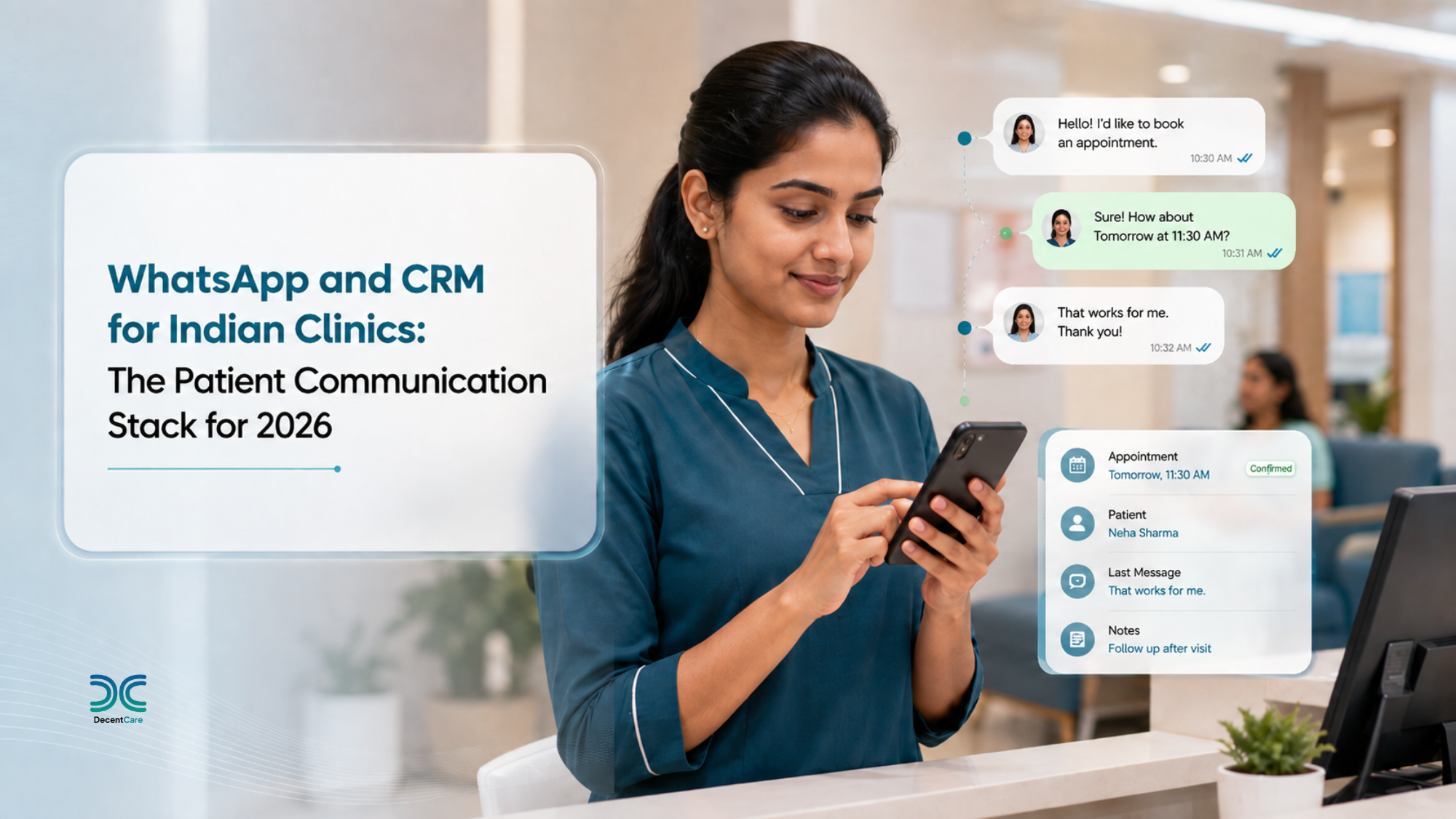


The WhatsApp patient communication stack that most Indian clinics run in 2026 is not really a stack. It is a WhatsApp Business number handled by the front desk, plus a CRM or spreadsheet that logs enquiries after the fact, plus a HIMS that records what happened once the patient arrives. Three tools, three views of the same patient, and no shared memory. DecentCare, a behavioural intelligence platform built for Indian hospitals and clinics, treats this differently: WhatsApp is not a channel that a clinic plugs into a CRM, it is the primary signal source that the full patient journey is read through. This piece explains what a real WhatsApp plus patient journey CRM stack looks like in 2026, why the two components collapse into one behavioural loop rather than sitting side by side, and how each patient conversation compounds the intelligence of the next.
What WhatsApp and CRM together form for a clinic: the patient communication stack, defined
The WhatsApp patient communication stack for an Indian clinic is the set of systems that together turn every WhatsApp conversation with a patient into a decision the clinic can act on, and every clinic action into a message the patient actually reads. In 2026 that stack has three necessary parts: a WhatsApp Business Account approved by Meta for templated healthcare messaging, a patient journey CRM that reads intent from what patients do rather than from what staff remember to type, and a behavioural layer that connects the two so the message and the moment always match. Most clinics own the first part. Many own a version of the second. Very few own the third, and the third is what turns two separate tools into a stack.
WhatsApp on its own is a communication channel. A CRM on its own is a record of what the staff logged. The stack begins when the CRM stops being a record and starts being a reader: when a patient opening a template, replying with a question, going quiet for eleven days, or tapping a location link stops being background noise and becomes data the system can score, place on a journey and act on.
Why WhatsApp has become the primary channel and why a CRM alone cannot handle it
WhatsApp has become the primary patient channel in India for a reason that has nothing to do with marketing preference. Patients read WhatsApp messages within minutes, reply on their own time, share location and documents inside the same thread, and expect a clinic response within the hour. The channel behaves less like an outbound broadcast tool and more like a low-friction two-way conversation that starts weeks before a booking and continues months after a discharge.
A generic CRM was not built for that shape of interaction. Sales CRMs assume a linear deal that either closes or stalls. A patient thread is not linear. A single WhatsApp number can carry a first enquiry, a reschedule request, a pre-op query, an insurance document, a discharge acknowledgment and a six-month follow-up, all from the same person across different journey stages. If the CRM treats each of these as a separate lead, ticket or task, the memory of the patient breaks every time the stage changes.
The clinics that make the jump in 2026 stop trying to connect WhatsApp to a sales CRM through integrations and start using a patient journey CRM where WhatsApp is native. In that architecture the WhatsApp thread is not attached to a lead record; the WhatsApp thread is the timeline, and every stage of the journey reads from the same timeline.
The three signal types a WhatsApp thread carries, and what most stacks miss
Every patient WhatsApp thread carries three kinds of signal at the same time. Most stacks capture the first, log the second poorly, and lose the third entirely.
A patient journey CRM that reads all three signal types has an entirely different picture of the same patient than a CRM that reads only the words. That difference is what a 2026 stack is built around.
How the stack turns WhatsApp signals into patient intent, one case at a time
The stack turns WhatsApp signals into patient intent by placing every interaction on one behavioural timeline for that patient and scoring the timeline as a whole, rather than reacting to messages one at a time. OmniLens, the behavioural data layer inside DecentCare, sits underneath the WhatsApp thread and captures every touch the patient makes: the missed call at 9:47pm on a Sunday, the WhatsApp template read at 7:12am on Monday, the location tap at 11:03am, the silent seventy-two hours after the appointment confirmation. The layer treats these as a single connected sequence, not as separate events in separate systems.
That sequence is what OmniJourney, the behavioural AI engine, reads. It places the patient on a journey stage (researching, comparing, decided, hesitating, recovering), scores intent strength from the depth and shape of engagement, predicts which patients are about to disengage before they go silent, and recommends the single next best action for each one. A patient who has read three templates in eight hours and tapped the location pin twice sits at a different point on the timeline from a patient who received the same three templates and did not open any of them. The stack knows the difference.
Where the patient journey CRM fits: the difference between logging conversations and running them
The patient journey CRM sits at the top of the stack, where the clinic team actually works. In DecentCare that layer is OmniCare. Where a generic CRM logs conversations after the fact, a patient journey CRM runs them: it is the surface where the front desk, the coordinator, the doctor and the counsellor see one timeline for each patient and act on it, with WhatsApp templates, SMS fallback, email and voice all triggered from the same view.
The mechanics matter. When a patient sends a WhatsApp query, the coordinator does not open a separate WhatsApp Web tab and copy the reply back into a CRM record. The thread renders inside the patient timeline, the reply is composed inside the timeline, and the outbound template goes through the WhatsApp Business Account using a Meta-approved format. When the patient replies, the reply lands in the same place. When a follow-up is due, OmniJourney recommends the template and the moment, and OmniCare sends. Nothing about the patient is stored in one system and referenced from another.
The practical result is a WhatsApp workflow that no longer depends on which staff member remembered to log which message. Whoever picks up the case next sees exactly what happened, what the platform read from it, and what to do next.
Why status tracking is not the same as intent-aware WhatsApp communication
Many clinics that already run a CRM alongside WhatsApp assume that adding a status field to each patient (new, contacted, booked, no-show, follow-up) is what a WhatsApp stack should do. Status tracking helps a manager count where patients are on a given day, but it does not help the person on WhatsApp send the right message this afternoon. Two patients labelled "follow-up" in the CRM can be at very different levels of readiness, and treating them the same by status wastes both of them.
Intent-aware communication reads what each patient just did and picks the next message from that. A patient who was labelled "follow-up" but opened the last two templates and replied within the hour is closer to booking a second consult than a patient with the same label who has not opened a message in ten days. Status tracking treats both the same. A behavioural stack beyond a clinic CRM treats each as the specific case it is.
This is the point where the 2026 stack diverges from the 2024 setup that most clinics still run. The change is not about switching from one CRM to another. The change is about the CRM knowing more about the patient at any given moment than the coordinator can hold in their head, and prompting the right WhatsApp action at the right moment for the right patient.
The Meta rules and DPDP compliance the stack has to respect
A WhatsApp stack built for Indian clinics has to work inside two sets of rules at all times. The first is Meta's: WhatsApp Business messaging outside a 24-hour customer service window can only use pre-approved templates in specified template categories, and outbound utility or marketing templates require documented patient opt-in. The stack does not send free-form outbound messages to patients who have gone silent; it triggers Meta-approved templates from within the WhatsApp Business Account.
The second is India's Digital Personal Data Protection Act, 2023. Patient communication is personal data processed for the specific purpose of care delivery and follow-up. The stack has to be able to demonstrate purpose-limited processing, consent captured at the right point in the journey, and a defensible retention practice. A patient journey CRM that reads WhatsApp signals sits inside the same architecture that captures the opt-in, which keeps the message trigger and the consent record in one place rather than in different systems that a compliance officer has to reconcile.
The specific consent workflow for any clinic is a decision for the clinic's own data protection officer or counsel, but the stack is designed so that the decision, once made, can be enforced consistently for every patient.
What changes for the clinic when the stack is in place
When the WhatsApp patient communication stack is set up as one behavioural loop rather than as three separate tools, four things change in the day-to-day. The clinic stops losing patients in the gap between WhatsApp and the CRM, because there is no gap. The team stops depending on the front desk's memory of who said what, because the timeline holds it. The manager stops guessing which patients are ready to convert, because the intent score is visible on the same screen the team already uses. And the marketing spend starts tracing back to real patients, because every WhatsApp interaction is tagged to source from the first touch.
None of these are dramatic new features. They are what a stack, as opposed to a set of connected tools, produces when it is in place: no dropped context, no owned-by-nobody follow-up, and no patients missed because a message went to the wrong number or came at the wrong moment. The compounding effect is what makes it a 2026 stack rather than a 2024 setup: each patient conversation makes the next one sharper.
Frequently asked questions about the WhatsApp CRM stack for Indian clinics
Is WhatsApp Business enough on its own for a clinic in 2026, or does it need a CRM as well?
WhatsApp Business handles the sending, receiving and template approval side well, but it does not read behavioural signals, does not score patient intent, and does not carry the memory of what happened before or after the message. Most clinics running WhatsApp alone lose patients between conversations. A patient journey CRM that reads WhatsApp signals is what closes that gap.
How is a WhatsApp CRM different from a healthcare CRM with WhatsApp integration?
A healthcare CRM with WhatsApp integration bolts a messaging channel onto a record-keeping system, which means the CRM still stores conversations after the fact. A patient journey CRM built for WhatsApp treats every message, read receipt, reply and silence as behavioural data that changes the patient's intent score in real time. The difference is architectural, not featural.
Can this stack be set up without an IT team inside the clinic?
Yes. DecentCare is designed to go live within 48 hours for an Indian clinic without an IT team, with a dedicated customer success manager handling the WhatsApp Business Account linkage, the template library setup, the department and doctor configuration, and the role-by-role staff training. No infrastructure is installed on the clinic's side.
What happens to old WhatsApp conversations and the existing CRM when the stack is set up?
Existing patient records can be imported into the patient journey CRM at onboarding, and historical WhatsApp conversations tied to the clinic's WhatsApp Business number become part of each patient's timeline from the point the stack goes live. The clinic does not lose prior history; the history simply moves into a system where it can be read as behavioural data.
Does the stack work for a single-specialty clinic, or is it only for hospitals?
The behavioural intelligence stack is used by both hospitals and single-specialty clinics across India. A smaller clinic often gets more compounding value from the stack per patient, because the ratio of coordinator time to patient volume is tighter and the cost of losing a patient in a WhatsApp gap is proportionally higher.
How does the stack handle DPDP consent for WhatsApp messages sent to patients?
Consent is captured at the point of first contact, tied to the specific purpose of care communication, and stored inside the same patient timeline the messages are sent from. Meta-approved template categories, template content, and the patient's opt-in status are enforced together at send time. Specific consent workflows should be validated with the clinic's own data protection officer or counsel.
What is the difference between an intent score and a lead score in this context?
A lead score in a sales CRM ranks how likely a contact is to convert into a deal. An intent score in a patient journey CRM reads how likely a specific patient is to proceed with care at this moment, based on their behavioural signals across WhatsApp, calls, web and visits. Care intent is not deal intent, and a patient journey CRM scores accordingly.
Conclusion: the stack question is no longer WhatsApp or CRM, it is one loop or three tools
The WhatsApp patient communication stack for an Indian clinic in 2026 is not a question of which CRM to buy and which WhatsApp tool to plug into it. It is a question of whether the clinic wants three tools that hand data across gaps, or one behavioural loop where the same patient timeline holds every WhatsApp signal, every intent score and every next best action. The tools are the visible part of the answer. The loop is the answer.
To see how the WhatsApp plus patient journey CRM stack works on a real clinic's workflow, book a 30-minute demo. Live in 48 hours, no IT team needed, built for Indian hospitals and clinics. Understand your patients, grow your hospital.

Creates reader-focused content that simplifies complex topics and delivers valuable insights across healthcare, publishing, and content development.